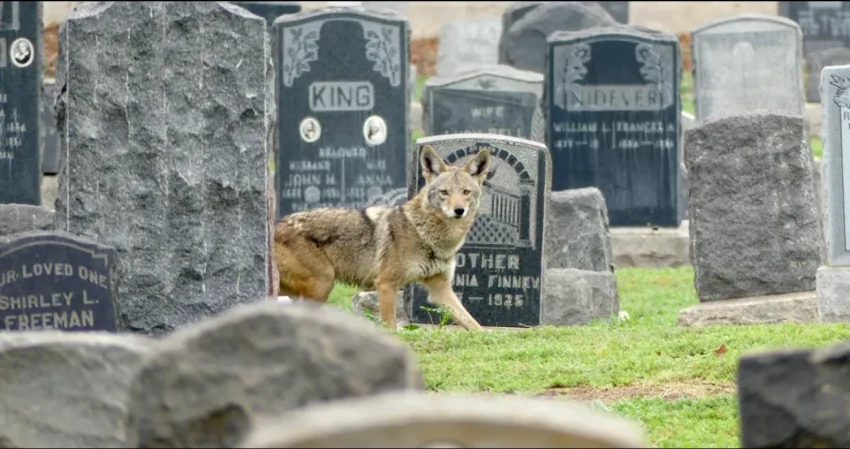
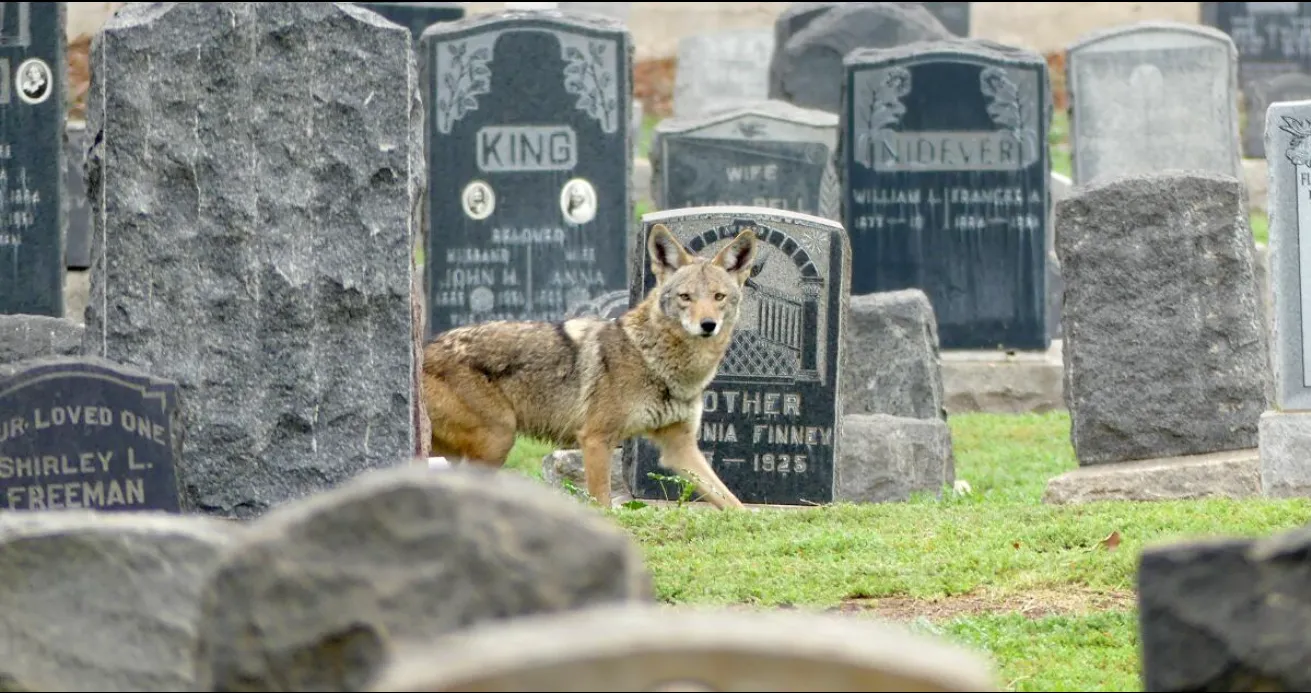
In the still hush of a cemetery at dusk, a lone coyote lay among the tombstones — his breath shallow, his eyes dimming. He hadn’t come there to hunt or to hide. It was as if, sensing the end, he had chosen this quiet place to rest.
When rescuers found him, his frail body trembled but didn’t resist. Glen, a volunteer with Berkshire Wildlife Services, gently knelt beside the fading animal. A blood test soon revealed the grim truth: his blood refused to clot. Even after minutes passed, it remained thin and red — a telltale sign of poisoning.
Wildlife specialists see this pattern too often. Rodenticides — poisons meant for rats and mice — do not stop at their intended victims. The cycle continues when predators like coyotes eat contaminated prey. Within days, the toxins rise up the food chain, turning nature’s hunters into silent casualties.
The coyote in the graveyard was one of many. Across North America, wildlife rehabilitation centers report an alarming increase in secondary poisoning cases. These deaths are slow, painful, and invisible — the kind of suffering that doesn’t make headlines.
Thanks to Glen’s swift response and the tireless team at Berkshire Wildlife Services, the coyote was treated immediately. Against all odds, he began to respond. His breathing steadied. His eyes opened. Hope — faint but real — returned.
But his story isn’t just about survival. It’s a warning.
Predators like coyotes are vital to ecological balance. They keep rodent populations in check, which in turn curbs diseases and protects crops. When they die, the balance collapses — and nature, in her quiet way, begins to unravel.
Despite growing awareness, broad-spectrum poisons and devices like the M-44 cyanide ejector remain in use across many states. These methods kill indiscriminately — coyotes, foxes, owls, pets, and sometimes even humans.
Experts have long argued that such tools are not only inhumane but ineffective. Killing predators doesn’t solve rodent problems long-term; it simply removes nature’s built-in pest control.
This coyote’s final journey — from poisoned fields to a graveyard — forces us to confront a simple truth: our poisons don’t just kill pests. They ripple outward, touching lives that never should have been lost.
We can all make small choices that matter.
Ask your pest-control company about non-lethal options. Educate your community. Support wildlife rehabilitators — the quiet heroes who fight for creatures most will never see.
Because when a coyote lies down among the dead, it’s not coincidence.
It’s a mirror. A reflection of what happens when we forget that nature’s balance depends on mercy as much as on management.
Let him rest in peace — and let his story awaken ours.
CARLSON’S ACCUSATIONS
After Tucker Carlson claimed the FBI lied about the Donald Trump assassination attempt, the agency responded directly. Carlson questioned the FBI’s statements regarding suspect Thomas Crooks, suggesting the bureau misrepresented his digital footprint. Crooks, charged with attempting to kill Trump at a July campaign rally in Butler, Pennsylvania, ultimately only struck the president’s ear but killed 50-year-old firefighter Corey Comperatore. A Secret Service sniper shot Crooks shortly after, while two others, David Dutch and James Copenhaver, were injured.
Carlson said, “The FBI told us Thomas Crooks tried to kill Donald Trump last summer, but somehow had no online footprint. The FBI lied, and we can prove it because we have his posts. The question is why?”
THE FBI RESPONDS
The FBI Rapid Response account pushed back immediately: “The FBI has never said Thomas Crooks had no online footprint. Ever.”
CARLSON DOUBLES DOWN
Carlson later shared a video he claimed the FBI, under director Kash Patel, had tried to hide. The footage, allegedly from Crooks’ Google Drive, showed shooting drills and suggested Crooks maintained multiple online personas and left YouTube comments. Carlson argued that this proved Crooks “was not some secretive lone wolf who never warned anyone that he was planning violence.” He added, “Thomas Crooks came within a quarter inch of destroying this country, and yet, a year and a half later, we still know almost nothing about him or why he did it.”
He accused the FBI of “hiding from the public what they know” and described Crooks as a “volatile, troubled, possibly mentally ill young man with a long record of espousing violence in public.” Carlson claimed the bureau “used a selective read of those comments to lie about what Thomas Crooks was thinking.”
THE FBI SETS THE RECORD STRAIGHT
On Friday, Patel released documents and statements that contradicted Carlson’s claims. On X, he wrote: “The investigation, conducted by over 480 FBI employees, revealed Crooks had limited online and in-person interactions, planned and conducted the attack alone, and did not leak or share his intent to engage in the attack with anyone.”
The bureau detailed its investigation, which included examining over 20 online accounts, data from more than a dozen electronic devices, numerous financial records, and over 1,000 interviews plus 2,000 public tips. Patel’s statement reinforced that Crooks acted independently and that the FBI had no record of him openly warning anyone about his intentions.