The Supreme Court has cleared the path for the Trump administration to deport a group of immigrants held at a U.S. military base in Djibouti to South Sudan.
In a brief opinion issued on Thursday, the justices affirmed that their June 23 order, which stayed a federal judge’s ruling in Massachusetts that had restricted the government’s ability to deport immigrants to countries not explicitly named in their removal orders, applies in full to the eight immigrants currently in U.S. custody in Djibouti, SCOTUSblog reported.
The order came less than two weeks after the high court temporarily stayed an April 18 ruling by U.S. District Judge Brian Murphy, whose order barred the federal government from deporting immigrants to “third countries”—those not explicitly named in their removal orders—without first ensuring, through a series of safeguards, that the individuals would not face torture upon deportation.
Murphy’s May 21 ruling found that the government violated his April 18 order by attempting to deport eight men to South Sudan. The U.S. has evacuated all non-emergency personnel from South Sudan, and the State Department advises against travel there due to “crime, kidnapping, and armed conflict.”
The flight carrying the immigrants bound for South Sudan instead landed in nearby Djibouti, where the men have since been held at a U.S. military base, SCOTUSblog noted further.
On May 27, the Trump administration appealed to the Supreme Court to stay Murphy’s April 18 order, seeking permission to proceed with “third country” removals while the legal battle over the practice unfolds.
U.S. Solicitor General D. John Sauer contended that Murphy’s “judicially created procedures are currently wreaking havoc on the third-country removal process” and “disrupt[ing] sensitive diplomatic, foreign policy, and national-security efforts.”
Lawyers representing the immigrants facing potential third-country removals urged the justices to uphold Murphy’s order. They emphasized that the government could still proceed with these deportations, but Murphy’s order “simply requires” the Trump administration “to comply with the law” in doing so.
Several hours after the Supreme Court responded to the Trump administration’s first request, made on June 23, Murphy then claimed that his May 21 order remained unaffected by the high court’s decision.
The Trump administration returned to the Supreme Court the following day, requesting that the justices clarify the federal government’s authority to proceed with deporting the immigrants currently held in Djibouti. Sauer urged the court to act swiftly to address what he called Murphy’s “unprecedented defiance” of the court’s authority.
In Thursday’s brief, unsigned 7-2 opinion, the majority indicated that the court’s “June 23 order stayed the April 18 preliminary injunction in full. The May 21 remedial order cannot now be used to enforce an injunction that our stay rendered unenforceable.”
Two of the Supreme Court’s liberals, Justices Sonia Sotomayor and Ketanji Brown Jackson dissented, while the third liberal, Justice Elena Kagan, sided with the court’s conservative majority.
She noted that she had previously disagreed with the Supreme Court’s original ruling permitting third-country removals to proceed. “But a majority of this court saw things differently, and I do not see how a district court can compel compliance with an order that this court has stayed,” she wrote, per CNN.
The eight illegal immigrants include individuals from Cuba, Vietnam, and Laos, reports noted.
Sotomayor’s dissent contended that “[w]hat the Government wants to do, concretely, is send the eight noncitizens it illegally removed from the United States from Djibouti to South Sudan, where they will be turned over to the local authorities without regard for the likelihood that they will face torture or death.”
She argued that the court should not have considered the government’s request at all, as the government should have made its arguments in the lower courts first. Moreover, she suggested that the Supreme Court’s “continued refusal to justify its extraordinary decisions in this case, even as it faults lower courts for failing to properly divine their import, is indefensible.”
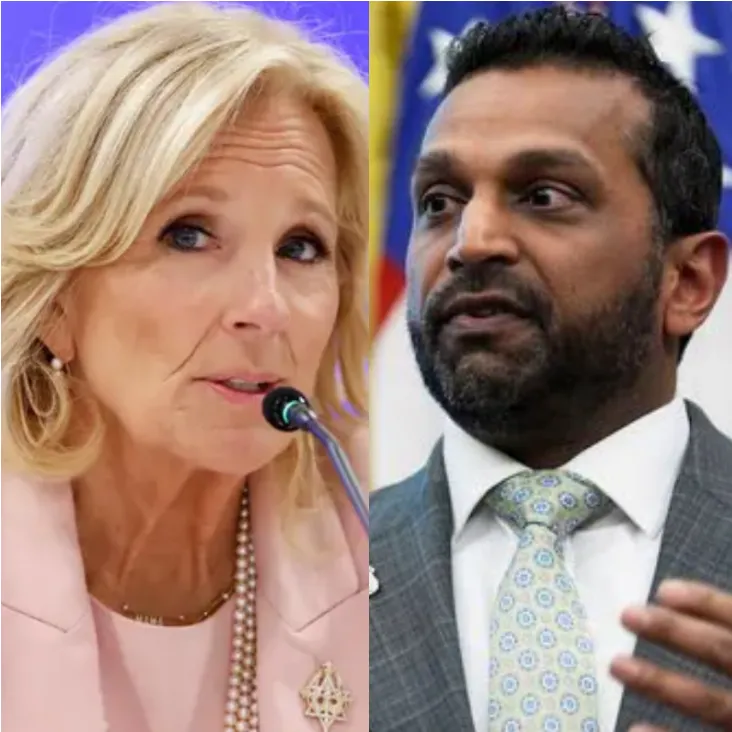
In a stunning turn of events during a recent House Judiciary Committee hearing, first lady Jill Biden found herself at the center of a political firestorm after her bold attempt to confront Kash Patel, the newly appointed director of the FBI. What began as a routine oversight session quickly escalated into a dramatic clash that captivated the nation and raised serious questions about accountability in American politics.
The atmosphere in the House Judiciary Committee hearing room was electric, filled with lawmakers from both parties, reporters, and spectators eager to witness the unfolding drama. At the witness table sat Kash Patel, a figure of calm authority, prepared to outline his vision for the FBI amidst growing scrutiny. The hearing, titled “FBI Leadership Priorities and Reform under New Direction,” was intended to focus on Patel’s plans to restore public trust in law enforcement.
However, Jill Biden’s unexpected interjection transformed the proceedings into a spectacle. Known for her advocacy in education, she had been invited to discuss the intersections of federal enforcement and educational policy. But her intentions took a sharp turn when she decided to make a personal attack on Patel.
As the hearing commenced, Chairman Jim Jordan praised Patel’s early efforts to streamline investigations. Suddenly, Jill Biden raised her hand, demanding the floor with a sense of urgency. Dressed in a navy blue suit, she stepped forward, locking eyes with Patel, and launched into a passionate tirade.
“Director Patel,” she declared, “you represent a grave peril to the very foundations of American democracy.” The room fell silent as she accused him of politicizing the FBI and turning it into a tool of intimidation. “You are a clear and present danger to democracy itself,” she concluded, invoking gasps from both sides of the aisle.
Her remarks were calculated, aiming to paint Patel as a villain in a narrative of institutional decay. However, she underestimated Patel’s composure and the evidence he was prepared to present.
Patel remained unfazed by Biden’s accusations. After a brief moment of silence, he addressed her with measured professionalism. “Dr. Biden, I appreciate your passionate defense of democratic principles,” he began, before revealing that he had an active FBI case file with her name on it. The tension in the room escalated as he lifted a thick folder stamped with “Highly Restricted” and declared, “Perhaps we should examine some concrete examples of accountability right here in this room.”
The folder contained details of an active investigation into financial irregularities linked to Jill Biden’s affiliated entities. As Patel began to outline the specifics, the atmosphere shifted dramatically. What had started as a personal attack on him was quickly turning into a public examination of her actions.
Patel’s presentation was methodical and precise. He detailed how the FBI’s financial crimes unit had uncovered significant discrepancies in the financial records of Jill Biden’s educational foundations, revealing over $350,000 in unreported transfers from donor funds to personal consulting entities. As he laid out the evidence, including charts and bank statements, the gravity of the situation became apparent.
Jill Biden’s initial confidence began to wane as Patel highlighted transactions that appeared to divert charitable donations intended for educational programs into personal real estate acquisitions. The room was filled with murmurs of disbelief and concern as lawmakers processed the implications of Patel’s revelations.
As Patel continued to present evidence, Jill Biden attempted to defend herself, claiming that the funds in question were legitimate administrative fees for program development. However, Patel countered her assertions with documented evidence of suspicious transactions, including a series of suspicious activity reports from major banks.
The tension reached a boiling point when Patel revealed that the FBI had obtained court-authorized surveillance recordings that implicated Jill Biden in discussions about fund allocation. The recordings captured her voice discussing strategies to keep donor streams “clean but flexible,” suggesting a calculated effort to obscure the true nature of the funds.
The implications were staggering. What began as a confrontation over Patel’s leadership turned into a detailed exposé of Jill Biden’s financial dealings, raising serious questions about her integrity and the potential misuse of federal funds.
As the hearing progressed, it became clear that the narrative had shifted. Instead of being the hero of her own story, Jill Biden found herself on the defensive, struggling to maintain her composure as Patel presented a relentless stream of evidence. The audience, including reporters and lawmakers, were captivated by the unfolding drama, with many realizing that the stakes were far higher than anyone had anticipated.
Patel’s calm demeanor and unwavering commitment to presenting the facts stood in stark contrast to Jill Biden’s increasingly desperate attempts to regain control of the narrative. Her legal team scrambled to respond to the allegations, but the evidence Patel presented was overwhelming.
The turning point came when Patel announced that a federal grand jury had been impaneled to review the evidence for potential indictments. The room erupted in gasps as the implications sank in. This was no longer a simple oversight hearing; it was a serious investigation into potential criminal activity.
Jill Biden’s defiance began to crack as the weight of the federal machinery bore down on her. Her team rushed to formulate a defense strategy, but the damage had been done. What was supposed to be a moment of triumph for her advocacy had spiraled into a meticulously dismantled facade.
As the hearing concluded, the ramifications of the day’s events were profound. Cash Patel emerged not just as a figure of authority within the FBI, but as a symbol of accountability in government. His evidence-driven approach restored faith in the integrity of federal law enforcement, sending a clear message that no one, regardless of their legacy, stands above the law.
The fallout from the hearing would reverberate throughout Washington, with calls for greater transparency and accountability echoing in the halls of Congress. Jill Biden’s public career faced an uncertain future, overshadowed by the revelations that had come to light.
In the end, the hearing served as a stark reminder of the importance of integrity in public service. As the nation watched, it became clear that the pursuit of justice and accountability remains a cornerstone of democracy, and that the truth, no matter how uncomfortable, will always find a way to surface.
The tragic accident that occurred on the morning of last Sunday, July 16, on the CE-060 highway, between Caririaçu and Juazeiro do Norte, casts a veil of mourning over the Cariri region.The irreparable loss of an entire family, made up of Hérida Nascimento da Silva, Sebastião Cícero Gomes and little Miguel Nascimento Gomes,
just 3 years old, highlights the fragility of life and the unpredictability of destiny.
The information, broadcast by TV Verdes Mares and confirmed by the Ceará Military Fire Department, paints a bleak picture
Six members of a Malaysian family, including a six-month-old baby, were found dead in their car submerged in the Sungai Korok river, Kedah.
The family had been reported missing since July 5 when they failed to return home to Jerlun after spending the night at a relative’s house in Taman Aman, Jitra, The Star reported.
The Kedah Fire and Rescue Department said the bodies were found on July 7 during a search operation.
Senior Fire Superintendent Ahmad Aminuddin Abd Rahim, Zone 1 chief, said four bodies had been retrieved and brought to the riverbank, while two others, believed to be the parents, remained inside the vehicle at the time.
Firefighters had to cut open the roof to remove the victims, all of whom were found in the back seat. Authorities believe they may have been trying to escape as the car sank, Sinar Harian reported.
The car was only about 1 meter from the riverbank, submerged at a depth of around 6 meters, Ahmad Aminuddin said, adding that the operation was not too difficult as the vehicle was already floating and could be pulled to shore.
The victims were identified as Mohd Azim Ezzat Ishak, 32, his wife Nurul Hidayah Khalijah Razman Effendy, 31, and their four children aged between six months and nine years.
Authorities are continuing recovery efforts and investigating the cause of the tragedy
seemore
A car believed to belong to a family that went missing almost 70 years ago is set to be pulled from a river in Oregon, authorities have said.
The Martin family vanished in December 1958 after heading to find a Christmas tree in their Ford station wagon, per The Oregonian.
Ken and Barbara Martin were thought to have taken their daughters Barbara, 14, Virginia, 13, and Sue, 11, on a ride to the mountains for the greenery, per previous Associated Press reports. However, they never returned.
The news agency stated that authorities looking for the missing family managed to narrow down the search to the Cascade Locks near the Columbia River after learning that Ken Martin had used a credit card to buy gas at a station in the area.
The body of the youngest daughter Sue, 11, was discovered in the river near Camas, Washington, around five months after the family went missing, per the AP, before 13-year-old Virginia’s body was found the following day approximately 25 miles upstream from where Sue’s remains were discovered. The rest of the family hasn’t been found.
Ken Martin family via AP, File
On Thursday, March 6, the Hood River County Sheriff’s Office confirmed officers were “attempting to recover a vehicle from the Columbia River near Cascade Locks.”
“This vehicle is believed to be associated with the 1958 missing persons case involving the Martin Family,” a Facebook post stated, adding, “An independent diver discovered what is believed to be the vehicle the family was last seen in. This is an active investigation, and further details will be available at a later time.”
Per the AP, authorities called off the search just before dark on Thursday evening and will continue to attempt to get the vehicle out of the water on Friday, March 7.
AP Photo
The news agency reported that the vehicle had been found by diver Archer Mayo, who discovered it upside down at around 50 feet deep in the water after searching for it for seven years. The diver’s representative, Ian Costello, said the car was covered in salmon guts, silt and mussel shells.
Mayo reportedly found other cars nearby, and Costello said those vehicles will need to be removed before the station wagon comes out, per the AP.
Hood River County sheriff’s deputy, Pete Hughes, said of what they think is the Martin family car, “We’re not 100% sure it’s the car. It’s mostly encased in mud and debris, so we don’t know what to expect when we pull it out of the water today,” the news agency reported.
“We don’t know what we will find,” the officer said when questioned whether he thought they’d find bodies in the other vehicles, the AP stated.
AP Photo, File
Never miss a story — sign up for PEOPLE’s free daily newsletter to stay up-to-date on the best of what PEOPLE has to offer, from celebrity news to compelling human interest stories.
“More than circumstantial evidence points us to believe it’s the Martin car,” Sheriff Matt English told reporters on Thursday, reported The Oregonian.
“Even though this is 66 years ago, this is a tragedy. We need to determine to the best of our ability what happened to this family,” English said, according to the outlet, while talking about treating the Martin family case like any other investigation.
The Martins also had a 28-year-old son Don, a former Marine who was a graduate student at Colombia University in New York at the time, the AP reported.
The Hood River County Sheriff’s Office and Ian Costello didn’t immediately respond when contacted by PEOPLE for additional information.
Following his first yearly medical since taking office again, the doctor of President Donald Trump praised the 78-year-old as fit to serve.
“President Trump exhibits excellent cognitive and physical health and is fully fit to execute the duties of the Commander-in-Chief and Head of State,” wrote Dr. Sean Barbabella, physician to the president.
Following Trump’s Friday visit to Walter Reed National Military Medical Center for his yearly physical before leaving town for the weekend, the White House sent the memo on Sunday.
The examination in detail Trump stands six feet three inches tall and weighs 224 pounds.
“President Trump remains in excellent health, exhibiting robust cardiac, pulmonary, neurological, and general physical function,” Barbabella wrote.
“His active lifestyle continues to contribute significantly to his well-being,” he added.
The president’s “frequent victories in golf events” were highlighted in the memo, which also acknowledged his hectic schedule and appearances.
According to the physical report, Trump’s resting heart rate was 62 beats per minute and his blood pressure was 128/74 mmHg.
After consulting with fourteen specialists, we carried out Friday’s examination, which involved laboratory and diagnostic testing. It stated that several tests were all normal.
“Examination of the head, ears, nose and throat revealed no significant abnormalities with the exception of scaring on the right ear from a gunshot wound,” the memo stated.
The medical report was the first public information on Trump’s health since the July assassination attempt in Butler, Pennsylvania. However, there were no additional details regarding the impact of the occurrence beyond mentioning the scar.
The Montreal Cognitive Assessment, a simple 10-minute test for mild cognitive impairment, was used to evaluate his cognitive abilities, and the findings showed that he scored a normal 30 out of 30.
He had previously completed the test. During his first tenure, the president also took the cognitive test. Dr. Ronny Jackson, the White House physician, reported that Trump received a score of 30 out of 30 on the January 12, 2018, test.
According to the memo, the president is taking four medications: Aspirin, Mometasone cream when necessary for a skin issue, and Rosuvastatin and Ezetimibe for cholesterol control.
It said that every vaccination the president has advised is up to date, including those for travel.
In January, Trump became the oldest person in American history to be inaugurated in as president.
He spent about five hours at Walter Reed for his first yearly physical of his second term.
His new personal doctor, Barbabella, who served in both Afghanistan and Iraq and has a wealth of battle trauma knowledge, performed the examination.
“Overall, I felt I was in very good shape. A good heart, a good soul, a very good soul,” Trump told reporters while traveling to Florida on Friday after his exam.
He also touted taking a cognitive test, claiming “I got every answer right.”
“I was there for a long time,” Trump said before the results were released. “I think I did very well.”
The document was circulated over Trump’s weekend in Mar-a-Lago, where the president spent Sunday at his golf club.