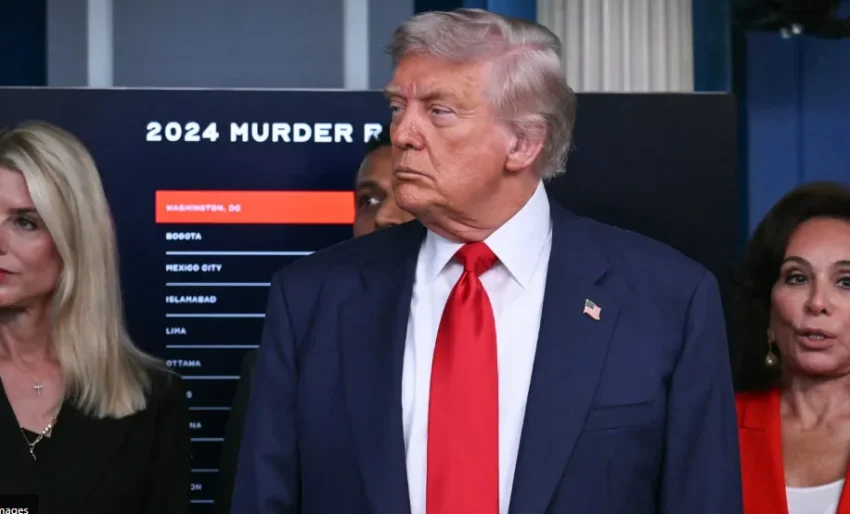
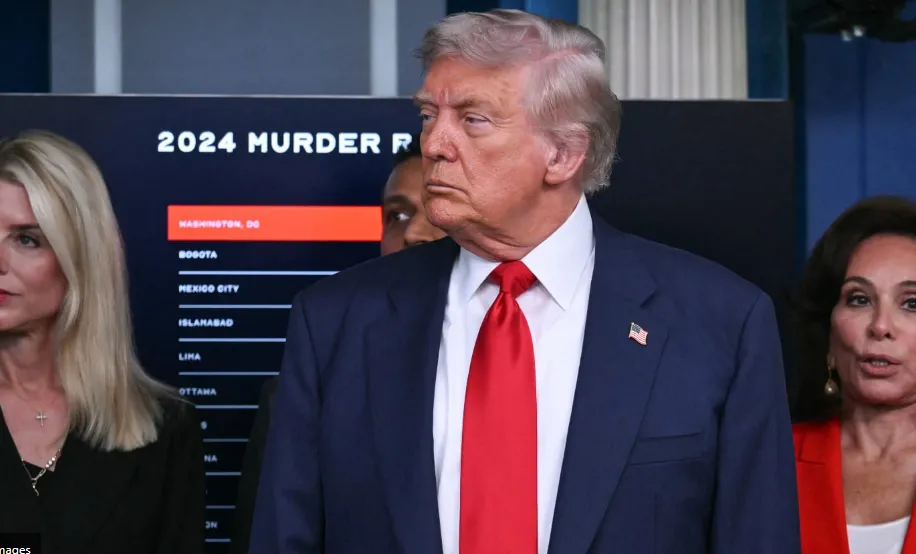
In the first week after the White House assumed control of Washington, D.C.’s police force and deployed federal agents and National Guard troops, the city recorded a modest drop in reported crime but a sharp increase in immigration-related arrests, according to a CNN analysis of government data.
For the week beginning August 12 — the first full week under federal control — property crimes fell by about 19 percent compared to the week prior, while violent crime dropped 17 percent, based on the most recent Metropolitan Police Department statistics.
The trends varied by category. Robberies and car break-ins fell by more than 40 percent, while thefts remained flat. Burglary cases rose 6 percent, and assaults with a dangerous weapon increased 14 percent. Two homicides occurred during the period, consistent with recent weeks, though none have been reported since August 13.
Federal agencies have embedded with local police, assisting in arrests, searches, and warrant executions while patrolling the city in unmarked vehicles, CNN noted further.At the same time, immigration enforcement surged. Since August 7, federal officials have arrested about 300 individuals in the district without legal immigration status — more than ten times the typical weekly number of ICE arrests in the city,
During the first six months of Trump’s current term, ICE averaged about 12 arrests per week in Washington, according to data from the Deportation Data Project at the University of California, Berkeley, School of Law.
Officials told CNN that ICE agents have been accompanying MPD officers and intervening when individuals stopped or questioned are found to be in the country unlawfully.
In response to CNN’s findings, White House spokeswoman Abigail Jackson stated that the media was attempting to dismiss the “exceptional results” of Trump’s efforts in Washington, D.C.
The drops in crime are not ‘moderate,’ they are life-changing for the countless of DC residents and visitors who have not been murdered, robbed, carjacked, or victims of overall violent crime in the last week,” Jackson said. “The priority of this operation remains getting violent criminals off the streets — regardless of immigration status.”
The administration said those taken into custody include individuals arrested for committing crimes or wanted on outstanding warrants, including some for serious offenses. CNN noted it could not independently confirm the details of the arrests or determine what share involved non-immigration-related charges.
The sharp increase in immigration arrests has also fueled concerns among Democratic leaders in D.C., including Mayor
Muriel Bowser, who argue that the true aim of Trump’s federal takeover may be targeting illegal immigrants.
Last week, Bowser told reporters that an order from U.S. Attorney General Pam Bondi “almost exclusively focused on immigration enforcement and homeless encampment enforcement.”
The District of Columbia’s attorney general has filed a lawsuit challenging Attorney General Pam Bondi’s order directing police to disregard the city’s sanctuary laws, which had limited cooperation with Immigration and Customs Enforcement in immigration cases.
During a hearing last week, however, the federal judge overseeing the case suggested that Trump’s authority under the Home Rule Act likely gives him the power to require local police to assist ICE.
Viral videos circulating in Washington this week show Immigration and Customs Enforcement agents tackling immigrants, including food delivery workers, and in one case breaking car windows to detain two men.
During one evening of heightened police activity, CNN observed officers responding to reports of shootings, drug and firearm possession, and a stolen vehicle. Federal agents were heard communicating over local police channels as they carried out stops, searches, and crime responses, at times warning each other about the city’s speed cameras.
Over the past week, the Metropolitan Police Department and federal agencies have also set up traffic checkpoints — a practice rarely used in the district — including one large operation with dozens of officers and agents along a major highway leaving the city, CNN said.
Officers were seen pulling over vehicles and conducting searches, though it was not immediately clear what criteria were being used to determine which vehicles were stopped, said the outlet.
Newly declassified documents from the government’s 2016 “Crossfire Hurricane” investigation into alleged collusion between Donald Trump’s campaign and Russia have reignited controversy over whether top officials in former President Barack Obama’s administration coordinated with Hillary Clinton’s campaign to undermine Trump before he entered the White House.The disclosures, made public by current Director of National Intelligence Tulsi Gabbard, include a memo circulated in 2016 that stated unequivocally that Russian activity had not altered the outcome of the U.S. presidential election.The release has intensified scrutiny on Obama-era intelligence officials, Clinton’s campaign aides, and senior law enforcement leaders who played central roles in launching and sustaining the Russia investigation.The newly decla
ssified memo was written for then-President Barack Obama in the aftermath of the 2016 election. It concluded that “Russian and criminal actors did not impact recent U.S. election results by conducting malicious cyber activities against election infrastructure.”
While acknowledging limited attempts by hackers to probe Illinois voter rolls and other systems, the memo said these efforts were unsuccessful and never came close to altering results.“The targeting of infrastructure not used in casting ballots makes it highly unlikely it would have resulted in altering any state’s official vote,” the memo stated. “Criminal activity also failed to reach the scale and sophistication necessary to change election outcomes.”The assessment, which was not publicly shared at the time, directly undermines years of claims that Russian interference helped Trump secure the presidency.Paul Sperry, a senior reporter with Real Clear Investigations, reported that sources told him of explosive text messages and emails allegedly showing coordination between Clinton campaign aides and Obama administration officials.
DEVELOPING: I’m told there are texts/emails indicating Hillary Clinton campaign aides directly coordinated with the Obama White House, NSC, State Dept and Intelligence Community officials in efforts to dig up dirt tying Donald Trump to Vladimir Putin in July 2016 … developing…” Sperry posted on X.If accurate, these communications would bolster Trump’s long-standing claim that the Russia investigation was orchestrated by his political opponents to delegitimize his election victory.For President Donald Trump, who has repeatedly called the Russia investigation a hoax, the memo and reports of coordination are being framed as vindication.Trump has argued since 2016 that the allegations of collusion were fabricated by Clinton’s campaign and amplified by Obama’s intelligence officials to sabotage his presidency before it even began.The memo released by Gabbard is now being cited as the strongest evidence yet that top officials knew the Russian interference narrative was weak but pursued it anyway.Attention is now turning to the actions of former CIA Director John Brennan and former FBI Director James Comey, both of whom played leading roles in the early stages of the Crossfire Hurricane probe.According to CIA records released by current Director John Ratcliffe, Brennan is accused by career intelligence officials of deliberately concealing information from other agencies while aggressively pushing to incorporate the controversial Steele dossier into assessments.That dossier, compiled by former British spy Christopher Steele, contained salacious and unverified allegations about Trump’s ties to Russia.
Officials are also examining whether Brennan misled Congress during testimony when he denied relying on the Steele dossier in crafting the intelligence community’s final assessment.While the statute of limitations for perjury may have lapsed, legal experts say Brennan could still face conspiracy-related charges if evidence shows deliberate coordination to mislead lawmakers.Comey, meanwhile, is also facing renewed scrutiny. Once the public face of the FBI during the Russia probe, he has remained defiant in public comments.Recently, he stirred controversy after posting a cryptic social media message interpreted by some as threatening. Sources confirmed that the U.S. Secret Service visited him earlier this year in response.The Crossfire Hurricane investigation was launched by the FBI in July 2016 to examine possible links between Trump campaign associates and Russian officials.The probe later served as the foundation for Special Counsel Robert Mueller’s inquiry, which concluded in 2019 that there was no evidence of criminal conspiracy between Trump’s team and Moscow.Yet despite the lack of proof, the Russia narrative dominated U.S. political discourse for years, weakening Trump’s presidency and fueling partisan conflict. The release of internal memos now raises questions about whether the investigation was pursued in good faith or as part of a deliberate political strategy.Special Counsel John Durham, who conducted a years-long review of the origins of the Russia investigation, concluded in 2023 that the Trump–Russia collusion allegations were baseless.
His report criticized the FBI for rushing into the probe without sufficient evidence and for relying on the Steele dossier, which was funded by the Clinton campaign and the Democratic National Committee.The newly declassified memo aligns with Durham’s conclusions, suggesting that senior officials knew early on that Russian activity had not compromised election results.Director of National Intelligence Tulsi Gabbard has framed the release of the memo as the first step in a broader push for transparency. A former Democratic congresswoman from Hawaii and 2020 presidential candidate, Gabbard has often criticized political corruption in both parties.“In order to restore trust, we have to provide the American people with the truth,” Gabbard said in a statement. “This is only the beginning. More documents will be reviewed and declassified so that accountability is possible.”Her announcement has set the stage for additional disclosures, including notes from the Crossfire Hurricane investigation and transcripts from Durham’s interviews with intelligence officials.A 200-page congressional audit has reportedly been compiled following a closed-door meeting between Department of Justice leaders and intelligence officials.Lawmakers are now considering whether to release more documents to the public, including internal emails and classified assessments that guided the investigation.Republicans in Congress are expected to press aggressively for declassification, arguing that the public deserves to know the full extent of coordination between Obama officials and Clinton aides. Democrats, however, are likely to push back, warning against compromising intelligence sources and methods.
The morning sun cast long shadows across the parade ground at Marine Corps Base Quantico as families gathered to witness one of the military’s most sacred traditions—the commissioning ceremony for new Marine officers. Among the sea of proud parents, siblings, and friends stood one figure whose presence would transform a routine military tradition into an extraordinary moment that would be remembered for generations: 94-year-old Sergeant Major Robert “Bobby” Sullivan, a decorated World War II veteran who had traveled across the country to witness his grandson’s transformation from civilian to Marine officer.
What happened that day would become legendary within military circles—a moment so powerful that it transcended the boundaries of family celebration and became a symbol of the unbroken chain of service that connects American military families across decades of conflict and sacrifice. The story of Second Lieutenant Marcus Sullivan’s first salute represents more than just military ceremony; it embodies the living connection between past heroism and future promise that defines the finest traditions of American military service.
The tradition of the “first salute” holds special significance in military culture, representing the moment when a newly commissioned officer receives their initial salute from an enlisted service member, symbolically acknowledging their new authority and responsibility. Typically, this honor is bestowed by a non-commissioned officer who has mentored the new lieutenant, often accompanied by the presentation of a silver dollar as a token of respect and recognition.
But Marcus Sullivan’s first salute would be different—profoundly, memorably different—in ways that no one could have anticipated when the ceremony began that crisp October morning.
Robert Sullivan’s military service began on December 8, 1941, the day after Pearl Harbor was attacked. At eighteen years old, he walked into a Marine Corps recruiting station in Chicago with the same determination that would characterize his entire military career. The young man who emerged from boot camp at Parris Island twelve weeks later bore little resemblance to the idealistic teenager who had enlisted, having been forged into a warrior capable of facing the brutal realities of Pacific theater combat.
Sergeant Major Sullivan’s war record reads like a chronicle of the Marine Corps’ most defining moments in World War II. He landed on Guadalcanal as part of the initial assault force, survived the hellish fighting on Peleliu where casualty rates exceeded 40%, and participated in the flag-raising on Iwo Jima as a member of the 5th Marine Division. His combat decorations included two Purple Hearts, a Bronze Star with V device for valor, and a Silver Star for extraordinary heroism during the battle for Suribachi.
But the medals and commendations told only part of Robert’s story. The complete narrative included the friends he lost, the wounds that never fully healed, and the burden of survival that he carried for decades after the war ended. Like many veterans of his generation, Robert rarely spoke about his combat experiences, believing that the price of freedom was something to be borne silently rather than discussed openly.
What Robert did discuss, however, was his pride in the Marine Corps and his hope that future generations would understand the importance of service to something greater than themselves. When his son David chose a career in engineering rather than military service, Robert felt no disappointment—he understood that freedom meant having choices, including the choice not to serve. But when his grandson Marcus began talking about military service during his college years, Robert felt a stirring of something he thought had been buried with his war memories.
Marcus Sullivan grew up hearing fragments of his grandfather’s war stories, usually shared during quiet family gatherings when Robert’s guard was down and memories surfaced unexpectedly. These glimpses into his grandfather’s service created a sense of connection to something larger than Marcus’s comfortable suburban upbringing, instilling values of duty, honor, and sacrifice that would shape his character throughout his formative years.
As a student at the University of Virginia, Marcus excelled academically while participating in ROTC programs that gave him firsthand experience with military discipline and leadership principles. His professors noted his exceptional ability to motivate peers and his instinctive understanding of tactical thinking, qualities that suggested natural leadership potential. But it was his genuine concern for the welfare of others and his willingness to accept responsibility for difficult decisions that truly set him apart from his contemporaries.
The decision to pursue a commission in the Marine Corps wasn’t made lightly. Marcus understood the demands that military service would place on his personal life, the risks inherent in leading Marines in combat, and the weight of responsibility that comes with commanding the lives of others. But conversations with his grandfather, though infrequent and often interrupted by Robert’s reluctance to relive painful memories, had given Marcus a deep appreciation for the honor of serving in an organization that had shaped some of America’s finest leaders.
When Marcus informed his family of his intention to become a Marine officer, the reactions varied significantly. His parents expressed concern about the dangers of military service in an era of ongoing global conflicts, while his younger sister worried about the long separations that would characterize his career. But Robert’s response was different—a mixture of pride, concern, and something approaching relief that the family’s military tradition would continue into another generation.
Marine Officer Candidate School at Quantico represents one of the military’s most demanding leadership development programs, designed to identify and eliminate candidates who lack the physical, mental, and moral qualities necessary for leading Marines in combat. Over the course of ten grueling weeks, Marcus and his fellow candidates endured physical challenges that pushed their bodies to breaking points, academic instruction that tested their ability to make complex decisions under pressure, and leadership evaluations that revealed character traits they didn’t know they possessed.
The training was deliberately designed to create stress levels that approximated combat conditions, forcing candidates to make critical decisions while exhausted, overwhelmed, and operating on minimal sleep. Marcus discovered reservoirs of determination and leadership ability that surprised even him, earning recognition from instructors who had seen thousands of potential officers pass through their programs.
But perhaps more importantly, Marcus learned about the weight of responsibility that comes with earning the trust of Marines who would follow his orders into dangerous situations. The abstract concept of leadership became intensely personal as he realized that his decisions could determine whether the men and women under his command would return home safely to their families.
Letters from his grandfather during this training period provided encouragement and perspective that helped Marcus understand the continuum of service that connected him to previous generations of Marines. Robert’s sparse but meaningful correspondence reminded Marcus that every Marine who had ever served had faced moments of doubt and difficulty, but that the Corps provided strength that transcended individual limitations.
The day Marcus graduated from Officer Candidate School marked his formal transition from civilian to Marine officer, but the ceremony represented something far more significant than a career change. As he stood with his fellow new lieutenants, wearing the uniform that Robert had worn with such distinction seven decades earlier, Marcus felt the weight of tradition and the responsibility of carrying forward values that had been tested in the crucible of combat.
The commissioning ceremony itself followed protocols that had remained largely unchanged for generations, emphasizing the continuity and permanence of the values that define Marine leadership. As family members pinned new lieutenant bars on their graduates, the parade ground filled with emotions that ranged from pride to concern to overwhelming gratitude for the young people who had chosen to serve.
But for the Sullivan family, this ceremony held additional layers of meaning that extended far beyond the individual achievement of earning a commission. Three generations were represented on that parade ground: Robert, whose service had helped secure victory in humanity’s greatest conflict; David, whose civilian career had contributed to the prosperity that military sacrifice had made possible; and Marcus, who represented the continuation of American military tradition into an uncertain future.
The tradition of the first salute typically occurs immediately after the commissioning ceremony, when newly minted officers receive their initial salute from a non-commissioned officer of their choice. The selected NCO renders a perfect salute, which the new officer returns before presenting a silver dollar as a token of respect and gratitude for the guidance that helped shape their development as a leader.
Marcus had initially planned to request his first salute from his platoon sergeant from Officer Candidate School, a grizzled veteran whose tough love and demanding standards had pushed Marcus to achieve more than he thought possible. But as the commissioning ceremony concluded and families began gathering for the traditional first salute presentations, Marcus made a decision that would create one of the most memorable moments in Marine Corps tradition.
Instead of seeking out his platoon sergeant, Marcus walked directly to where his grandfather stood with the rest of the Sullivan family. Robert, now 94 years old and moving with the careful deliberation that comes with advanced age, had insisted on wearing his dress blue uniform for the occasion—the same uniform he had worn when he was discharged from active duty in 1946.
“Grandpa,” Marcus said, his voice carrying clearly across the parade ground, “I would be honored if you would give me my first salute.”
The reaction on the parade ground was immediate and profound. Conversations stopped mid-sentence as Marines, families, and military personnel turned to witness what was about to unfold. Word spread quickly through the crowd that a World War II veteran was about to render the first salute to his grandson, creating a circle of respectful silence around the Sullivan family.
Robert Sullivan, standing as straight as his 94-year-old frame would allow, looked into his grandson’s eyes with an expression that carried seven decades of military experience, personal loss, and family pride. The moment stretched as grandfather and grandson faced each other across the generations, connected by the uniform they both wore and the values they both embodied.
When Robert raised his right hand in salute, the gesture carried the weight of every battle he had fought, every friend he had lost, and every moment of doubt he had overcome during his years of service. His salute was perfect in form despite the arthritis that stiffened his joints and the tremor that occasionally affected his hands—muscle memory and military pride combining to create a moment of flawless military bearing.
Marcus returned the salute with equal precision, his own gesture acknowledging not only military protocol but also the family legacy he was accepting and the responsibility he was embracing. The exchange lasted perhaps ten seconds, but those present would later describe it as feeling much longer—a suspended moment when the past and future of American military service converged in perfect unity.
As Robert lowered his salute, the emotional impact of what had just occurred became apparent to everyone present. Hardened Marine instructors, who had witnessed thousands of commissioning ceremonies over their careers, found themselves fighting back tears. Family members openly wept at the power of what they had witnessed, while fellow new officers stood in respectful silence, understanding that they had witnessed something unprecedented and sacred.
Marcus reached into his pocket and withdrew the traditional silver dollar, but instead of simply handing it to his grandfather, he pressed it into Robert’s palm while maintaining eye contact. “Thank you for showing me what it means to be a Marine,” Marcus said, his voice thick with emotion but carrying clearly across the silent parade ground.
Robert’s response was equally moving in its simplicity: “Thank you for continuing what we started.” The words, spoken in a voice weakened by age but strengthened by conviction, captured the essence of military tradition—the understanding that each generation builds upon the sacrifices of those who came before while preparing the foundation for those who will follow.
The moment was captured by multiple photographers and videographers, but the images and recordings could barely convey the emotional power of what had transpired. Those present understood that they had witnessed something that transcended normal military ceremony—a living connection between past heroism and future promise that embodied the finest traditions of American military service.
News of the Sullivan family’s first salute ceremony spread quickly through military social media channels and veteran organizations, touching hearts and inspiring conversations about the importance of honoring military tradition and family legacy. The photographs and video footage were shared thousands of times, accompanied by comments from veterans who recognized the profound significance of what they were witnessing.
For many viewers, the ceremony represented more than just a touching family moment—it symbolized the unbroken chain of service that connects American military families across generations of conflict and sacrifice. The image of a World War II veteran saluting his Marine officer grandson resonated particularly strongly with military families who understood the weight of tradition and the responsibility of carrying forward values that had been tested in combat.
Military historians noted that while family members occasionally participated in first salute ceremonies, the combination of a World War II veteran and the exceptional emotional impact of the Sullivan ceremony made it truly unique in military tradition. The moment would be referenced in speeches at future commissioning ceremonies and used as an example of the living connection between past and present that defines military service.
In the months following his commissioning, Second Lieutenant Marcus Sullivan began his career as a Marine officer with the knowledge that he carried not only his own hopes and ambitions, but also the legacy of his grandfather’s service and the expectations of a family tradition that had been forged in the crucible of World War II combat.
His first assignment took him to Camp Pendleton, where he would lead a platoon of Marines in training exercises designed to prepare them for potential deployment to overseas conflicts. The responsibility of commanding the lives of others, which had been abstract during his training, became intensely personal as he got to know the individual Marines under his command and their families who depended on his leadership to bring them home safely.
Robert Sullivan, despite his advanced age, remained actively interested in his grandson’s military career, offering advice based on his own combat experience while respecting the differences between World War II and modern military operations. Their conversations, which had been infrequent and sometimes difficult before Marcus’s commissioning, became regular and deeply meaningful exchanges that strengthened their relationship while honoring their shared military heritage.
The story of the Sullivan family’s first salute ceremony inspired other military families to explore their own traditions and find ways to honor the service of multiple generations. Veteran organizations began organizing events specifically designed to connect older veterans with younger service members, creating opportunities for mentorship and the sharing of military wisdom across generational lines.
Military families who had previously taken their traditions for granted began to document their service histories and create formal ceremonies that honored the contributions of family members who had served in different conflicts. The Sullivan ceremony became a template for celebrating military legacy while passing traditions forward to future generations.
Educational institutions with ROTC programs began incorporating discussions of military family traditions into their leadership curriculum, using the Sullivan story as an example of how personal heritage can reinforce professional military values and strengthen commitment to service.
The Marine Corps formally recognized the significance of the Sullivan first salute ceremony by featuring their story in official publications and training materials that emphasized the importance of military tradition and family legacy. The ceremony was used as an example of how military values transcend individual service and create connections between generations that strengthen the entire military community.
Robert Sullivan received invitations to speak at military events and veteran gatherings, where his perspectives on the evolution of military service and the constants that define military character provided valuable insights for younger generations. Despite his reluctance to discuss his own combat experiences, Robert found that he could talk about military values and the importance of service in ways that inspired others without requiring him to relive painful memories.
The silver dollar that Marcus presented to his grandfather during the first salute ceremony became a treasured family heirloom that would eventually be passed down to future generations, carrying with it the story of military service and family tradition that it represented.