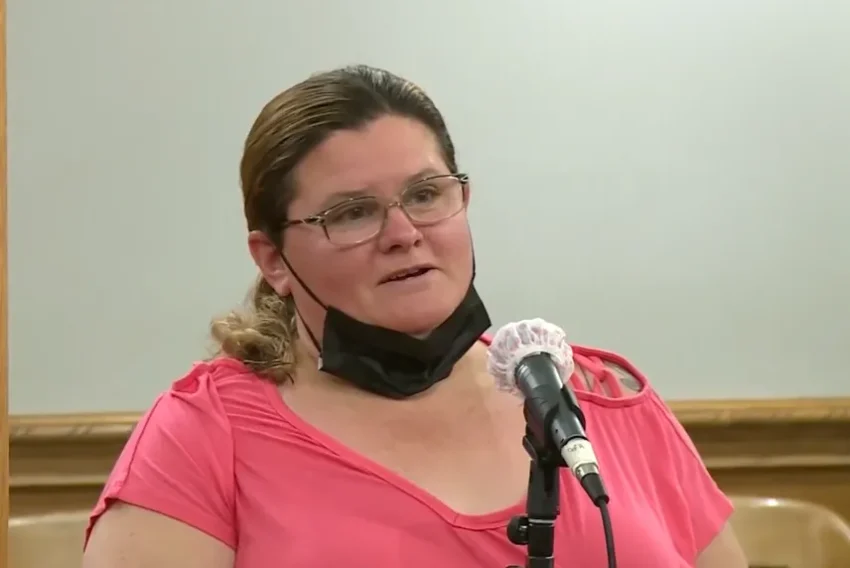
In a quiet Providence courtroom, a deeply human story unfolded—one that reached far beyond traffic violations and touched the heart of everyone present. The case centered on Mary Mo, a young woman facing four separate violations: a minor school zone speeding infraction clocked at 32 miles per hour, and three parking tickets, including one for parking on the sidewalk.
But the legal issues were only the surface layer. What emerged in the courtroom was a portrait of survival, resilience, and the thin line between stability and hardship.
From the outset, the list of charges appeared straightforward. Mary’s school zone violation was barely over the threshold—just one mile per hour beyond the typical ticketing speed. The remaining offenses—parking violations—looked on paper like routine infractions.
However, as Mary began to explain her situation, the courtroom’s tone shifted. Her story revealed that every citation was rooted in a period of profound instability and financial strain.
Mary shared that at the time she received her parking tickets, she was homeless and living inside her car. Losing the safety of stable housing pushed her into a constant state of uncertainty. Nights became a search for somewhere to park, somewhere to rest, somewhere that felt even slightly safe.
It was during these moments of desperation that the parking violations occurred. What might seem to others like carelessness or disregard for rules was, in truth, the result of having no place to go.
Her circumstances eventually improved enough for her to rent a room, but even that solace came with challenges. The landlord had no parking available, forcing her once again to search for places to leave her vehicle.
She was unfamiliar with Providence’s parking regulations, particularly the ban on overnight parking, because she came from Cumberland and never had to navigate similar restrictions there. Her inexperience led to additional tickets, each one placing more pressure on her already fragile situation.
One of the citations—parking on the sidewalk—came from necessity, not negligence. Mary explained that the roadway where she parked was extremely narrow, flanked by large trucks that routinely occupied most of the available space. Parking too far out into the street would have put her car at risk of being struck, so she nudged it closer to the sidewalk to avoid potential damage.
It was a practical decision made in an impractical moment, but it resulted in yet another fine.
Financially, Mary’s situation was even more precarious. She described recent difficulties caused by being out of work after undergoing tooth extractions. Initially, she feared she had contracted COVID-19, adding an additional layer of emotional and physical stress.
Even after securing housing, the mounting costs of daily life weighed heavily on her: $900 per month for a room, plus $50 for a parking permit she could barely afford. Every unexpected expense—every ticket, every repair, every setback—threatened to push her back toward homelessness.
Judge Caprio listened with clear empathy. Known for his compassionate approach, he recognized the pattern in Mary’s story: a person trying to stay afloat while life repeatedly pulled her under. He acknowledged that she was “hitting it real tough financially,” a phrase that captured the depth of her struggle.
Rather than treating the case as a simple legal proceeding, he approached it as a moment where the justice system could offer support instead of punishment.
His ruling reflected that compassion. He dismissed all of Mary’s parking tickets outright, removing the burden of multiple fines she had no means to pay. The remaining violation—the school zone infraction—carried a $50 fine.
Instead of requiring Mary to pay the fee herself, Judge Caprio turned to the Philomena Fund, a charitable resource created in honor of his mother to help those in need. He ordered that the fund cover the full $50, ensuring that Mary walked out without financial penalties.
In the end, Mary’s case was dismissed in its entirety. She left the courtroom owing nothing, but carrying something far more valuable: a reminder that even in difficult times, there are people willing to step up and help. Judge Caprio offered her one final piece of advice before she departed.
When life improves—and he expressed confidence that it would—she should remember the kindness shown to her and extend that same kindness to someone else in need.
The message was simple, but meaningful: compassion is a cycle, and each act of generosity sustains the next. Mary’s story became more than a legal matter; it became an illustration of how understanding, empathy, and community can intervene during someone’s darkest moments.
It served as yet another example of why so many people look to this courtroom not just for justice, but for hope.