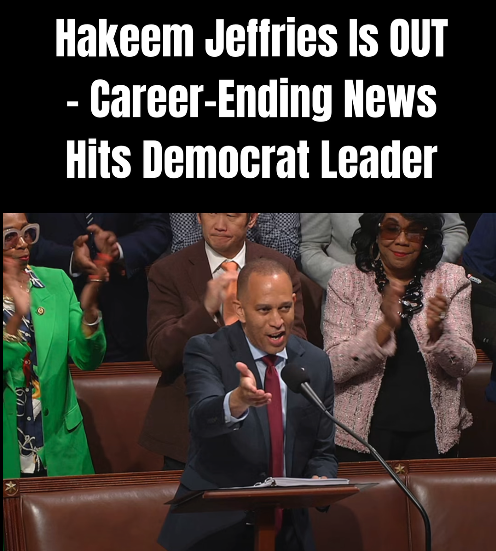
Zohran Mamdani’s democratic socialist allies are reportedly considering primary challenges next year against several congressional Democrats in New York City, including House Minority Leader Hakeem Jeffries.
However, a senior political advisor to Jeffries has vowed that anyone attempting to unseat the top Democrat in the House during next year’s primaries will face a “forceful and unrelenting” response, Fox News is reporting.
Mamdani, the 33-year-old Ugandan-born democratic socialist assemblyman from Queens, sent political shockwaves nationwide with his decisive victory two weeks ago over former New York Gov. Andrew Cuomo and nine other candidates in New York City’s Democratic mayoral primary.
His win marks a significant step toward potentially becoming the city’s first Muslim mayor, but would also signal the Democratic Party’s increasing shift to the extreme far-left.
In the wake of Mamdani’s primary victory in June, the Democratic Socialists of America (DSA) highlighted that “this movement is bigger than one person, election, city, or organization.”
“We encourage all people inspired by the Zohran campaign to join their local DSA or YDSA chapter and get involved so we can continue to fight alongside Zohran and DSA elected officials across the country to create the future we all deserve,” the party added.
Now, following Mamdani’s victory, DSA leaders are reportedly considering mounting primary challenges not only against Jeffries but also other House Democrats representing New York City districts, including Reps. Ritchie Torres, Jerry Nadler, Dan Goldman, and Yvette Clarke, Fox added.
Jeffries, who succeeded longtime House Democratic leader and former Speaker Nancy Pelosi two years ago, has faced criticism from some of New York City’s far-left leaders, who label him a moderate and establishment Democrat.
“His leadership has left a vacuum that organizations like DSA are filling. I think that is more important right now,” New York City’s Democratic Socialists of America chapter co-chair Gustavo Gordillo said in a CNN interview recently.
Democratic socialist state Sen. Jabari Brisport, who represents some of the same areas of Brooklyn that Jeffries does in the U.S. House, told Fox News in a statement that the longtime congressman is “rapidly growing out of touch with an insurgent and growing progressive base within his own district that he should pay more attention to.”
Democratic strategist Andre Richardson, a senior political advisor to Jeffries, highlighted the sweeping actions taken by President Donald Trump during the early months of his second term in the White House that the left vehemently opposes, said, “Leader Hakeem Jeffries is focused on taking back the House from the MAGA extremists who just ripped health care away from millions of Americans.”
Richardson also sent a warning in a statement to CNN against a hard-left primary challenge to Jeffries. “If Team Gentrification [Mamdani allies] wants a primary fight, our response will be forceful and unrelenting. We will teach them and all of their incumbents a painful lesson on June 23, 2026,” he warned.
The tension is escalating as pressure mounts on state and local Democrats in the city to support Mamdani in the general election, amid fears they could face primary challenges if they fail to join his coalition. Mamdani will face Republican Curtis Sliwa in November, while former Governor Andrew Cuomo and incumbent Mayor Eric Adams will appear on the ballot under minor party lines, the New York Post noted.
Brooklyn State Assemblywoman Phara Souffrant Forrest, a DSA member whose district overlaps with Jeffries’ congressional seat, cautioned Jeffries to be careful what he wishes for.“Weird threat to make since Hakeem already went after @JabariBrisport [DSA state senator] and I.How’d that go for him, again?” Forrest said in a statement on X on Thursday.
In a stunning upset,– who had been a heavy favorite until recent weeks – conceded after it became clear the the 33-year-old democratic socialist had built a substantial lead over the more experienced but scandal-scarred former governor.
In a speech to supporters, Mamdani said: “Tonight, we made history,” adding: “I will be your Democratic nominee for the mayor of New York City.”
If his win is confirmed, Mamdani will be seen as the frontrunner for the 4 November mayoral election in New York, a city where
After 93% of votes were counted in the primary’s first round, Mamdani, a state representative, had 43.5% of the vote. Cuomo was on 36.4%.
Speaking at a campaign rally,
New York City uses a ranked-choice voting system, and as neither candidate is likely to reach 50%, the board of elections will now tally people’s second-choice candidates.
Mamdani, who cross-endorsed with Brad Lander, a progressive who came third with 11.4% of the vote, last week, is predicted to benefit more than Cuomo from the count. He thanked Lander in his speech, telling supporters: “Together we have shown the power of the politics of the future: one of partnership and sincerity.”
Mamdani’s rapid rise will serve as a rebuke to the Democratic establishment and give hope to other progressives hoping to run in elections around the US. Cuomo was backed by deep-pocketed donors and endorsed by a wave of centrist figures including Bill Clinton, but Mamdani benefited from a rise in grassroots support among young people in particular.
Cuomo said he had called Mamdani to congratulate him. “He put together a great campaign and he touched young people and inspired them and moved them and got them to come out and vote,” Cuomo said. “I applaud him sincerely for his effort.”
Cuomo told the New York Times he may still run in the November mayoral election as an independent. “I want to analyse and talk to some colleagues,” he said.
But given the heavily Democratic makeup of New York, and the unpopularity of the incumbent Eric Adams, Mamdani would be favorite to become New York’s 111th mayor.
The race for New York mayor has been closely watched across the US. In pitting two drastically different Democrats against each other, it offered a vision of what voters want from a party that has struggled to present a coherent alternative to Donald Trump.
Cuomo, a centrist, and Mamdani emerged as the frontrunners in the final weeks of the primary, Mamdani closing the gap on Cuomo through an abundance of enthusiasm from young New Yorkers.
Mamdani had hoped to benefit from the voting system that allows voters to rank five candidates in order of preference.
Cuomo, who was elected to three-terms as governor before resigning in disgrace amid accusations of sexual harassment, entered the race with the far superior name recognition, and at one point had a 30-point lead in polling. Mamdani ran on a progressive platform, promising to freeze rent and make buses free citywide, and his campaign was propelled by a social media following that dwarfs his rivals’. He was endorsed by Alexandria Ocasio-Cortez at an event attended by thousands of people in June, and has also won the backing of Bernie Sanders, the Vermont senator.Cuomo was much less visible, eschewing large rallies for tightly managed appearances at union offices and other small venues. As the race narrowed, his campaign and the organizations backing him – some of which were funded by billionaire Republican donors – focused almost exclusively on attacking Mamdani, spending millions of dollars on mailers and TV adverts.
“This has been a historically contentious race,” Mamdani said. “I hope now that this primary has come to an end, I can introduce myself once more, not as you’ve seen me in a 30-second ad or in a mailer in your mailbox, but as how I will lead as your mayor.
“I will be the mayor for every New Yorker, whether you voted for me, for Governor Cuomo, or felt too disillusioned by a long, broken political system to vote at all.”
Early voting started in New York on 14 June, and the city said more than 380,000 people had voted by Sunday, more than double the number that voted early in the 2021 primary. A heatwave on Tuesday – temperatures in New York reached 100F (38C) – appeared not to have suppressed turnout with more than 1 million people estimated to have voted, CBS New York
The winner of the primary is not guaranteed to become the 111th mayor of New York, but it is highly likely in a city where registered Democrats heavily outnumber Republicans.
Adams, who won the 2021 election as a Democrat but is running this year as an independent candidate, is deeply unpopular. He was charged last year with taking bribes and accepting foreign campaign contributions but the charges were dropped in April after the Trump administration intervened.
Kid Rock has officially declared that he will no longer be performing in New York City, blaming what he calls the city’s “new communist regime” under recently elected mayor Zohran Mamdani.
The 54-year-old rocker, known for blending southern patriotism with unfiltered Twitter tirades, announced the decision Thursday morning in a post that read like a declaration of independence — if the founding fathers had written theirs in all caps and misspelled half of it. “SORRY NYC, BUT I DON’T SING FOR COMMIES,” he wrote. “Y’ALL ELECTED MARX LITE, AND I DON’T POUR MY WHISKEY OUT FOR THAT.”
In an interview later that afternoon on a Nashville radio show, Kid Rock elaborated. “I took one look at that guy and said, ‘Hell no.’ You can’t be calling yourself a socialist and expect Kid Rock to roll into town with the American flag and a six-pack of freedom.”
The host tried gently to point out that Mamdani identifies as a democratic socialist, not a communist. Kid Rock wasn’t having it. “That’s what they always say,” he replied. “First, they’re ‘democratic socialists.’ Next, they’re telling you to share your lawnmower with your neighbor and report to the nearest tofu ration line.”
His stance has sent ripples of laughter, confusion, and mild indifference through the city he’s now boycotting. Many New Yorkers were unaware Kid Rock had even scheduled concerts there. “Wait, Kid Rock was coming here?” asked one Brooklyn resident, sipping a cold brew in disbelief. “I thought his last tour was just yelling at beer cans.” A bartender in Queens was more blunt: “Bro canceled something that wasn’t sold out. That’s like me canceling my yacht trip to Mars.”
Still, Kid Rock insists this is not about ticket sales — it’s about standing up for principle. “This is bigger than me,” he said. “It’s about the American dream. You think George Washington fought the British just so Zohran Mamdani could raise taxes on Bud Light?” When asked what specific policies offended him, Rock hesitated before responding, “I don’t know, man. Probably something about free subway rides. You know what’s free in communism? Nothing. Except misery.”
Mayor-elect Mamdani, for his part, seemed unbothered. His office released a short statement thanking Kid Rock for his input and assuring fans that New York City remains open for all artists — even those who “confuse universal healthcare with gulags.” When asked by reporters for his personal response, Mamdani smiled and said, “Honestly, I had to Google him. I thought Kid Rock was a TikTok prank.”
On conservative talk shows, however, Rock’s decision was hailed as an act of modern patriotism. Fox & Friends dedicated an entire segment titled “Kid Rock vs. Red City: The Battle for Freedom.” One commentator even compared the musician’s boycott to the Boston Tea Party, “except with more fireworks and less reading.”
Tucker Carlson reportedly recorded a surprise monologue from his Maine home titled “When the Music Dies — Because of Marxism,” featuring slow-motion clips of Kid Rock waving an American flag, set to a mournful guitar solo.
Economists were less impressed. “This will not affect the city’s GDP,” said an NYU analyst flatly. “New York’s entertainment economy is worth billions. Kid Rock canceling two nights is like one pizza place running out of pepperoni.” Still, the singer maintains the move is purely about values. “I don’t care if I lose money,” he told fans. “You can’t buy freedom. Except, of course, at my merch table — hoodies are 20 percent off with the promo code LIBERTYROCKS.”
Social media reactions have ranged from supportive to gleefully sarcastic. Fans from red states praised Rock for “taking a stand against tyranny in Times Square,” while New Yorkers joked that the city’s air quality had already improved. “Maybe now we can hear the subway rats again,” one commenter wrote. Others wondered how long it would take before Rock realized that a mayor doesn’t control concert permits. One viral tweet summed it up: “Kid Rock boycotts NYC. NYC: Okay.”
Meanwhile, a group of Brooklyn musicians has announced plans to hold a free “Welcome to the People’s Republic of New York” concert on the same night Rock was scheduled to perform. The lineup includes a jazz trio, a drag queen poet, and a folk band called “The Red Scares.” Event organizers promise “plenty of communal snacks and no cover charge — because that’s socialism, baby.”
Rock, undeterred, says his tour will continue in what he calls “freedom-loving states.” His next shows will be in Florida, Texas, and “anywhere the government still lets you grill in peace.” He’s reportedly writing a new song inspired by the controversy, tentatively titled “Born Free, Except in Brooklyn.” His management has also hinted at a line of “Patriot Approved” beer cans — because if you can’t beat socialism, you might as well sell something off it.
Political analysts have struggled to interpret the symbolism of Kid Rock’s rebellion. “It’s part performance, part protest, and mostly marketing,” said columnist Erin Delaney. “He’s turning outrage into income — ironically, the most capitalist thing imaginable. In a weird way, he and Mamdani are both working-class heroes. One’s fighting for higher wages, the other for higher merch sales.”
For most New Yorkers, though, the story barely registers. “We’ve survived blizzards, blackouts, and Rudy Giuliani,” said one cab driver. “We can survive Kid Rock staying home.” As the city moves on with its usual chaos, residents continue doing what they do best — rolling their eyes, paying too much for coffee, and ignoring celebrity tantrums.
By evening, the controversy had already faded into the endless scroll of internet noise. But in Nashville, Kid Rock remained resolute, sipping whiskey and promising that his stand against “Marxism in Manhattan” will be remembered. “History will thank me,” he said. “Someday, when America is free again, people will say, ‘Kid Rock saw it coming.’” Then he paused. “Now if you’ll excuse me, I’ve got a freedom soundcheck to run.”
Back in New York, a saxophonist busking near Times Square shrugged when asked about the boycott. “If Kid Rock doesn’t want to play here, that’s fine,” he said. “More space for the rest of us. The revolution will have better music anyway.”