

The Senate Judiciary Committee is examining whether the Justice Department improperly moved to shut down an inquiry into the Clinton campaign’s funding of the Steele dossier.
Committee Chairman Sen. Charles E. Grassley said a whistleblower has alleged that two senior officials involved in the Justice Department’s Arctic Frost investigation of President Trump previously played key roles in blocking an FBI probe into Hillary Clinton and other Democrats, the Washington Times reported on Friday.
Grassley, a Republican from Iowa, released email exchanges from June 2019 between an unidentified FBI agent and Richard Pilger, then an official in the Justice Department’s Public Integrity Section, along with J.P. Cooney, who at the time served as a prosecutor in the U.S. Attorney’s Office for the District of Columbia.
The emails show Pilger and Cooney rejecting the agent’s questions regarding what the agent described as the “unambiguous concealment” of payments made by the Democratic National Committee and the Clinton campaign to fund the Steele dossier, compiled by former British intelligence officer Christopher Steele.
The DNC and Hillary Clinton’s 2016 presidential campaign hired the research firm Fusion GPS to help produce the dossier, which contained unverified allegations about then-GOP presidential nominee Donald Trump and saddle him with a phony scandal linking him to Russia. The payments were reported as legal expenses, obscuring the political nature of the project.
In a message to a supervisor, the FBI agent said Pilger made obvious threats that the agent said were “intended to have a chilling effect and stop me from asking questions” about the Clinton and DNC funding, the Times reported.
“In my [redacted] years of being an agent, a successful agent with a great reputation, I have never been met with such suspicion or response intended to have me go away,” the FBI agent noted.
Pilger, who served as director of the Justice Department’s Election Crimes Branch, later played a significant role in authorizing the Arctic Frost investigation into former President Trump’s conduct following the 2020 election. That probe, led by then-Special Counsel Jack Smith, resulted in Trump being indicted on election-interference charges.
Cooney served as Smith’s deputy during the investigation, the Times reported.
In a letter to Attorney General Pam Bondi and FBI Director Kash Patel, Sen. Grassley requested additional records and emails related to the FBI’s earlier inquiry into the DNC and Clinton campaign payments to Fusion GPS, which he said appeared to have been halted by Justice Department officials.
“These records show the same partisans who rushed to cover for Clinton rabidly pursued Arctic Frost, which was a runaway train aimed directly at President Trump and the Republican political apparatus,” Grassley wrote.
In a June 21, 2019, email, Pilger criticized an FBI agent for seeking to open an investigation into whether payments had been concealed, accusing the agent of showing “bias” and acting with “a rush to judgment.” A week earlier, on June 14, Cooney had advised the same agent that the issue “is not a good candidate to open for a false reporting case,” noting that Fusion GPS had been retained by the Clinton campaign’s law firm, Perkins Coie, rather than by the campaign itself.
“Although not typically what we think of as legal services, I think we would have an exceedingly difficult time proving it was a willfully false report,” Cooney said in a note to the agent, the Times reported.
The dossier — later discredited as a collection of unverified claims — alleged improper ties between Trump and Russia. The document circulated ahead of the 2016 presidential election and was subsequently cited by the FBI, then led by Director James Comey, to support the opening of a secret investigation into the Trump campaign.
The Clinton campaign and the Democratic National Committee were not criminally investigated over the underlying payments but instead faced civil penalties after watchdog groups filed complaints with the Federal Election Commission, said the Times.
In 2022, the FEC fined the Clinton campaign $8,000 and the DNC $105,000 for misreporting more than $1 million in payments to the law firm Perkins Coie, which used the funds to hire Fusion GPS.
In a dramatic showdown that left the political world reeling, Tulsi Gabbard turned the tables on Congressman Adam Schiff during a Senate hearing, exposing a web of deceit and manipulation that has shaken the foundations of American politics. What started as an attempt by Schiff to discredit Gabbard as a “Putin’s puppet” quickly spiraled into a devastating revelation of his own misdeeds, leading to one of the most significant political reversals in recent history.
On the morning of the hearing, tensions ran high in the Hart Senate Building. Adam Schiff, known for his theatrical flair and aggressive stance against perceived threats to national security, arrived armed with a meticulously prepared dossier aimed at dismantling Gabbard’s credibility. His staff had spent weeks compiling evidence of what they claimed were her ties to foreign adversaries, hoping to end her political career once and for all. However, Schiff had no idea that Gabbard was prepared for a fight that would expose his own questionable actions.
As the clock struck 10 a.m., Gabbard entered the hearing room with a calm demeanor, carrying only a thin manila folder and a silver laptop. Her understated appearance contrasted sharply with Schiff’s anxious energy, and observers sensed an impending clash. The gallery was filled with veterans and media, creating an electric atmosphere that hinted at the drama to unfold.
Schiff wasted no time launching into his accusations, painting Gabbard as a threat to American intelligence. “Putin’s puppet has no business accessing our nation’s secrets,” he declared, setting the stage for what he believed would be a decisive blow against her. Gabbard, however, remained unfazed. As Schiff rattled off his claims, she took notes with a slight smile, exuding the confidence of a seasoned warrior.
When it was her turn to respond, Gabbard shifted the narrative. “Thank you for that passionate performance,” she began, subtly undermining Schiff’s credibility. “Since you’ve raised the topic of foreign influence and propaganda, perhaps this is the perfect moment for what I call a comparative analysis.” Schiff’s expression shifted from confidence to concern as he realized Gabbard was about to unleash a counteroffensive.
With a calm yet commanding presence, Gabbard revealed that she had spent months preparing not just to defend herself but to expose the weaponization of the intelligence community for political gain. She slid her laptop across the table, opening it with the care of someone handling sensitive ammunition. “For every lie you tell about me, I have documented evidence of two you’ve told about others,” she stated, her voice steady and authoritative.
The room fell silent as she pulled up emails, texts, and recorded conversations that detailed Schiff’s own manipulations. “This laptop contains five years of your communications, all legally obtained, all devastating.” The tension in the room was palpable as Gabbard laid bare Schiff’s actions, revealing a pattern of deceit that contradicted his public persona as a defender of democracy.
As she presented her evidence, the atmosphere shifted dramatically. Gabbard’s calm demeanor and the weight of her revelations began to erode Schiff’s carefully constructed narrative. The veterans in the gallery, initially there to support Gabbard, now leaned forward, captivated by the unfolding drama.
With each piece of evidence Gabbard presented, Schiff’s composure crumbled. She detailed how he had misled the public about Russian collusion, revealing emails where he coordinated with media outlets to keep the narrative alive even when evidence was lacking. “You knew there was no evidence to support your claims,” Gabbard asserted, her voice rising with conviction. “Yet you continued to lie to the American people.”
As the hearing progressed, the tide had completely turned. Schiff, once the aggressor, now stood exposed as a man who had abused his power, weaponizing intelligence for political advantage. Gabbard’s revelations painted a clear picture of a politician more interested in maintaining his narrative than in upholding the truth.
The gallery erupted in murmurs, and several senators began to distance themselves from Schiff. The atmosphere shifted from one of political theater to a reckoning, as the reality of Schiff’s actions became undeniable.
Just when it seemed Schiff could not be further humiliated, Gabbard revealed the most damaging piece of evidence: a FISA application that had been used to surveil her while she served in the military. “You spied on me, Congressman, while I was in uniform,” she declared, her voice cutting through the chaos. The room fell silent, the gravity of her words hanging heavily in the air.
The evidence showed that Schiff had used lies to justify surveillance against a fellow American, violating not only her rights but also the sanctity of the intelligence community. “You turned the awesome power of American intelligence against an American family because you couldn’t accept that your political opponent was exactly what she appeared to be—a patriot serving her country,” she charged.
As the hearing reached its climax, calls for Schiff’s accountability echoed through the chamber. Senators from both parties began to call for immediate investigations into Schiff’s actions, recognizing the severity of the situation. The fallout from Gabbard’s revelations would undoubtedly reshape the political landscape.
In the weeks following the hearing, the consequences of Schiff’s actions became increasingly apparent. Investigations were launched into his conduct, revealing a pattern of abuse that extended beyond Gabbard’s case. The FBI uncovered a trove of evidence detailing illegal surveillance operations targeting political opponents, journalists, and even fellow members of Congress.
As the media landscape shifted, Gabbard’s victory became a rallying point for those advocating for transparency and accountability in government. Whistleblowers began to come forward, emboldened by Gabbard’s courage to expose corruption. The narrative that had once been dominated by Schiff’s lies was now being rewritten by the truth.
Gabbard’s appointment as Director of National Intelligence marked a new era for the intelligence community. Her commitment to restoring integrity and accountability resonated with veterans, intelligence professionals, and the American public alike. “The cancer of corruption will be cut out completely and permanently,” she promised, setting a tone of reform that echoed throughout the halls of power.
The dramatic showdown between Tulsi Gabbard and Adam Schiff serves as a powerful reminder of the importance of accountability in politics. In a time when trust in government institutions is waning, Gabbard’s revelations have sparked a renewed call for transparency and integrity.
As the dust settles from this remarkable political battle, one thing is clear: the truth has a way of emerging, no matter how deeply it is buried. Tulsi Gabbard’s unwavering dedication to her principles has not only reshaped her own career but has also set a new standard for those in positions of power. The reckoning has begun, and the American people are watching closely as the fight for truth and justice continues.
 as if he were chewing on the words he couldn’t quite say. “This…this isn’t what you should be working for,” he finally managed, his voice barely above a whisper. The frustration in his eyes was palpable, but so was something else—fear, perhaps, or regret.
I wanted to argue, to demand why he couldn’t just be proud of me, why he couldn’t see the value in what I had achieved. But words failed me, lost in the haze of hurt and disappointment. Instead, I sat across from him, the kitchen table a vast, unbridgeable chasm between us.
The silence stretched, thick and suffocating. It was the same silence that had enveloped our house since my mother passed away, a silence filled with unspoken grief and unresolved anger. I thought of all the nights I had come home late, quietly so as not to disturb him, and how he had never asked how my day was or if I needed anything.
“You know,” I started, hesitantly, “I didn’t do all this just for me. Mom always said—”
“Don’t,” he interrupted sharply, his eyes flashing with an emotion I couldn’t quite decipher. “Don’t bring her into this.”
“But she believed in me,” I insisted, my voice rising. “She wanted this for me. She wanted you to want this for me.”
He looked at me then, really looked at me, and I saw the shadow of a man who once loved fiercely and lived fully. Yet, what remained now was a shell, hollowed out by loss and bitterness. “I’m trying, Sophie,” he said finally, his voice cracking. “But it’s hard.”
The admission hung in the air, raw and unexpected. It softened something in me, though the hurt was still too fresh, too deep. I realized then that while my trophy could be replaced, the years of strained silence and unvoiced pain between us could not be so easily mended.
“I know it’s hard,” I said, my voice gentle but firm. “But I’m not giving up on us. I want us to be okay again, to talk. Can we try?”
He nodded slowly, a glimmer of hope breaking through the hardness of his gaze. “Yeah, maybe we can. It’ll take time, though.”
His words were a tentative offering, and though it wasn’t a promise of immediate reconciliation, it was a start. It was something to hold onto, a fragile thread of connection in the vast sea of our shared grief.
As I went to my room that night, I passed by the remnants of my trophy, scattered and gleaming under the dim hallway light. I knelt down, gathering the pieces in my hands, feeling their sharp edges bite into my skin.
I realized that like the trophy, our relationship was broken but not beyond repair. I carefully placed the pieces on my dresser, a reminder of the day’s events and the work that lay ahead.
In the quiet of my room, I resolved to turn this moment of fracture into one of healing, however long it might take. Because at the end of the day, success wasn’t just about accolades or recognition; it was about the people who stood by you as you earned them, and the bonds you fought to mend even when shattered.
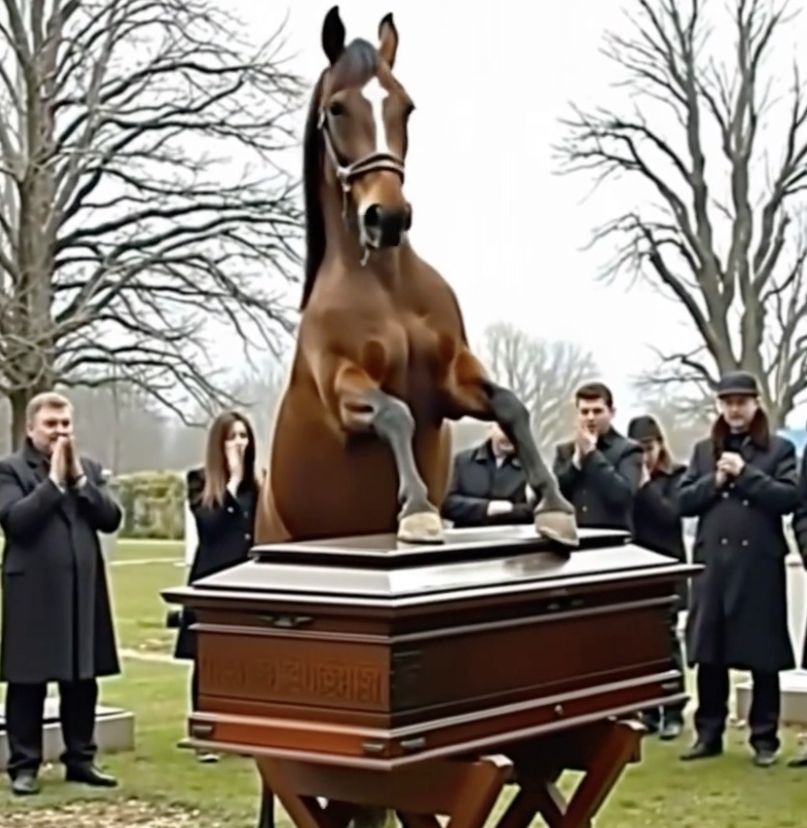 Astoria’s presence at my husband’s funeral was both a comfort and a reminder of all we had lost. She galloped with a fervor that was both passionate and terrifying, her hooves striking the ground with a rhythm that echoed through the chilled air. I had seen her run countless times, but never with such urgency.
The crowd parted like a river making way for a boat. The guests gasped and many reached out in an attempt to slow her down or redirect her path, but Astoria’s determination was unwavering. Her usually gentle eyes were focused and intense, a stark contrast to the mourners’ sorrowful expressions.
As she approached the coffin, a few brave souls tried to hold her back, but she was impossible to restrain. She rose on her hind legs, her front hooves striking the air with a grace that was both beautiful and violent. Then, with surprising precision, she brought them down upon the coffin lid. The wood splintered under her powerful strike, a sound that tore through the air like a clap of thunder.
Gasps and cries filled the cemetery. People stumbled backward, their expressions a mix of shock and disbelief. Expecting to see something horrifying, I hesitated to look inside, but the pull of curiosity and fear was too strong. I moved closer, peering into the broken coffin.
Instead of my husband, there lay a stranger—an unfamiliar man, dressed in my husband’s best suit. His hair was darker, his face gaunter, and his features sharper. My heart pounded as the realization sunk in. This was not my husband; this was an imposter.
A murmur of disbelief spread through the crowd as they too peered into the coffin. Whispers of confusion and speculation filled the air. How had this happened? Where was my husband? The questions swirled around me, their answers just out of reach.
Astoria, now calm, stood beside the coffin, her mission seemingly complete. Her large, soulful eyes met mine, and for a moment, I felt an understanding pass between us. She had known, somehow she had known. Her bond with my husband had transcended the grave, guiding her to uncover the truth.
The officiant, who had been attempting to maintain order, now looked at me, waiting for guidance. I took a deep breath, trying to steady the torrent of emotions threatening to consume me. “We need to find him,” I said, my voice stronger than I felt.
The crowd, once a sea of mourners, became a collective force, galvanized by the mystery. Phone calls were made, authorities were contacted, and plans were quickly set into motion. The day that had begun in mourning had transformed into a quest for truth and justice.
As people dispersed to follow leads and gather information, I remained by the shattered coffin, Astoria standing steadfast by my side. Together, we stared at the broken remains of what was meant to be a final farewell. But there would be no farewell today—only hope that we would uncover the truth and find my husband, wherever he may be.