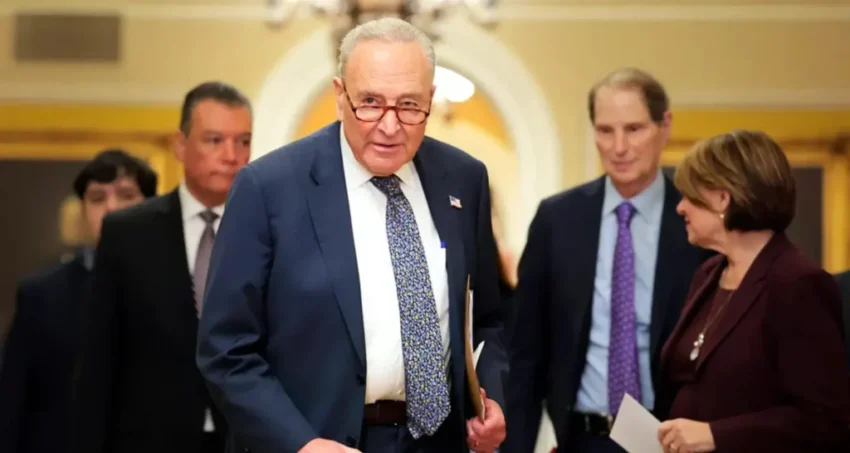

There was actually a rare and hilarious moment on CNN when anchor John Berman pressed Senate Minority Leader Chuck Schumer about the government shutdown—and even threw the term “Schumer Shutdown” at him.
Schumer clearly wasn’t ready for that kind of pushback from CNN.
The exchange came Wednesday, right after Democrats voted to shut down the government in order to jam through taxpayer-funded healthcare for illegal aliens. When the anchor repeated what Republicans were calling the closure—the “Schumer Shutdown”—the Senate minority leader froze, awkwardly claiming he couldn’t hear the question. It was the kind of flustered non-response you give when you know the charge hits a little too close to home.
“Every Republican who’s gone on TV the last 12 hours or so has called this the Schumer Shutdown. What do you say about that name?” Berman said.
The camera then went to a live shot of Schumer on Capitol Hill, who sat there on camera saying nothing.
The anchor asked, “Senator, can you hear me?”
Before the Democrat senator said… “I can’t hear.”
The CNN host asked once more, “Senator Schumer, can you hear me?” But the minority leader just sat there.
“I don’t think Senator Schumer can hear me right now. Maybe the government shutdown included audio on Capitol Hill,” the anchor hilariously snarked.
During the interview, Schumer was asked about his previous comments regarding government shutdowns in 2013, 2019, and March 2025:
Those comments included calling it “a politics of idiocy, of confrontation of paralysis,” “self-defeating,” and “holding American workers hostage.”
“That was you three times in the past… what’s the difference?” the anchor said. At that, Schumer interjected with a lame excuse, claiming it was before Republicans had reportedly done “these horrible things to healthcare,” without further explanation.
Schumer can spin it all he wants, but his claim that Republicans pulled the plug on healthcare for illegal immigrants after his remarks in March simply isn’t true. Vice President JD Vance has already laid out the timeline in detail: that funding was cut back in January, the moment President Trump took office. In other words, Schumer is rewriting history to dodge accountability.
The vice president explained:
This is a Democrat talking point. They say, “We’re not actually trying to give health care benefits to illegal aliens,” and here’s why it’s not true. There are two Biden-era programs that explicitly gave the taxpayer health care money to illegal aliens that we turned off when President Trump took over in January. Program number one is there’s a lot of emergency healthcare at hospitals that are provided to illegal aliens that was funded by the federal government. We turned off that funding, and because of course we want American citizens to benefit from those hospital services, not to be taxed, and then to have those hospital services go to illegal aliens.
The second of which is, the Biden administration gave mass parole to millions upon millions of illegal aliens, and then they simultaneously made those parolees eligible for healthcare benefits covered by taxpayers. In the One Big Beautiful Bill President Trump and Congressional Republicans turned off that money for healthcare funding for illegal aliens, the Democrats want to turn it back on.
White House Press Secretary Karoline Leavitt wasted no time sharing the photo, highlighting just how tone-deaf Schumer looked while his party owns this mess.
A student at the University of Texas was allegedly expelled on the spot after choosing to kneel during the national anthem at a major school event, sparking an immediate firestorm of controversy, debate, and national outrage.
The incident reportedly occurred during the opening ceremony of a UT Longhorns football game this past weekend. According to eyewitnesses, the student — a sophomore majoring in sociology — quietly took a knee as the “Star-Spangled Banner” played, in what appeared to be a peaceful protest. Moments later, security escorted the student out of the stadium.
But what happened next stunned both students and faculty: by Monday morning, the university administration had allegedly issued an official expulsion notice, citing “actions unbecoming of a representative of the university” and “disruption of school values.”
Social media exploded overnight. Hashtags like #UTExpelsForKneeling, #FreedomToProtest, and #FirstAmendmentFail trended nationwide. Celebrities, activists, and politicians weighed in, with some calling the university’s decision “outrageous” and “deeply un-American.”
“This is not about disrespecting the flag — it’s about demanding justice,” tweeted one user. “Expelling a student for expressing their beliefs peacefully? This is fascism disguised as discipline.”
Civil rights organizations, including the ACLU and NAACP, have already announced plans to investigate the incident and offer legal support to the student.
However, the university’s official response added more fuel to the fire. In a now-deleted statement, a UT spokesperson claimed the expulsion was “in line with campus conduct standards” and aimed at preserving “unity and institutional integrity.”
Still, critics aren’t buying it.
“This is a disgrace to higher education,” said Dr. Elaine Brooks, a professor of political science at the university. “Colleges are supposed to be the breeding ground of free thought. Expelling someone for peaceful protest sets a terrifying precedent.”
As of Thursday, student protests have erupted across the UT campus, with hundreds marching, chanting, and demanding the student’s immediate reinstatement. “We kneel with them,” read banners across the main square. Classes in several departments were canceled as students organized sit-ins.
Meanwhile, some conservative commentators have praised the university’s bold stance, arguing that “discipline and patriotism must come before activism.” But the backlash appears to be far greater than the support.
Legal experts say the university could face a massive lawsuit on constitutional grounds, especially if the expulsion is verified as retaliation against a First Amendment-protected act.
So far, the expelled student has not spoken publicly but is reportedly consulting with legal counsel.
As tensions continue to mount, the University of Texas finds itself at the center of a fierce national debate: where do we draw the line between protest and punishment — and who gets to decide?