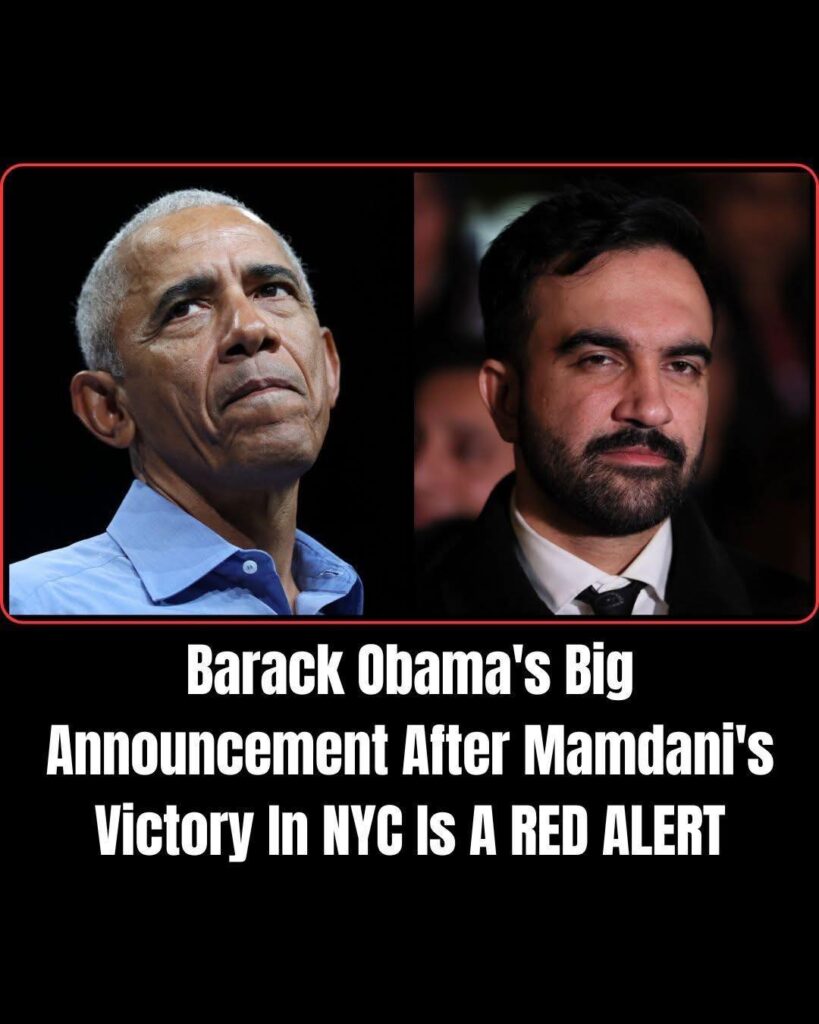
Former President Barack Obama has often positioned himself as a voice urging unity within the Democratic Party, and his latest comments continue that theme. During an appearance on the popular podcast Pod Save America, Obama said that if Democrats want to build a winning national coalition, they must make space for a variety of ideological viewpoints—including those associated with democratic socialism.
Rather than drawing sharp boundaries around what it means to be a Democrat, Obama argued that party leaders should avoid creating rigid “litmus tests” that exclude members who differ on policy priorities. The former president pointed to recent election results as an example of the party’s wide ideological spectrum. He highlighted both the victory of Abigail Spanberger, a more moderate Democrat, and the election of Zohran Mamdani, the newly chosen mayor of New York City, who openly identifies as a Democratic Socialist.
“These are all voices that reflect a vision for where the country can go,” Obama explained. He suggested that the Democratic Party’s strength has always come from bringing together people with diverse backgrounds and beliefs. According to him, this approach allows the party to stay connected to a broad swath of Americans—even when internal disagreements arise.
Obama said the goal is not to create uniformity, but engagement. “We want everyone involved,” he told the podcast hosts, emphasizing that tough debates are a natural part of a large political movement. What matters, he said, is the shared goal of building a country where people are treated with fairness, opportunity is accessible, and communities can thrive without constant division.
He also spoke about the importance of maintaining genuine communication across ideological lines. Obama noted that the country cannot move forward if disagreements immediately fracture alliances. Differences in policy preferences, he said, should not overshadow the deeper values Americans share, such as a desire for stability, dignity, and a better future for the next generation.
The newly elected Mayor Mamdani has gained national attention not only for his victory but for the platform he ran on. His proposals include raising taxes on large corporations and high-income earners, implementing a citywide rent freeze, expanding free bus service, creating city-operated grocery stores, and offering publicly funded childcare. Supporters see his agenda as a way to make essential services more accessible, while critics caution that such programs could impose heavy financial burdens on the city.
Regardless of where one stands on his policies, Mamdani’s win demonstrates the shifting political landscape within urban centers, where younger voters and diverse communities are increasingly receptive to economic reforms associated with democratic socialism. Obama seemed to suggest that ignoring or sidelining these voices would only weaken the party in the long run.
His comments come at a moment when polling data shows a generational divide within the Democratic base. A Gallup survey released in early September indicated that only 42 percent of Democrats expressed a positive view of capitalism, while roughly two-thirds said they viewed socialism favorably. Pollsters have noted that this represents a significant change from previous decades, when capitalism maintained overwhelming support across the party.
This shift has prompted debate among strategists about the best path forward. Shortly after the Gallup poll was made public, political commentator Chris Cillizza shared his concerns on his YouTube channel. According to him, embracing the term “socialism”—no matter how it is defined—could create challenges for Democrats as they prepare for the 2028 presidential cycle.
Cillizza argued that while progressive economic policies may be gaining traction within the left wing of the party, the label itself carries negative associations for many independent and moderate voters nationwide. He warned that relying too heavily on socialist branding may alienate crucial swing-state constituencies.
“You can rename it or package it however you like,” Cillizza said, “but the idea of socialism still has limited appeal across much of the country.” His caution reflects a long-standing strategic concern within Democratic circles: how to energize the party’s increasingly progressive base while also appealing to pragmatic middle-ground voters.
Obama’s perspective, however, appears to be more focused on cohesion than branding. He acknowledged that ideological fights will continue but maintained that the Democratic Party’s identity should not be defined by these conflicts. Instead, he insisted that values such as respect, equality, and genuine community must remain central.
The former president also emphasized that political disagreements should not escalate into personal hostility. He said collaboration is essential, even when lawmakers or activists disagree sharply on policy. Without cooperation, he warned, the party risks fracturing into factions that struggle to work together when facing national challenges.
Obama’s comments reflect his broader political philosophy, which often centers on balancing idealism with pragmatism. His call for unity does not mean avoiding debate; rather, it suggests creating an environment where discussions occur without shutting people out of the movement entirely. According to him, this is the only way to build a durable and effective coalition capable of winning elections and implementing policy.
Political analysts noted that Obama’s remarks may be aimed at reducing tension between the party’s moderate and progressive wings, which have clashed frequently in recent years over issues such as healthcare reform, taxation, climate policy, and the role of government. Public disagreements between the two factions have occasionally overshadowed campaign goals or legislative strategies.
At the same time, progressives have argued that their ideas reflect the concerns of younger voters, who are more likely to struggle with housing costs, student loans, income inequality, and instability in the job market. Many young Democrats say solutions once considered politically unrealistic now feel necessary for addressing the economic challenges of the 21st century.
Obama’s message seems to be that neither side should view the other as an enemy. Instead, he encouraged the party to find common ground where possible and maintain open discussions on areas of disagreement.
By urging Democrats to welcome socialists rather than push them out, Obama may also be acknowledging a reality of modern American politics: the party’s future depends on broad participation from a variety of voices, especially younger generations that will shape elections for decades to come.
Whether party leaders and strategists embrace that philosophy remains to be seen. But Obama made it clear that, in his view, unity and engagement are vital to building a winning coalition—one capable of addressing the challenges ahead while reflecting the diverse ideas and perspectives of its members.
Stormed toward me, his fury was palpable. His finger jabbed the air in my direction as he shouted, “What do you think you’re doing?” The crowd that had started to gather around us was tense, anticipation crackling in the oppressive heat. I held the dog in my arms, feeling her ribs heave as she tried to catch her breath.
I squared my shoulders, trying to remain calm. “Your dog was in distress,” I said firmly. “You left her in a hot car.” His anger was a storm, words tumbling out in a chaotic rage. “You had no right to touch my car! I’m calling the cops. You’re going to pay for this!” I stood my ground, the German Shepherd still clutched tightly against me. Her eyes met mine, and I could feel her fear melting into a quiet trust, a bond forged in the heat of crisis.
And then, out of the corner of my eye, I noticed movement. A woman from the crowd stepped forward, her expression one…
Stormed toward me, his fury was palpable. His finger jabbed the air in my direction as he shouted, “What do you think you’re doing?” The crowd that had started to gather around us was tense, anticipation crackling in the oppressive heat. I held the dog in my arms, feeling her ribs heave as she tried to catch her breath.
I squared my shoulders, trying to remain calm. “Your dog was in distress,” I said firmly. “You left her in a hot car.” His anger was a storm, words tumbling out in a chaotic rage. “You had no right to touch my car! I’m calling the cops. You’re going to pay for this!” I stood my ground, the German Shepherd still clutched tightly against me. Her eyes met mine, and I could feel her fear melting into a quiet trust, a bond forged in the heat of crisis.
And then, out of the corner of my eye, I noticed movement. A woman from the crowd stepped forward, her expression one of stern determination. She pulled out her phone, but instead of filming the confrontation, she started dialing a number. “I’m calling animal control,” she announced, her voice unwavering. “This isn’t right.”
Her declaration seemed to flip a switch in the crowd. They began murmuring, some nodding in agreement, others pulling out their own phones. The man’s bravado wavered as he realized he was outnumbered, his audience turning against him.
Before he could react further, a second woman approached, a bottle of water in her hand. She offered it to me, her eyes full of compassion. “For the dog,” she said softly. I nodded my thanks, unscrewing the cap and helping the parched animal drink. The water seemed to revive her little by little, her panting growing less frantic.
Then, something even more unexpected happened. A young boy, no more than eight years old, stepped out from behind the crowd, tugging at the man’s shirt. “Daddy,” he said, his voice small but insistent. “You told me dogs are family. We shouldn’t leave family in the car.”
The man’s face fell, the anger dissipating into something like shame. He glanced around, seeing the disapproval etched on the faces of strangers, the eyes of his son wide with innocence and truth. His shoulders sagged, the fight leaving him. “I… I didn’t think it was that hot,” he mumbled, his gaze dropping to the ground. The boy looked up at him, his expression a mixture of disappointment and understanding. “It’s okay, Daddy. We can make it right.”
In a moment, the tension that had gripped the parking lot began to dissolve. The man nodded, his resolve softening. He turned towards me, the anger gone from his eyes. “Thank you,” he said quietly, his voice filled with a humbled sincerity.As animal control arrived, the situation was diffused with a sense of collective relief. The German Shepherd was checked over and deemed okay to go home after a proper cooling off. The man, his son by his side, promised to be more careful in the future, his gratitude evident in every word.
As I watched them leave, I realized something important had happened. A community had come together, speaking out for those who couldn’t speak for themselves. In the end, it wasn’t just about breaking a window; it was about breaking barriers — of indifference, of neglect — and choosing to act with compassion.
And as I left the parking lot, the dog safe, the crowd dispersed, I knew that sometimes, the unexpected is exactly what’s needed to change hearts and minds.