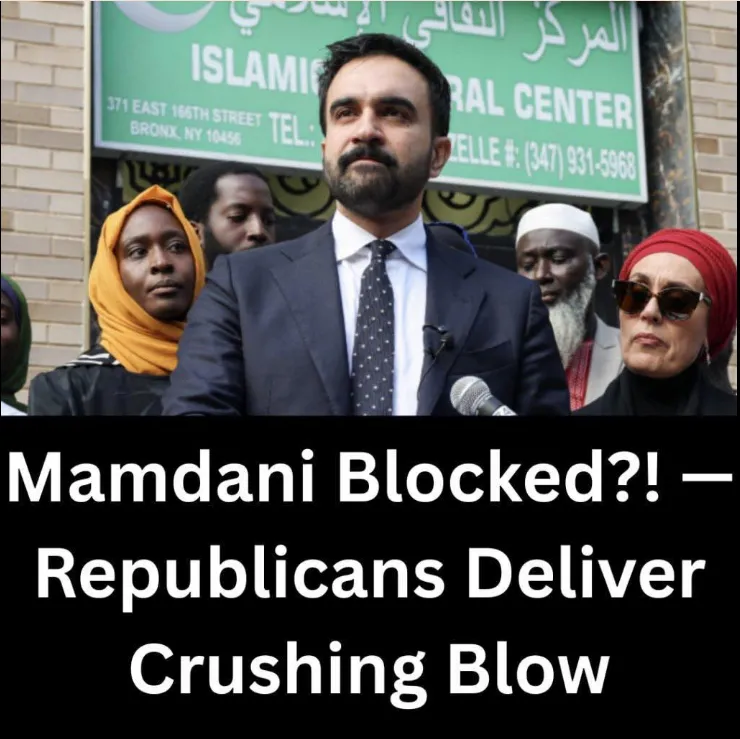
After Zohran Mamdani’s victory in the New York City mayoral election—making him the city’s first Muslim and first South Asian mayor-elect—Republican leaders in Washington, D.C., signaled plans to try to block him from taking office.
President Donald Trump has accused the 34-year-old Ugandan-born politician of being a communist, after previously warning that he would withhold federal funding from New York City if Mamdani won. Mamdani secured his win last week with a decisive margin, defeating former Governor Andrew Cuomo by nearly 10 percentage points, though Mamdani barely won a majority of votes overall.
But some Republican lawmakers have vowed to block him from taking office. Some Republican lawmakers have demanded investigations into Mamdani’s naturalisation process, calling for him to be stripped of his US citizenship and deported. They have accused him of involvement in communist and “terrorist” activities and figures linked to terrorism.
“If Mamdani lied on his naturalisation documents, he doesn’t get to be a citizen, and he certainly doesn’t get to run for mayor of New York City. A great American city is on the precipice of being run by a communist who has publicly embraced a terroristic ideology,” Rep. Andy Ogles (R-Tenn.) said in an October 29 news release, after asking US Attorney General Pam Bondi to investigate the mayor-elect, the Economic Times reported.
“The American naturalization system REQUIRES any alignments with communism or terrorist activities to be disclosed. I’m doubtful he disclosed them. If the information is confirmed, put him on the first flight back to Uganda,” Ogles added.
Meanwhile, a campaign finance watchdog has filed two criminal referrals against Mamdani, accusing the leftist socialist of taking illicit donations from overseas contributors.
The Coolidge Reagan Foundation sent the recommendations to the Department of Justice’s Criminal Division and Manhattan District Attorney Alvin Bragg’s office last week. They say that Mamdani may have broken the Federal Election Campaign Act and the New York Election Code.
The recommendations were made after the New York Post reported earlier this month that Mamdani’s campaign got about $13,000 in donations from at least 170 people who live outside the US, including one from his mother-in-law in Dubai.
“These are not isolated incidents or clerical errors,” Dan Backer, a national campaign finance expert and president of the Coolidge Reagan Foundation, said in a statement.
“This was a sustained pattern of foreign money flowing into a New York City mayoral race which is a clear violation of both federal law and New York City campaign finance rules,” Backer added. “Mamdani’s campaign was on notice for months that it was accepting illegal foreign contributions, and yet it did nothing meaningful to stop it.”
The Coolidge Reagan Foundation has previously filed complaints against Rep. Alexandria Ocasio-Cortez (D-NY), Hillary Clinton’s presidential campaign, and the Democratic National Committee.
The watchdog told Bragg and the DOJ to look into and arrest Mamdani for the campaign cash that may have come from Australia, Turkey, France, Canada, Germany, and other countries.
The group said that Mamdani’s campaign had shown a “systematic failure to comply” with the rules about campaign money.
The Federal Election Campaign Act says that it is against the law to “accept or receive” donations from people who are not US citizens in any federal, state, or local election.
People who knowingly accept donations from other countries could face big fines and jail time.
“The law is crystal clear that foreign nationals may not participate in American elections, and that includes making contributions,” Backer continued. “Yet Mamdani’s campaign repeatedly accepted donations from individuals abroad, some even tied to regions and individuals openly sympathetic to hostile actors.”
“Whether through negligence or intent, this conduct undermines the integrity of the democratic process.”
Mamdani’s campaign for mayor of New York City sent back about $9,000 in donations from people outside the U.S., the Post reported.
In a sharp rebuke to Representative Ilhan Omar’s ongoing controversial statements and actions, former President Donald Trump made an uncharacteristic yet telling suggestion: he offered the head of Somalia the opportunity to take Rep. Omar back to her home country.His comments, although dismissed as a joke by many, reflect deeper concerns about Omar’s loyalty and her increasingly divisive rhetoric within the U.S. political landscape.
Trump’s suggestion was more than just a sarcastic remark; it was an acknowledgment of the growing concerns about Omar’s actions, her rhetoric, and her place in American politics.Omar, who fled war-torn Somalia with her family at a young age, became a naturalized U.S. citizen and rose to national prominence as a progressive Democrat in Minnesota.Over time, her outspoken criticism of American policies, especially regarding Israel, her polarizing views on immigration, and her controversial remarks about the 9/11 terrorist attacks, have ignited fierce debates.Omar has regularly found herself at odds with many, including members of her own party, but it is her increasingly caustic statements about the U.S. and its leaders that have raised the stakes.Trump’s response to Omar’s rhetoric was swift and direct, describing her as a “lying buffoon” and declaring that no one should take her seriously.
It’s clear from his comments that he believes Omar’s words have crossed a line. While some would argue that his response was crude, there’s a certain logic in Trump’s call for Omar to return to Somalia if she can’t seem to respect the values and beliefs of the nation that gave her refuge.
After all, why should a representative of the United States be allowed to continue spouting vitriol and misinformation if they show little respect for their country?Ilhan Omar has repeatedly undermined American policies, criticized its leadership, and expressed disdain for various aspects of the nation’s institutions.
For example, her repeated claims that the U.S. is a nation built on white supremacy and her suggestion that it was founded on racist principles directly contradict the foundation of American democracy.Many of her critics view these remarks as a slap in the face to the sacrifices made by those who fought for the freedoms that allowed her to thrive in America.It’s one thing to criticize your government from a position of respect and a desire to improve, but it’s quite another to publicly vilify the entire nation, as Omar has done time and again.In particular, Omar’s comments on the 9/11 attacks drew significant backlash.
When she referred to the terrorist attacks as “some people did something,” she was accused of trivializing the tragedy that killed thousands of innocent Americans.
Her words were perceived as callous, and they angered countless families of 9/11 victims, survivors, and first responders. Such dismissive language regarding the worst terrorist attack in U.S. history reveals a lack of understanding of the gravity of the event and raises questions about her commitment to this country.For those who lived through that tragic day, Omar’s comments were not just offensive; they were a painful reminder of how some people appear to downplay the national trauma that shaped much of the 21st century.
Omar’s views on Israel have also sparked controversy and earned her harsh criticism, even from fellow Democrats. Her remarks comparing the American-Israeli political relationship to an “alliance” of “enemy states” have been widely regarded as anti-Semitic.Her repeated attacks on American allies, like Israel, not only jeopardize the country’s diplomatic standing but also threaten to alienate many who still hold strong to the values of allyship and national security.Omar’s growing ties with far-left groups have made her an increasingly polarizing figure, and her statements have stoked distrust among many who now wonder if she is fully committed to the values and interests of the U.S.
When Trump suggested that the head of Somalia “take her back,” it was not just a personal attack but a reflection of a broader sentiment: Omar seems more interested in criticizing America than in contributing to its future.This suggestion, though harsh, highlights the dissonance between a lawmaker’s responsibility to represent her constituents and her continued pattern of divisive rhetoric.
If Omar truly feels that the U.S. is so fundamentally flawed, her suggestion to return to Somalia should not be dismissed lightly. There are many who feel that someone with her views might be better suited working for change in the country of her birth, rather than publicly attacking the country that gave her a platform to speak.Critics of Trump’s remarks have accused him of stooping to childish insults and attacking Omar on the basis of her background and ethnicity. They argue that his comments play into divisive rhetoric that serves no purpose other than to alienate voters.While these criticisms are understandable in a political context, they ignore the underlying issue: the crux of Trump’s suggestion is the belief that Omar’s rhetoric and actions are not conducive to her role as a U.S. representative.
To some, her repeated attacks on American policies, institutions, and leaders have not only hurt her standing but have made her a liability to her party.On the other hand, Trump’s bluntness is one of the hallmarks of his political persona. His brand of rhetoric resonates with those who feel Omar’s progressive views are out of touch with the majority of Americans.These voters, many of whom feel abandoned by the political establishment, see Trump as someone who calls out hypocrisy, exposes double standards, and isn’t afraid to challenge figures like Omar.
To these individuals, Omar’s rhetoric isn’t just harmful to her reputation; it’s harmful to the fabric of the nation itself.In addition, Trump’s call for Omar to return to Somalia isn’t just about her criticisms of America but also her failure to recognize the privilege and opportunities that the U.S. has afforded her.It’s easy to critique a country when you’ve been given the chance to become a lawmaker in its most powerful institution. Omar is a symbol of the American dream — a refugee who escaped hardship and found success in one of the most powerful governments in the world.If she can’t respect that opportunity, perhaps her loyalties lie elsewhere. While many may dismiss Trump’s remarks as a cheap shot, they strike at the heart of a larger concern about the responsibility that lawmakers have in representing the values of their country, especially if they seem intent on undermining those values at every turn.
While Trump’s suggestion to send Omar back to Somalia may seem extreme, it serves to expose the deep frustration many Americans feel with a representative who has repeatedly chosen to vilify her country.Given her increasingly provocative rhetoric, it’s clear that Trump’s idea, while controversial, reflects a legitimate concern about Omar’s commitment to the principles that America was founded upon.