The Great Contradiction: Character vs. Ideology
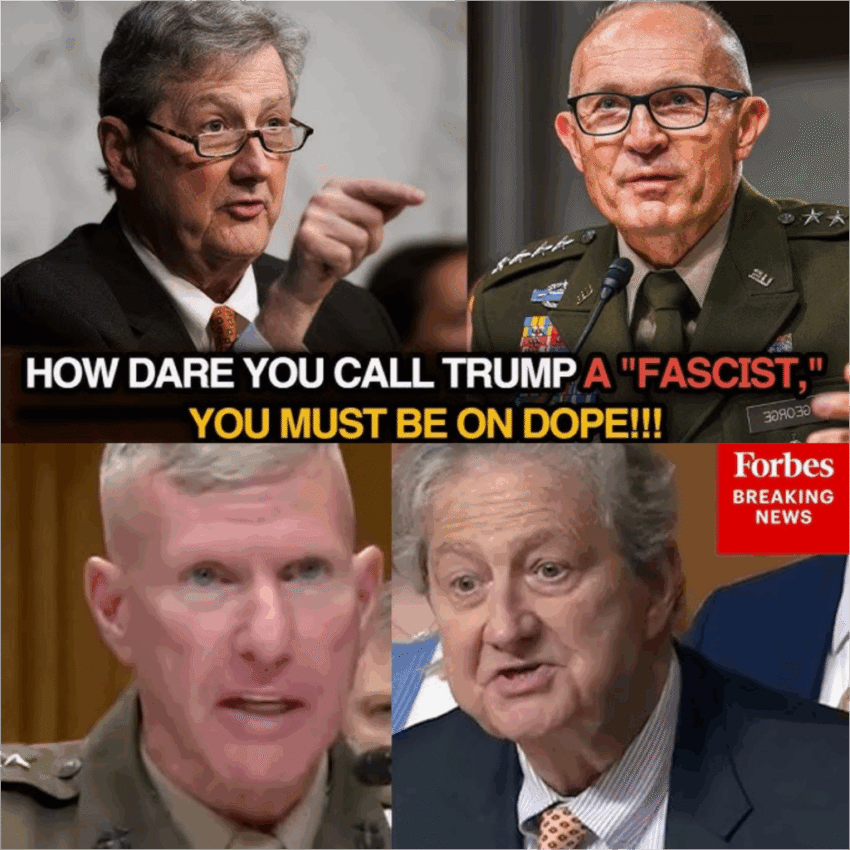
Senator Kennedy’s strategy was simple and devastating: to expose the inherent contradiction between the witness’s claim to uphold Duty, Honor, and Respect (as stated in his opening remarks) and his public willingness to use highly inflammatory political language against millions of citizens and a former Commander-in-Chief.
The Fascism Accusation on the Record
The exchange began with Kennedy forcing the witness to acknowledge his own words spoken on CNN: “I’m very proud of General Millie for saying that President Trump is a total fascist,” and that the “reality is that [MAGA Republicans] are in fact fascists themselves.”
The context of this statement is crucial: Retired General Mark Milley, the former Chairman of the Joint Chiefs of Staff, privately described Donald Trump as “fascist to the core” in a book by Bob Woodward. The witness was not only endorsing this highly politicized and loaded term but was also expanding the accusation to include a significant portion of the American electorate (“most MAGA Republicans”).
The gravity of such a statement from an individual in a high-ranking official position cannot be overstated. It suggests a profound disrespect for the political process and the people he claims to serve.
When confronted, the witness attempted to deflect, hiding behind bureaucratic procedure: “Senator, I am happy to discuss my personal perspectives with you separately at any time. That’s not the purpose of the hearing today.
“
Kennedy immediately cut through the evasiveness, repeating the question until the witness was forced to admit: “I believe so. Yes.”
The Moral Indictment: Smarter and More Virtuous?
Having established the damning quotes on the record, Kennedy shifted his attack to the witness’s perceived arrogance and elitism.
“You think you’re smarter than the American people, don’t you?”
“You think you’re more virtuous than the American people, don’t you, General?”
These questions directly challenged the witness’s right to occupy a position of public trust while holding such contemptuous views. The witness’s defense—”I am here to discuss the use of the military as part of this mass deportation”—was dismissed by Kennedy as an attempt to pivot away from the issue of character.
Kennedy’s point, made clear through his persistence, was that an official cannot lecture the country about the values of “Duty, Honor, and Respect” while simultaneously labeling the former president a fascist and painting millions of voters as too ignorant to understand basic political terminology. The witness’s indignation (“Senator,
The Policy Motive and the Broken Border Reality
The confrontation transitioned to immigration, with Kennedy suggesting the witness’s political bias was inextricably linked to the issue at hand.
Linking Anger to Open Borders
Kennedy pressed the witness on his fundamental beliefs regarding border control: “And it makes you angry that President Trump does not believe in open borders, doesn’t it?”
Though the witness denied the anger, claiming belief only in “the rule of law,” Kennedy successfully established the underlying political motive driving the confrontation: the vast ideological gap on immigration.
The hearing context—which centers on the use of federal resources, likely the National Guard or other forces, for immigration enforcement—makes the witness’s political leanings directly relevant to his capacity for objective judgment in his official role.
The Injustice of the System
In a moment of bipartisan agreement, Kennedy and the witness confirmed the obvious truth about the current border crisis:
The broken Southern border is “man-made,”
a result of policies implemented by the current administration (implicitly naming Joe Biden).
The system has created a situation where those attempting to immigrate legally are being penalized. When Kennedy asked, “under President Biden, if you wait in line for legal immigration,
This admission underscored the injustice created by the current policies, validating the anger and frustration felt by those who advocate for stricter border security and adherence to legal immigration processes.
Conclusion: Accountability Over Procedure
Senator John Kennedy emerged from the hearing having achieved his mission: he forced a high-ranking official to confront the uncomfortable truth of his own rhetoric.
The intense questioning served as a powerful reminder of why congressional oversight matters. It is a necessary mechanism to ensure that powerful individuals, regardless of their political alignment or professional stature, are held accountable for their words and their actions.
The witness failed to use procedure (the purpose of the hearing) as a shield against the examination of his character. Kennedy made it clear that character and respect are non-negotiable values for those who claim to serve the American people, and that publicly insulting millions while occupying a position of power is an affront to the very principles of duty and honor he professed to uphold. His questioning was driven not by hostility, but by a deep responsibility to the citizens who expect honesty and fairness from those in positions of authority.
The confrontation provided a striking contrast between an official attempting to protect his elite, unassailable viewpoint and a senator fighting to protect the values of everyday Americans who feel they are being ignored and insulted by Washington’s inner circle.
Watch Gen. Mark Milley’s comments on President Trump below: Gen. Mark Milley: Donald Trump is a “total fascist” – YouTube. This video provides context on the original “fascist” comment referenced by the witness and Senator Kennedy.
The roar of Chicago’s downtown bus terminal was constant—horns, engines, hurried footsteps, and the endless shuffle of commuters. It was a place where no one lingered, where most people kept their eyes down, focused on their phones or the ground in front of them. But above the noise, one voice managed to break through.
“Sir, please. Just a dollar.”
The words were trembling, fragile, and raw. They came from a woman bundled in layers of soiled clothing, her hair peeking from beneath a threadbare beanie, her hands cracked and trembling. She looked less like someone asking for a handout and more like someone asking to be seen.
Michael Jordan stopped. Not the polite half-pause that celebrities sometimes give when they’re recognized, not the automatic shake of the head as they keep walking. He stopped completely, his frame towering above the sea of rushing bodies. The terminal kept moving around him, but in that moment, the air shifted.
The woman blinked, startled. She hadn’t expected him to even look her way, much less stop. His eyes locked onto hers—not with pity, not with annoyance, but with something she hadn’t experienced in months: recognition.
“What’s your name?” he asked.
The question stunned her. Strangers rarely looked past the surface. Famous people, if they noticed her at all, dropped a few coins and vanished quickly. But this man—the most recognizable athlete in Chicago—was standing still, asking her to define herself not by circumstance, but by identity.
“My name’s Taylor,” she stammered, her voice small but clear. “Taylor Winslow.”
“How long have you been on the streets, Taylor?” he asked.
The sound of her name spoken with respect made her throat tighten. “Eight months,” she whispered, tears beginning to well. “Since I lost everything.”
“What did you do before?” Jordan pressed gently.
Her chest clenched at the question. That part of her life felt like another world, one she didn’t dare talk about anymore. “I was a nurse,” she said softly, avoiding his eyes. “Twelve years in the ICU at Northwestern Memorial.” She swallowed, her voice breaking. “I saved lives.”
The noise of the terminal seemed to fade as people slowed to watch. A few commuters whispered, pointing, phones already in hand to record what was happening.
Jordan didn’t flinch. “What happened?” he asked, his tone not prying, but sincere.
Taylor’s tears spilled freely now. “I had a breakdown. During the pandemic, I lost too many patients. I couldn’t handle it anymore. I lost the job, then my apartment, and then…” She gestured weakly at herself, at the layers of grime and fabric, the shell of who she once was.
Jordan was silent for a long moment, absorbing her words. Then he asked something no one else had ever bothered to. “Do you still have your nursing license?”
The question caught her off guard. Most people only focused on the fall—the tragedy, the loss. No one had ever asked about what might still remain.
“Yes,” she said quickly, almost too quickly, a spark of pride flickering in her eyes. “It’s valid for another six months. I tried to keep up with my continuing education courses, whenever I could use a computer at the library.”
Jordan tilted his head, curiosity in his voice. “Why did you keep it up?”
Taylor hesitated, then drew in a shaky breath. “Because I still hope to go back one day. Being a nurse wasn’t just a job. It was who I was. It’s still who I am, even if nobody can see it right now. But…” She gestured down at her stained coat, her worn shoes. “Even if I got an interview, one look at me and they’d know something’s wrong. Who would hire me like this?”
Jordan studied her for a moment longer, his expression unreadable. Around them, the crowd thickened, the curiosity of bystanders mixing with the hum of the terminal. But the conversation remained just between the two of them—an icon and a forgotten woman, one who had once carried life and death in her hands, now reduced to asking for a dollar.
What Taylor didn’t yet know was that this moment would not end the way it had so many times before—with a coin, a nod, and footsteps fading away. Jordan wasn’t just hearing her story; he was considering her future.
For months, she had lived in shadows, invisible to the city she once served. But in this instant, under the harsh fluorescent lights of a bus terminal, she was seen—fully and completely. Not as a homeless woman, not as a statistic, but as Taylor Winslow, nurse, survivor, human being.
And Michael Jordan, whose name symbolized resilience and greatness across the world, was about to prove that true greatness wasn’t only measured on a basketball court. It was measured in moments like this—moments when one person chose to stop, to look, and to listen.
Bob Saget, Comedian And ‘Full House’ Star, Found Dead In Orlando Hotel Room**
Bob Saget, the beloved comedian and star of the iconic television series “Full House,” was found dead in an Orlando hotel room. Known for his role as Danny Tanner, the wholesome, endearing father figure on the hit 90s sitcom, Saget’s passing has left fans and fellow comedians mourning the loss of a deeply talented and much-loved figure in entertainment.
Saget’s career spanned decades, from his early days in stand-up comedy to his successful run on “Full House” and its sequel “Fuller House.” Beyond acting, Saget’s unique comedic voice was highlighted in his stand-up specials, where he often subverted his clean-cut television persona with his edgier, more adult-oriented humor.
His sudden death at the age of 65 has sent shockwaves through the entertainment industry. Tributes have poured in from friends, fans, and colleagues who praised his warmth, humor, and ability to bring joy to others.
George Strait’s “I Cross My Heart”: A Classic Country Vow
Written by Steve Dorff and Eric Kaz back in 1982, the song spent years in limbo before being chosen for
Strait’s delivery turns those words into something deeply personal — not just romantic lyrics, but a genuine vow. The repetition of the title line makes it feel like a promise renewed with each chorus, emphasizing devotion, loyalty, and timeless love.
Over the years, I Cross My Heart has become a staple at weddings, anniversaries, and special occasions. It’s not just a hit — it’s a part of people’s lives. The song’s video, which includes scenes from
Pure Country, adds visual emotion to its message, helping solidify its legacy.
Even decades later, George Strait still performs this song to enthusiastic crowds. It’s a reminder of how a simple melody and sincere words can touch hearts across generations. More than just a hit,
I Cross My Heart is a cultural touchstone — a song that captures what it means to truly love someone.