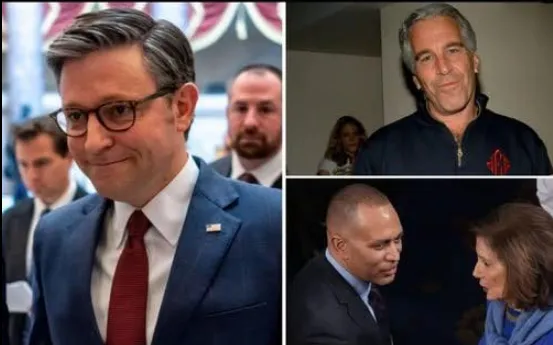
Tuesday, at the weekly House Republican Leadership press conference, Speaker Mike Johnson discussed House Republicans’ efforts to deliver maximum transparency regarding the Epstein files and ensure justice for victims of Jeffrey Epstein’s crimes.
Speaker Johnson also addressed what he called Democrats’ newfound interest in the Epstein files, despite the information being in the government’s possession throughout the Biden Administration.
“The truth is, the biggest proponents of this discharge petition were never actually interested in transparency or ensuring justice or protecting victims of this unspeakable tragedy, the Epstein evils. And how do we know that? Because the Democrats had every one of the Epstein files in their possession for the four long years of the Biden Administration,” Speaker Johnson
“For four long years under the previous administration of the Biden-Harris Administration, Democrats insisted there was no border crisis. Remember, they told you that that wasn’t a problem at all. They dismissed inflation as transitory. That’s what they told us. They told the American people not to believe what we could all see with our own eyes, that there was an obvious mental and physical decline on the part of President Biden individually,” Johnson said. “And now, seemingly overnight, these same cast of characters, they’ve taken a sudden and urgent interest in the Epstein investigation.”
“None of them held press conferences. None of them demanded the release of the documents. And under Biden’s DOJ, when they prosecuted just Epstein and Ghislaine Maxwell, not a single one of these Democrats or any of the proponents of the discharge ever made any noise about that at all,” he said. “So, it’s fair for the American people to ask the question, why now? Why suddenly are they so interested?”
“This was an unspeakable tragedy, and we have great compassion for the victims,” Johnson said. “They deserve justice. It has been too long delayed.”
Dozens of Democratic candidates running for U.S. House seats nationwide told Axios they either would not support House Minority Leader Hakeem Jeffries (D-N.Y.) for party leader or were not prepared to commit to voting for him.
The responses suggest growing unease within some parts of the Democratic Party about its current leadership as the 2026 election cycle approaches, the outlet reported this week.
Since assuming the role of Democratic leader in 2022, Hakeem Jeffries has maintained unanimous support within his caucus. That unity, however, may be tested in the next Congress amid rising frustration from grassroots activists, particularly on the party’s left flank.
While Senate Minority Leader Chuck Schumer (D-N.Y.) has drawn much of the criticism from progressive circles this year, Jeffries is increasingly becoming a focal point of dissatisfaction as well, Axios noted.
Axios contacted nearly every Democrat running for a U.S. House seat considered potentially winnable for the party in 2026, receiving responses from 113 candidates through phone interviews or written statements.
Of those surveyed, 20 said they would not vote for Hakeem Jeffries as speaker or minority leader, while another five indicated they were likely to oppose him. Fifty-seven candidates declined to commit to supporting Jeffries, describing it as too early to decide or citing concerns over ideology, strategy, messaging, or leadership style.
Only 24 respondents said they would definitely back Jeffries, and seven more said they were likely to do so, the outlet said.
However, his office pushed back on the narrative that he’s lost support.
“Leader Jeffries is focused on battling Donald Trump, ending the Republican shutdown of the federal government and addressing the crushing GOP health care crisis,” Jeffries spokesperson Justin Chermol told Axios.
Many of the Democrats expressing skepticism toward Hakeem Jeffries are political outsiders or long-shot candidates, while several front-runners in key battleground races declined to respond to Axios’ inquiries. Still, a number of Jeffries’ critics and noncommittal candidates have credible paths to winning seats in Congress.
Among them are Daniel Biss and Kat Abughazaleh, two leading contenders in the Democratic primary to replace retiring Rep. Jan Schakowsky (D-Ill.), both of whom stopped short of pledging to support Jeffries.
Other prominent challengers — including Luke Bronin, Donavan McKinney, Mai Vang, Saikat Chakrabarti, and Patrick Roath — have also withheld their support. Each is running well-funded campaigns aimed at unseating long-serving Democratic incumbents.
Heath Howard, a New Hampshire state representative running for an open U.S. House seat, told Axios regarding the Democratic leader: “I think we need to have a new type of leadership that’s … going to fight back significantly harder against the Trump administration.”
Abughazaleh, meanwhile, told Axios she will support a leader who is “taking actual action against this administration” and that the left should use “our leverage to demand progressive change.”
“We’ve got to see improvement, without question,” Amanda Edwards, who was a member of the Houston city council and is now running in a Texas special election, told the outlet.
Harry Jarin, a firefighter mounting a primary challenge to former House Majority Leader Steny Hoyer (D-Md.), told Axios: “The anger of the base right now is not being matched by Democratic leadership … and that is going to have to change one way or another.”
A recurring theme among candidates who declined to back Jeffries was his refusal to endorse socialist New York City mayoral candidate Zohran Mamdani — a decision that has also become a source of frustration among left-wing members of Congress.
“His refusal to endorse Zohran makes me nervous that, if I were to become the nominee in my race, he and the party would not support me,” noted Jacob Lawrence, who is set to challenged Rep. Chuck Edwards (R-N.C.).
Chakrabarti, when asked whether he would support for Jeffries, quipped: “What is it that Hakeem said about endorsing Zohran? ‘I’ll have conversations with him and see where it goes.
 In the midst of her vulnerability, an unexpected act of solidarity unfolded in the barbershop. The barber paused, looking around the room, and then cleared his throat. His eyes met those of his colleagues, a silent understanding passing between them. In that moment, the atmosphere shifted from silent sympathy to active compassion.
Without a word, the barber removed his cap, revealing his own head of hair. He handed the clippers to a colleague and gestured towards his own head. The colleague raised an eyebrow, taken aback by the gesture, but then nodded. In a surprising twist of events, the barber sat in the adjacent chair and allowed his hair to be shaved off as well. It was a gesture that needed no explanation — his actions spoke volumes.
As the clippers buzzed and more hair fell to the floor, the young woman looked up, wiping her tears. She saw what was happening and gasped. Her friend, the barber, was smiling at her through the mirror, his eyes gentle and full of understanding. His bald head, in solidarity with hers, was a declaration that she was not alone in her battle.
The other barbers, inspired by their colleague’s act of kindness, began to follow suit. One by one, they each took turns in the chair, shedding their own hair in support. The shop, once filled with the quiet hum of mourning, was now alive with a profound sense of unity and camaraderie. The young woman couldn’t believe what she was witnessing. Her tears of sorrow turned into tears of gratitude and disbelief.
As the last lock of hair fell from the final barber’s head, the room erupted in applause. It was not just an applause for the barbers’ selflessness, but for her courage, for her journey, and for the unbreakable bond of human empathy. The young woman, overwhelmed with emotion, found herself smiling through her tears. She realized, in that transformative moment, that she hadn’t lost anything; instead, she had gained something invaluable — a community ready to stand with her, bald heads and all.
The barbershop, once her sanctuary for haircuts, had become a sanctuary for her spirit. The men, with their tough exteriors, had shown her the true essence of strength — not in the hair they wore, but in their willingness to share in her pain and support her through her struggles. They had turned a moment of loss into a powerful testament of solidarity and hope.
The woman left the barbershop feeling lighter and not just because of her shaved head. She left with a renewed sense of strength, buoyed by the knowledge that she was part of something greater, a community woven together by compassion and courage. As she walked out into the world, bald and beautiful, she carried with her the heartfelt lesson that even in the darkest of times, unexpected kindness can illuminate the path forward.