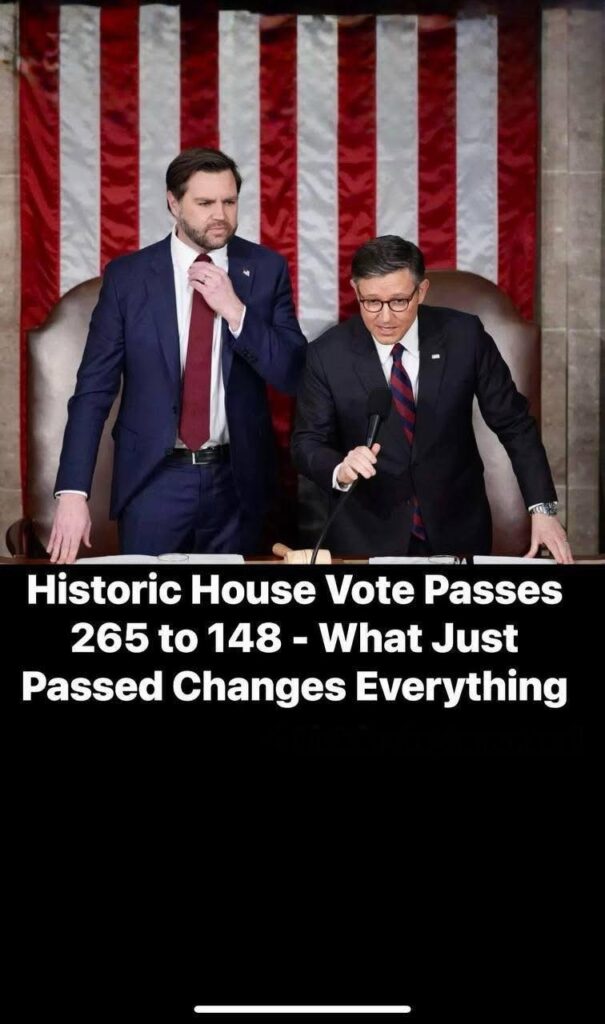
The U.S. House of Representatives has approved a bill mandating the deportation of undocumented immigrants convicted of assaulting law enforcement officers, following a contentious debate that highlighted deep partisan divides over immigration enforcement and public safety.
The measure, titled the Detain and Deport Illegal Aliens Who Assault Cops Act, was introduced by Rep. Jeff Van Drew (R–N.J.) and passed in a bipartisan vote of 265 to 148, with 54 Democrats joining Republicans in support.
Purpose and Provisions of the Bill
The legislation would require federal immigration authorities to detain and deport any undocumented immigrant convicted of assaulting a police officer, while also creating a new category of inadmissibility that would bar such individuals from entering or re-entering the United States.
Under the bill, those accused of assaulting law enforcement officers would be held in federal custody pending deportation proceedings. The bill does not change existing criminal penalties for assaulting an officer but adds immigration consequences that mandate removal from the country following conviction.
“There is no reason that an illegal alien who attacks our law enforcement should remain in our country,” Van Drew said in a statement after the vote. “That shows zero respect for our rule of law or our institutions. Those who endanger police officers cannot be positive contributors to our society.”
Van Drew, a former Democrat who switched parties in 2019, argued that the measure is essential to protect law enforcement and restore public confidence in the nation’s immigration system.
Partisan Debate on the House Floor
Debate over the bill became heated, with supporters portraying it as a common-sense public safety measure and opponents warning that it could lead to overreach and potential due process concerns.
Republican lawmakers described the proposal as a necessary step to deter violence against police officers and hold offenders accountable.
“Law enforcement officers risk their lives daily to protect our communities,” said House Majority Whip Tom Emmer (R–Minn.). “If someone enters this country illegally and then assaults a police officer, they should have no right to stay. It’s that simple.”
Emmer later criticized Democratic opposition, claiming that it reflected misplaced priorities.
“House Democrats just voted to protect violent, illegal immigrants over our brave law enforcement officers,” he said. “Once again, the Democrat Party proves it is out of touch with public safety and the rule of law.”
Democratic lawmakers, however, argued that the bill’s language was overly broad and could be exploited to target immigrants unfairly or deny them due process.
“We all agree that assaulting an officer is unacceptable,” said Rep. Pramila Jayapal (D–Wash.), ranking member of the House Judiciary Subcommittee on Immigration. “But this bill conflates criminal justice with immigration enforcement in a way that risks punishing people before they’ve had their day in court.”
Other Democrats contended that the measure was politically motivated and intended to reinforce partisan talking points rather than address broader issues of public safety or immigration reform.
“We need comprehensive immigration reform, not reactionary policies that make headlines but don’t solve systemic problems,” said Rep. Veronica Escobar (D–Texas), who represents a border district.
Background: Immigration and Law Enforcement
The bill comes amid renewed national debate over immigration enforcement and the role of local police in dealing with undocumented immigrants. In recent years, several high-profile incidents involving crimes committed by undocumented individuals have reignited calls for stricter deportation laws.
Supporters of Van Drew’s bill argue that the legislation closes a loophole that allows individuals with criminal convictions to remain in the country while awaiting deportation hearings — a process that can take months or even years.
According to Immigration and Customs Enforcement (ICE) data, more than 12,000 non-citizens were arrested in 2024 for offenses involving assault or battery, including incidents against law enforcement officers.
Political Implications and Broader Trends
The bill’s passage represents a significant messaging victory for House Republicans, who have prioritized border security and immigration enforcement as central themes of their 2025 legislative agenda.
The vote also underscores growing bipartisan pressure to address violent offenses committed by undocumented immigrants, though it remains uncertain how the bill will fare in the Democrat-controlled Senate, where similar measures have previously stalled.
Political analysts note that the bill’s timing — just as the 2026 midterm campaign cycle begins — could have electoral implications. Republicans are expected to highlight it as part of a broader narrative emphasizing law and order, while Democrats may argue it distracts from needed immigration reform and economic policy.
“Republicans are betting that public concern over crime and border security will continue to resonate with voters,” said political analyst Meredith Cole. “Democrats, on the other hand, are divided between their progressive and moderate wings on how to respond.”
Public Reaction and Polling
The debate comes as new polling shows a shift in public opinion toward tougher immigration enforcement measures.
A recent CNN survey found that Republicans hold a double-digit advantage over Democrats on economic and immigration issues, surprising even some analysts within the network.
“You’d expect Democrats to have recovered ground by now, but they haven’t,” said CNN data analyst Harry Enten, discussing the results on-air. “The Republican lead on handling the economy and border security remains strong, within roughly the same 10-to-12-point range we’ve seen since late 2023.”
Public sentiment, particularly in swing states, appears to favor policies that emphasize stricter deportation measures for migrants convicted of violent crimes — a trend likely to shape campaign messaging in the months ahead.
White House and Senate Response
The White House has not yet issued an official statement on the House vote, but administration officials have previously expressed concern about legislation that mandates automatic deportations, citing potential conflicts with international human rights agreements and judicial discretion.
In the Senate, Majority Leader Chuck Schumer (D–N.Y.) has not indicated whether he will bring the bill to a vote. However, several moderate Democrats have suggested they might consider supporting the measure if amendments are added to clarify due process protections.
“We can support deporting those convicted of violent crimes,” said Sen. Joe Manchin (D–W.Va.), “but we have to make sure we’re not bypassing the judicial process or expanding this to include lesser offenses.”
Next Steps
The Detain and Deport Illegal Aliens Who Assault Cops Act now heads to the Senate, where its prospects remain uncertain. If passed, it would represent one of the most significant expansions of deportation mandates in recent years.
The Department of Homeland Security (DHS) has yet to comment on how the law would be implemented, but experts say enforcement could require increased coordination between local police departments and federal immigration authorities — a process that has sparked legal disputes in the past.
Immigration advocacy groups have already signaled plans to challenge the measure in court if it becomes law, arguing that it could violate constitutional protections for due process and equal treatment under the law.
“This bill uses public safety as a political tool,” said Maria Gomez, director of the advocacy group Justice for Immigrants. “Nobody supports violence against police officers, but this kind of blanket policy risks turning every immigrant accused of a crime into a deportation target before they’ve even been convicted.”
A Divided Congress Faces a Defining Vote
As the legislation moves forward, it highlights the growing divide in Congress over how to balance immigration enforcement with civil liberties.
For Republicans, the bill represents a reaffirmation of their stance on border security and law enforcement. For Democrats, it raises tough questions about fairness, proportionality, and the limits of government power.
Whether or not the measure becomes law, it is already shaping the political conversation around immigration, accountability, and the rule of law — setting the stage for what is likely to be one of the defining debates of the coming election year.
It started as a quiet week in Washington — until a private comment attributed to Hillary Clinton spread through political circles like wildfire.
During what sources described as a “closed-door donor event,” the former Secretary of State reportedly referred to Senator John Kennedy as a “stupid country bumpkin” while discussing his recent remarks about corruption and government waste.
The remark might have stayed behind closed doors — if it hadn’t been leaked.
According to multiple attendees, Clinton was speaking candidly about political image and perception when she made the now-viral remark. One insider, who spoke under condition of anonymity, recalled her tone as “dismissive” and “condescending.”
“I’m tired of these folksy, small-town politicians pretending they understand how the world works,” Clinton allegedly said. “John Kennedy may play the ‘southern charm’ act well, but he’s still just a stupid country bumpkin in the big leagues.”
Within hours, that line appeared in political blogs and social media posts — and by the next morning, it had been picked up by major outlets.
Reactions came fast and fierce.
Republicans accused Clinton of elitism, Democrats tried to downplay the story, and Kennedy’s office — at least for the first 48 hours — stayed completely silent.
But behind that silence, something was brewing.
Three days later, without addressing Clinton’s insult directly, Senator John Kennedy made a quiet yet monumental announcement from the Senate floor.
He unveiled a bipartisan bill — co-sponsored with Democrat Senator Joe Manchin — aimed at slashing federal lobbyist loopholes and forcing every registered lobbyist to disclose every single dollar of foreign funding.
“Public office should never be a retirement plan for influence peddling,” Kennedy declared. “If that makes me a bumpkin, then God bless every bumpkin who still believes in honesty.”
The chamber fell silent. For a brief moment, even those who disagreed with him politically couldn’t help but listen. His calm, deliberate tone carried more weight than any fiery speech could.
The proposal — dubbed the “Honest Hands Act” — immediately sent shockwaves through Washington. Analysts called it “the boldest anti-corruption proposal in years.”
But it was what happened after the announcement that made headlines.
The day after his Senate speech, Kennedy’s office quietly released a handwritten letter addressed to Hillary Clinton. It wasn’t angry. It wasn’t sarcastic. It was something far more devastating — sincere and direct.
The letter read, in part:
“Dear Secretary Clinton,
I grew up in a town where hard work mattered more than titles. Where people didn’t need Harvard degrees to tell right from wrong. You may think that makes us small, but this country was built by small towns — and big hearts. I’ll always take that over arrogance in a pantsuit.”
– Sincerely, John N. Kennedy
The letter ended with a Bible verse:
“Pride goeth before destruction, and a haughty spirit before a fall.” — Proverbs 16:18
The post went viral within hours. Within a day, it was trending #1 on X (formerly Twitter) under #CountryBumpkinPower.
Commenters from all sides weighed in:
“That’s how you respond — with class, not insults.”
“He just roasted her politely. That’s a rare art.”
“This letter belongs in history books.”
“I’m not even conservative, but wow — that hit deep.”
Even some left-leaning pages admitted Kennedy’s tone “hit harder than any political jab.” One viral meme showed a photo of Clinton next to Kennedy with the caption: “One speaks from a stage, the other speaks from the soul.”
Within 48 hours, Kennedy’s letter had been shared more than 10 million times across Facebook and X, surpassing most campaign ads in reach.
Initially, Hillary Clinton’s team declined to comment. But as the story dominated headlines, her spokesperson finally issued a statement:
“Secretary Clinton believes in civil discourse and respects Senator Kennedy’s service. The alleged quote has been taken out of context.”
However, a day later, Clinton herself appeared on a podcast and tried to clarify:
“Look, I have a sense of humor. Maybe my words were too casual, but Senator Kennedy has a long record of colorful remarks himself. I think we’ll both survive this.”
But by then, the damage was done. Kennedy’s calm, grounded image had already outshone her defense. Even major pundits on CNN and Fox News agreed on one thing — his restraint had turned an insult into a statement of character.
Political strategists began dissecting the event as a case study in image warfare.
Dr. Alicia Monroe, a Georgetown professor of political communication, told The Hill:
“Kennedy flipped the narrative. By refusing to retaliate emotionally, he turned Clinton’s insult into a reflection of her own detachment from everyday Americans. It was an old-school masterclass in grace.”
Meanwhile, Kennedy’s bill gained traction. Within a week, several senators — including independents and moderate Democrats — announced support for the “Honest Hands Act.”
What began as a personal jab had transformed into a national conversation about corruption, humility, and the cultural divide between Washington elites and rural America.
As the media continued to analyze every angle, one small but powerful revelation surfaced:
Kennedy’s “silent response” had actually begun before Clinton’s remarks went public.
Documents later showed that he had been working on the “Honest Hands Act” for months — quietly collaborating with ethics watchdogs and advocacy groups across party lines.
In other words, the action that “shook Washington” wasn’t a reaction at all — it was the continuation of a plan already in motion.
That final detail left even his critics surprised.
“He didn’t draft that bill to clap back,” one Capitol Hill staffer admitted. “He was already doing the work. The insult just gave it wings.”
The saga has already become political folklore — not for the insult, but for the response.
While Clinton’s words might have been forgotten in a week, Kennedy’s measured composure ensured the story took a very different turn. It reminded Americans of something often missing in today’s politics: dignity.
As one commentator wrote in USA Today:
“You can call a man names. You can mock his accent. But you can’t outshine authenticity.”
Whether one agrees with Kennedy’s politics or not, his handling of the situation reminded many that sometimes, silence and integrity can deliver the loudest message.
In a town where reputation often depends on the latest headline, John Kennedy didn’t shout. He didn’t tweet in rage. He wrote a letter, passed a bill, and walked away.
Days later, the nation was still talking — not about Hillary’s insult, but about the Louisiana Senator who turned ridicule into resolve.
Maybe that’s what leadership looks like in 2025: not a microphone, not a hashtag — but quiet strength that cuts through the noise.
And as one viral comment perfectly summarized:
“She mocked him with words. He answered with action. That’s why the whole country is still listening.”