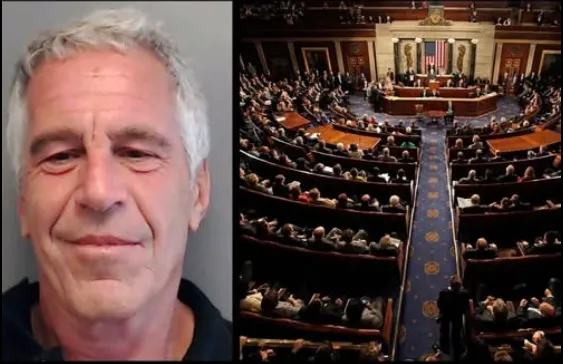
Newly released documents from Jeffrey Epstein’s estate show that the convicted sex offender exchanged text messages with a Democratic member of Congress during Michael Cohen’s February 2019 testimony, and that those messages may have influenced the congresswoman’s questioning of Cohen. The documents, published Wednesday by the House Oversight Committee, include copies of Epstein’s digital communications, emails, and text messages, The Washington Post reported.
In the texts, Epstein appeared to be watching the hearing in real time and notified the congresswoman — whose name was redacted in the documents — that Cohen had mentioned former Trump executive assistant Rhona Graff during his testimony.
At the time, Cohen was accusing Trump of racism, financial manipulation, and authorizing hush-money payments, allegations Trump denied.
Epstein texted, “Cohen brought up RONA – keeper of the secrets,” misspelling Graff’s name.
“RONA??” the lawmaker replied. “Quick I’m up next is that an acronym,” she wrote, indicating she was moments away from questioning Cohen.
The timestamps on the messages matched the live hearing feed, and the content indicated that the texting partner was Del. Stacey Plaskett of the U.S. Virgin Islands, who served as a member of the House Oversight Committee.
Plaskett declined to answer questions when reached by phone Thursday and referred inquiries to her staff.
Her chief of staff, Angeline Jabbar, said she was “not in a position to confirm or not” whether Plaskett was texting with Epstein and did not respond to follow-up questions
After the story was published Friday evening, Plaskett’s office issued a statement acknowledging she received messages from Epstein during the hearing.
“During the hearing, Congresswoman Plaskett received texts from staff, constituents and the public at large offering advice, support and in some cases partisan vitriol, including from Epstein,” the statement said.
It added that Plaskett “welcomes information that helps her get at the truth” and highlighted her record of combating sexual assault and human trafficking.
The documents show Epstein messaged Plaskett before the hearing began.
At 7:55 a.m. Eastern time, Plaskett texted Epstein, “He’ll talk about his grades.”
Epstein replied one minute later, “what privilege stands behind the none release of college transcripts?”
Throughout the morning, Epstein continued messaging Plaskett.
At 10:02 a.m., he texted, “Great outfit.”
At 10:22 a.m., he added, “You look great,” to which she replied, “Thanks!”
At approximately 10:40 a.m., the broadcast showed Plaskett moving her mouth as though chewing something.
At 10:41 a.m., Epstein texted, “Are you chewing.”
Plaskett responded, “Not any more. Chewing interior of my mouth. Bad habit from middle school.”
The messages continued throughout the hearing.
At 12:50 p.m., Epstein asked, “How much longer for you.”
“Hours. Go to other mtgs,” Plaskett replied.
Other messages indicate Epstein was offering input on lines of questioning.
At 12:25 p.m., Epstein wrote, “Hes opened the door to questions re who are the other henchmen at trump org.”
“Yup. Very aware and waiting my turn,” Plaskett responded.
When Plaskett questioned Cohen at 2:28 p.m., she asked about Trump associates Cohen had mentioned.
“So Allen Weisselberg is the chief financial officer in The Trump Organization,” Cohen began.
“You’ve got to quickly give us as many names as you can so we can get to them,” she interjected.
Plaskett’s line of questioning then turned to Graff, just as Epstein had flagged.
“Is Ms. Rhona, what is Ms. Rhona’s— …?” she asked.
Cohen replied, “Rhona Graff is the — Mr. Trump’s executive assistant … She was — her office is directly next to his, and she’s involved in a lot that went on.”
Epstein would not be charged with federal sex-trafficking crimes until July 2019, several months after the Cohen hearing, but he was already a known convicted sex offender following his 2008 plea agreement in Florida.
When Alexandria Ocasio-Cortez (AOC) took to Twitter calling Senator John Kennedy “dangerous,” “uneducated,” and someone who “needs to be silenced,” she probably thought it would be another round of online applause from her loyal followers.
She didn’t expect that Kennedy would take her words — every single one of them — and turn them into the most powerful moment of live television in months.
And by the time he was done, the entire room — and the entire Internet — had gone silent.
The tension started, as it often does in Washington, with a tweet.
AOC accused Kennedy of “pushing extremist ideas” and “using charm to disguise hate.” She ended the thread with a chilling line:
“People like him shouldn’t be heard — they should be silenced.”
Within minutes, the post had gone viral. Cable networks replayed it, social media divided into sides, and hashtags exploded across the platform.
But Kennedy didn’t respond online. He didn’t issue a press release, schedule an interview, or even tweet back.
He stayed quiet.
Until he didn’t.
A week later, Kennedy appeared at a nationally televised civic forum in Baton Rouge — a town hall meant to discuss free speech and civil discourse.
Reporters expected routine policy talk. What they got was something completely different.
Kennedy walked onstage carrying a small folder. He adjusted his glasses, opened the folder, and said calmly:
“I’d like to start tonight by reading something written by Congresswoman Ocasio-Cortez.”
The audience went still.
He unfolded the papers and began reading every word of AOC’s now-infamous thread.
“John Kennedy represents everything wrong with old America…”
“He hides behind charm and smiles while spreading ignorance…”
“Voices like his must be silenced before they poison progress.”
He read it all — slowly, clearly, without changing a single word.
No anger. No mockery. Just the unfiltered text, broadcast live on national television.
When he finished, Kennedy looked up from the page and said just seven words:
“That’s what freedom sounds like, folks.”
The crowd erupted.
Some stood. Some cried.
Even those who disagreed with him couldn’t deny the power of that moment.
Kennedy didn’t call for censorship. He didn’t ask for her to be punished. He simply demonstrated — through composure and principle — what it means to believe in the very freedom that allows critics to attack you.
Political strategists later called it “a masterclass in restraint.”
In an age where outrage fuels attention, Kennedy’s calm dismantling of AOC’s attempt to silence him became viral gold. Within hours, the clip dominated social media.
“He didn’t destroy her with insults,” one user wrote. “He destroyed her with patience and principle.”
Even some liberal commentators admitted the optics were devastating.
“He made her sound extreme without saying a word against her,” one political analyst said. “He weaponized her own tweets — and the Constitution — in real time.”
Kennedy’s follow-up remarks after reading the thread drew applause across the spectrum.
“I took an oath to protect the Constitution — not popularity,” he said. “And that includes protecting the right of people to call me names, to criticize me, even to try to silence me. But the moment we start deciding who gets to speak, we lose what makes America America.”
He paused, letting the weight of his words hang in the air.
“The First Amendment doesn’t exist to protect speech we like. It exists to protect speech we hate.”
It was the kind of reminder that cuts through partisanship — a line that instantly trended across every major platform.
In the hours that followed, reporters flooded AOC’s office for comment.
At first, there was none.
Then, late that night, a brief statement appeared on her social feed:
“Some people know how to perform. Others just pretend to serve.”
But by then, the tide had already turned.
The clip of Kennedy reading her tweets had been viewed over 20 million times within 24 hours. It was shared by veterans, pastors, teachers, and even some journalists who rarely praise conservative politicians.
It wasn’t about politics anymore.
It was about principle.
Social media exploded with reactions:
“This was the most respectful takedown I’ve ever seen.”
“He didn’t yell. He didn’t insult. He educated.”
“This is what leadership looks like.”
One veteran posted:
“I fought for the right of people to say dumb things. But I fought harder for the right of good men like Kennedy to answer them with truth.”
Within hours, #ThatsWhatFreedomSoundsLike was trending nationwide.
For Kennedy, it wasn’t a victory lap.
After the event, he was asked if he’d do it again.
He smiled slightly and said:
“Every time someone tries to silence another American, I’ll keep reading. Out loud. Until they remember why this country exists.”
He didn’t raise his voice once. He didn’t insult anyone. He simply lived the lesson he teaches: that courage is calm, and truth doesn’t need to shout.
In a time when division dominates headlines, that night in Baton Rouge felt like a reset — a moment when principle outshone politics.
Kennedy didn’t just defend his own name. He defended the right of every American to speak, to disagree, to stand — even when it’s unpopular.
And as the cameras faded, one line kept echoing in the minds of millions watching from home:
“That’s what freedom sounds like.”
Today, the folder Kennedy carried that night sits on his Senate desk. Inside are printouts of tweets, letters, and handwritten notes — some angry, some thankful, all free.
He calls it his “First Amendment file.”
“It’s a reminder,” he says, “that words are powerful — not because they can hurt, but because they can heal. And I’ll never stop reading them out loud.”
For once, Washington didn’t erupt in chaos.
It paused. It listened.
Because one man, armed only with paper, patience, and principle, turned noise into history — and proved that even in the loudest era in American politics, silence, truth, and freedom still have the last word.