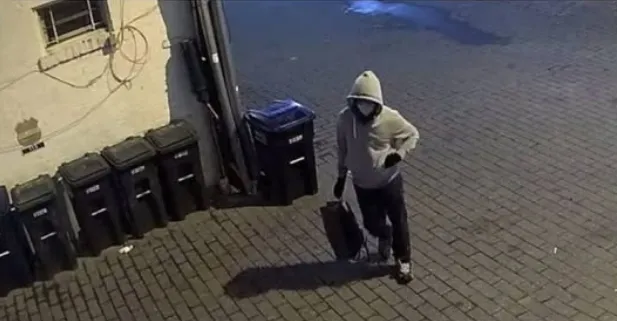
A new investigation from The Blaze has uncovered evidence that challenges the mainstream media narrative about the pipe bombs that were found in DC on January 6th, 2021. Forensic gait analysis comparing the movements of former U.S. Capitol Police officer Shauni Rae Kerkhoff to the still-unidentified pipe bomb suspect yielded a 94%–98% match, according to multiple intelligence sources who reviewed the results.
The analysis, which measures factors like knee flexion, hip extension, step length, and cadence, was confirmed by multiple intelligence sources.
“The software rated Shauni Kerkhoff’s gait at a 94% match to the pipe bomb suspect,” said the veteran analyst who conducted the study. “Based on my visual review, I’d personally estimate the match closer to 98%. The unique stride, the slight limp — it’s all there.”
Kerkhoff, a former member of the Capitol Police Civil Disturbance Unit, left the department in mid-2021 to work on security detail at the CIA. Her past injury — a broken tibia from a college soccer collision — left her with a permanent limp, a feature that the analysis flagged as nearly identical to the suspect’s.
Even more troubling are the claims of interference within the FBI itself. Former FBI Special Agent Kyle Seraphin told Blaze News, “The FBI put us one door away from the pipe bomber within days of January 6, and we were deliberately pulled away for no logical or logically investigative reason. And everything about that tells me that they were involved in a cover-up and have been since day one.”
“They were f***ing in on it,” Seraphin added bluntly
A source close to a congressional investigation also told Blaze News that “evidence has emerged recently that pointed toward law enforcement possibly being involved in the planting of the pipe bombs.”
Despite these revelations, the FBI continues to claim that it “has conducted all logical investigative steps and interviewed all logical individuals,” as Director Christopher Wray testified before Congress. But after nearly five years, the bureau has yet to identify the suspect. Even though, as Blaze News revealed, agents were “feet from the Falls Church address of the pipe bomb suspect days after Jan. 6.”
Former Capitol Police Chief Steven Sund said he was unaware of any officer involvement, telling Blaze News, “I had no knowledge that it was being carried out, nor were they carrying it out with any authorization from the chief’s office. I’m unaware of any legitimate reason that any Capitol Police or other law enforcement officer would be involved in the planting of those pipe bombs.”
“The prospect of a Capitol Police officer being the perpetrator, if confirmed,” the report concluded, “could recast the entire story of Jan. 6. It could start to unravel the carefully crafted, zealously defended Democrat narrative that massive crowds of Trump supporters stormed the Capitol as part of an insurrection.”
New York Governor Kathy Hochul delivered a sharp rebuke to newly elected Mayor Zohran Mamdani’s economic platform on Tuesday, signaling a major rift within the state’s Democratic ranks. In remarks that drew wide attention, Hochul dismissed the possibility of raising taxes to fund Mamdani’s expansive social agenda, effectively halting key parts of his “tax-and-spend” proposals before they could gain traction.
Speaking during a press conference in Albany, Hochul made her position unmistakably clear. “I’m the one putting money back in people’s pockets,” she said. “I won’t raise taxes. I know how to govern, and I know how to do this.” Her comments come as Mamdani begins his term as New York City’s first openly socialist mayor, after campaigning on a promise to expand public services and social programs through new taxes on high-income earners and corporations.
The governor’s statement represents a significant political obstacle for Mamdani, whose proposed policies rely heavily on state-level cooperation and funding approvals. While the new mayor has championed measures such as universal childcare, expanded public housing, and free public transit, Hochul’s categorical rejection of new tax hikes could severely limit his ability to finance such initiatives.
Political analysts immediately described Hochul’s remarks as a strategic move to assert fiscal authority and distance her administration from the more progressive elements of the party. In recent months, the governor has positioned herself as a moderate Democrat focused on economic stability, job growth, and cost-of-living relief — priorities she believes resonate with a broader base of voters across New York State.
The tension between Hochul and Mamdani highlights the ideological divide currently shaping Democratic politics, particularly in New York. Mamdani, who represents a younger, activist wing of the party, argues that aggressive public investment is necessary to address inequality, housing shortages, and climate change. Hochul, by contrast, has cautioned against policies she views as fiscally unsustainable or politically polarizing.
For the governor, the issue is not only economic but symbolic — a statement about pragmatic governance in an era of rising populism on both the left and right. “We can help people without breaking the bank,” one Hochul aide told reporters after her comments drew national attention. “The governor believes in affordability, not ideology.” That message, insiders say, is likely to guide her approach to the city’s new leadership in the months ahead.
As Mamdani’s administration gets underway, the clash between the state’s progressive and centrist wings may define the next chapter of New York politics. Supporters of the mayor see an opportunity to push long-delayed reforms; skeptics warn that his ambitions could run aground against fiscal and political limits. For now, Hochul’s words have sent a clear signal: when it comes to the balance between vision and realism, the governor intends to draw the line herself.