
This article may contain commentary
which reflects the author’s opinion.
The wheels are coming off the socialist bus.
New York Gov. Kathy Hochul is tapping the brakes on Mayor-elect Zohran Mamdani’s $700 million plan for free city buses, casting early doubt on one of the far-left lawmaker’s biggest campaign promises, The New York Post reported.
Speaking at the SOMOS political retreat in Puerto Rico on Saturday, Hochul said she’s already spent heavily to support the city’s struggling MTA and questioned how much further the state could go.
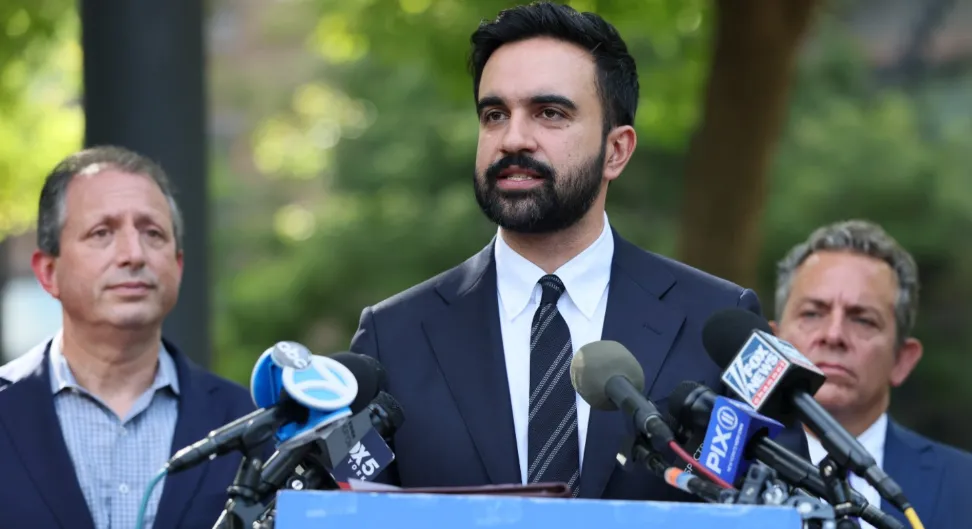
“I continue to be excited at the work of making the slowest buses in America fast and free,” Mamdani said Monday during an unrelated press conference. “And I appreciate the governor’s continued partnership in delivering on that agenda of affordability.”
But Hochul’s comments in San Juan marked the latest break between the moderate Democratic governor and Mamdani, the Democratic socialist she endorsed just two months ago.
Hochul happily rode Mamdani’s coattails during the campaign as he energized progressives with promises of affordability and social programs, but she has shown far less enthusiasm for actually paying for them.
The governor has rejected several of Mamdani’s cornerstone ideas, including proposals to raise taxes on wealthy New Yorkers to fund $10 billion in new benefits like free child care and fareless transit.
Her caution could create a serious roadblock for the incoming mayor, whose ambitious plans rely on support from Albany to move forward.
The top two Democratic leaders in the state Legislature — Assembly Speaker Carl Heastie and Senate Majority Leader Andrea Stewart-Cousins — have signaled more willingness to help Mamdani pursue his agenda.
That divide leaves Hochul increasingly isolated from the party’s energized left flank, which has been openly pressuring her to embrace higher taxes on the rich.
During recent public appearances, activists have twice interrupted the governor with chants of “Tax the rich,” drawing a sharp rebuke.
“The more you push me, the more I’m not going to do what you want,” Hochul told the SOMOS crowd in response.
Still, Hochul did not fully reject Mamdani’s wish list.
She said she’s open to working with him on expanding free child care, though she made clear it would be an expensive and long-term goal.
“We’ll be on a path to get there, because I’m committed to this as ‘mom governor’ — I get it,” Hochul said.
“But also to do it statewide, right now, it’s about $15 billion — the entire amount of my reserves.”
The cautious tone was a reality check for Mamdani, who has portrayed himself as the champion of “everyday New Yorkers” and promised to make the city more affordable through massive new public spending.
Hochul’s remarks also came as she continues her own political maneuvering ahead of a likely 2026 re-election bid.
After the SOMOS conference, she flew to the Dominican Republic to attend a breakfast celebrating cross-cultural exchange — an event seen as an appeal to one of New York’s largest and most influential immigrant voting blocs.
Hundreds of thousands of New Yorkers trace family roots to the Dominican Republic, making the outreach a politically savvy move for a governor seeking to rebuild her base while keeping the party’s left wing at arm’s length.
Whether Hochul and Mamdani can maintain their uneasy alliance may determine not only the future of free buses and child care, but also the balance of power within the New York Democratic Party.
The response from the United Kingdom was swift and pointed. British veterans and military figures condemned Vance’s comments, highlighting the 636 British soldiers who lost their lives in Iraq and Afghanistan.
Prominent veterans, including Johnny Mercer and Andy McNab, criticized Vance for his perceived lack of respect toward allied forces.
Former military leaders, such as Lord West and General Sir Patrick Sanders, also expressed their disapproval, emphasizing the deep bonds and shared sacrifices between the UK and the U.S.
Political leaders in the UK echoed these sentiments. Shadow Defense Secretary James Cartlidge underscored Britain’s substantial military contributions and called Vance’s remarks “deeply disrespectful.
” Former Foreign Secretary James Cleverly and other MPs joined in the criticism, urging Vance to acknowledge the shared history and sacrifices of British and American forces.
Prime Minister Keir Starmer reiterated the nation’s pride in its military’s past sacrifices and emphasized the importance of mutual respect among allies.
In response to the mounting criticism, Vice President Vance attempted to clarify his statements. He asserted that his comments were not specifically
directed at the UK or France but rather at countries lacking recent battlefield experience. Despite this clarification, the controversy has sparked a broader
discussion about the necessity of diplomatic sensitivity, especially when addressing the contributions of longstanding allies.
Former President George W. Bush recently made headlines when he stepped up to throw the ceremonial first pitch at the World Series opener. However, there was a surprising turn of events. His daughter, Jenna Bush Hager, shared some insights into what happened, revealing that her father had undergone back surgery earlier in the year.
She explained that when he threw the pitch, instead of going straight, it curved. This raised concerns that he might have injured himself due to the surgery.
Jenna Bush Hager elaborated on the situation, expressing concern for her father’s well-being. She mentioned that the surgery was likely a contributing factor to the unexpected outcome of the pitch. Despite the setback, she emphasized that her father is a resilient individual who is determined to overcome any challenges he faces.
A spokesperson for President Bush later confirmed the details of his back surgery, stating, “President Bush isn’t one to make excuses, but that’s true — he did have fusion surgery on his lower back early this year.”
This statement affirmed the authenticity of Jenna Bush Hager’s remarks and provided further context to the situation. The spokesperson also reassured the public that despite the surgery, President Bush is on the path to recovery.
Despite facing health challenges, President Bush’s determination to fulfill his ceremonial duties demonstrates his commitment to public service and resilience in the face of adversity.
The man who raised me wasn’t my father. He was a grease-stained mechanic named Big Mike, a six-foot-four biker with a beard down to his chest, arms covered in military tattoos, and a laugh that shook walls. Most people would’ve called the cops when they found a runaway kid sleeping in their dumpster, stealing crusts of leftover sandwiches.
Mike didn’t. At five in the morning, he opened the shop door, saw me curled up between garbage bags, and said five words that changed my life: “You hungry, kid? Come inside.”
That was twenty-three years ago.
Today I stand in a courtroom wearing a tailored three-piece suit, watching the city try to shut down his motorcycle shop—calling it a menace, a “blight” on the neighborhood. What they don’t know is that their opposing lawyer—the one fighting to keep the shop alive—is the same runaway kid Mike pulled out of the trash.
I was fourteen when I ended up at Big Mike’s Custom Cycles. My fourth foster home had turned into a nightmare—wandering hands from the dad, silence from the mom. I bolted and lived rough for weeks, sleeping under bridges, eating from dumpsters, dodging cops who would’ve just thrown me back into the system. That’s how I wound up behind his shop, trying not to starve to death.
Mike didn’t ask questions. He didn’t call social services. He handed me a broom, let me sweep floors, and “accidentally” left the back room unlocked at night so I had a cot. At the end of each day, he gave me twenty bucks and a hot meal.
The other bikers noticed the skinny kid hanging around. They could’ve been terrifying—tattoos, leather vests, bikes that roared like thunder—but instead they became my teachers.
Snake taught me algebra using engine measurements. Preacher made me read out loud while he worked, correcting every mistake. Bear’s wife quietly brought me bags of clothes her son had “outgrown,” though they fit me perfectly.
Six months later, Mike finally asked, “You got somewhere else to be, kid?”
“No, sir.”
“Then you better keep that room clean. Health inspector doesn’t like mess.”
Just like that, I had a home.
He wasn’t soft about it. Mike laid down rules. School was mandatory—he drove me there every morning on his Harley, ignoring the stares from other parents. I had to work in the shop after class, learning how to fix things “because every man needs to know how to use his hands.” I had to show up at Sunday dinners in the clubhouse, where thirty bikers quizzed me on homework and threatened to kick my ass if my grades slipped.
“You’re smart,” Mike told me one night after catching me reading one of his legal documents. “Scary smart. You could be something more than a grease monkey like me.”
“Nothing wrong with being like you,” I said.
He ruffled my hair. “Appreciate that. But you got potential. We’re gonna make sure you use it.”
The club pooled money to pay for my SAT prep. When I got into college on a scholarship, they threw a party that shook the block. Mike cried, though he blamed it on engine fumes.
College was another world. Kids with trust funds and summer homes had no idea what to make of the boy who got dropped off by a motorcycle gang. I stopped talking about Mike, stopped mentioning home. When asked about my family, I lied and said my parents were dead.
Law school was worse. Everyone had connections, parents in firms, family money. I mumbled about “blue-collar work” and left it at that. Mike showed up to my graduation in a new suit and motorcycle boots. I introduced him as a “family friend.” He never said a word about it. He just hugged me, told me he was proud, and rode eight hours home alone.
I got a job at a top firm and buried myself in work. Calls from the shop went unanswered. I convinced myself I was building a respectable life. Then, three months ago, Mike called.
“Not asking for me,” he said. That was always how he asked for help. “But the city wants to shut us down. Callin’ us a blight. Sayin’ we’re draggin’ down property values. They want to force me out.”
He couldn’t afford a good lawyer. I should’ve offered on the spot. Instead, I hesitated, afraid my colleagues would find out about my past.
It wasn’t until my paralegal, Jenny, caught me crying at my desk that I admitted the truth. I showed her a photo Snake had sent me—Mike sitting on the steps of his shop with a “CONDEMNED” notice on the door. “That’s the man who raised me. And I’m too much of a coward to help him.”
She looked at me with disgust. “Then you’re not the man I thought you were.”
That night, still in my suit, I drove five hours to the clubhouse. Thirty bikers sat around a table, trying to pool money for a lawyer. I stepped inside. “I’ll take the case.”
Mike’s eyes were red. “Can’t pay you what you’re worth, son.”
“You already did,” I said. “Twenty-three years ago.”
The trial was brutal. The city painted the shop as a gang den. They paraded residents who said they felt “unsafe,” though they’d never spoken to Mike.
But I had something better: the truth.
I brought in the kids Mike had helped—now grown doctors, teachers, mechanics, social workers. I showed records of toy drives, veteran support rides, neighborhood repairs. I put Mike on the stand, where he admitted to giving food and shelter to runaway kids.
“That’s kidnapping,” the prosecutor accused.
“That’s kindness,” Mike replied.
“And where are those kids now?”
Mike’s eyes went to me. “One of them is standing right there, Your Honor. My son.”
The courtroom froze. I stood. “Yes. I was a runaway. Abused, homeless, eating out of dumpsters. Mike Mitchell saved my life. If his shop is a blight, then maybe we need to redefine community.”
The judge ruled in our favor. Big Mike’s Custom Cycles stayed.
That night, at the clubhouse, I admitted what I’d hidden for years. “My name is David Mitchell. I’m a senior partner at Brennan, Carter & Associates. And I’m the son of a biker. Raised by bikers. Proud to be part of this family.”
The roar nearly lifted the roof.
Now, every Sunday, I ride down to the shop. Mike’s older, his hands shake, but he still opens at 5 AM, still checks the dumpster. Just last week, we found another kid. Fifteen, scared, hungry. Mike handed him a sandwich and a wrench.
“Know how to use this?” he asked.
The boy shook his head.
“Want to learn?”
And so it begins again.
I’m David Mitchell. Lawyer. Son of a biker. And I’ve never been prouder of where I came from.