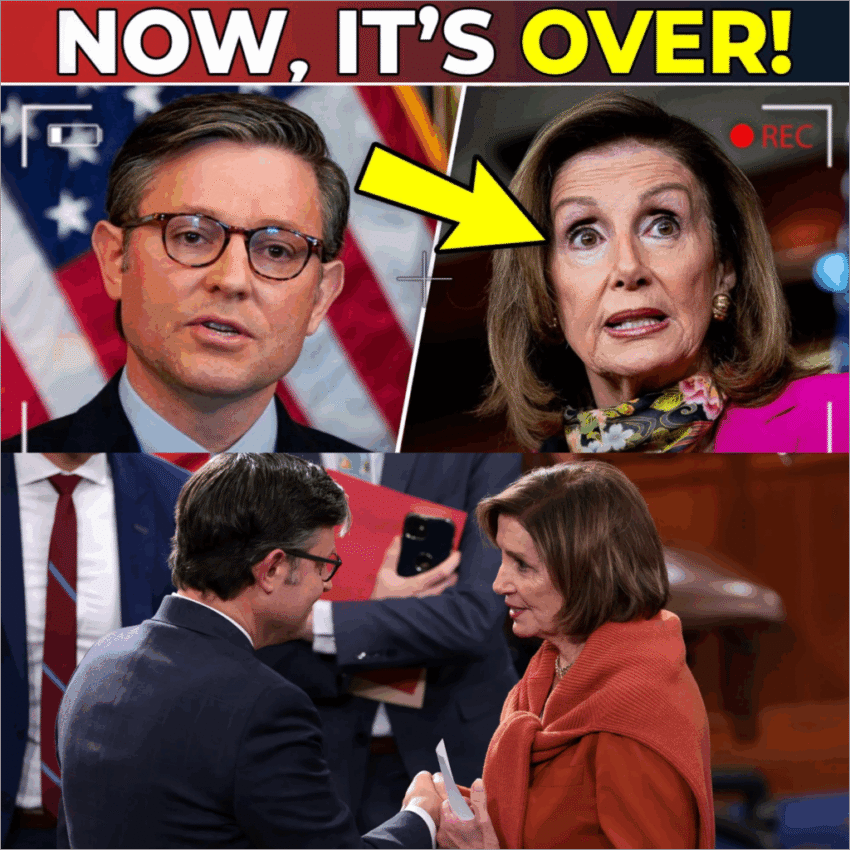
Mike Johnson TURNS THE TABLES on Pelosi’s Democrats After Explosive House Showdown
Mike Johnson Blunts Democratic Fury, Turns Tables with Nancy Pelosi’s Own Precedent in Explosive House Showdown
WASHINGTON, D.C.
– Speaker of the House Mike Johnson delivered a calm yet cutting rebuttal to Democratic outrage this week, effectively silencing critics who had accused him of political obstruction for delaying the swearing-in of a newly elected Democratic representative. Johnson’s move, executed without the bombast typical of Washington’s political sparring, relied entirely on the procedural precedent previously established and defended by former Speaker
The confrontation arises amid a continuing government shutdown (referenced in the video as entering its third consecutive week), with Democrats accusing Johnson of deliberately undermining democracy by preventing the newly elected representative,
The Core Dispute: A Seat in Session
The controversy centers on the timing of administering the oath of office to a member-elect who won a special election to fill a vacant seat.
Rep. Grijalva won her race in late September, after the House had already entered a recess and was not in legislative session. Democrats, including the Arizona Attorney General, threatened lawsuits and launched a media campaign alleging that Johnson was unilaterally blocking the representative from serving her constituents.
Johnson’s response was direct, pointing out that the House has historically only administered the oath when it is formally in session—a rule strictly adhered to by his predecessor, Nancy Pelosi.
“I will administer the oath to her. I hope on the first day we come back in legislative session. I’m willing and anxious to do that,” Johnson stated, adding that the Democrats’ outrage was simply a manufactured crisis for “national publicity.”
Citing the Pelosi Precedent: Democrats’ Double Standard
The most effective part of Johnson’s defense was his meticulous recollection of precedents set by the Democratic leadership. He provided concrete examples where Speaker Pelosi employed the exact same delay tactics:
Julia Letlow (Republican): Johnson pointed out that following Julia Letlow’s election to fill her deceased husband’s seat, Speaker Pelosi took 25 days to administer the oath of office.Pat Ryan and Joe Sempolinski (Democrats):
Johnson cited another instance where two representatives were elected during an August recess, and the Democratic leadership waited 21 days to administer their oaths because the House was not in session.
“Following the Pelosi precedent,” Johnson asserted, highlighting the selective outrage from the Democratic party. “The chronology is important.”
The argument immediately exposed a double standard. When Pelosi’s Democratic majority used the rule, it was considered “strategic” or “smart.” Now that Republicans are enforcing the same long-standing procedural rule, the media and Democrats are spinning it as “authoritarian” and “the end of the world.”
The Chaos and the Cover-Up: Democrats’ Role in the Shutdown
Johnson used the controversy as an opportunity to pivot and lay the blame for the continuing government chaos squarely at the feet of the Democrats. He argued that the Democrats were “playing political games” while the country suffered.
Instead of engaging in “TikTok videos,” Johnson suggested, the representative-elect should be serving her constituents by “taking their calls” and “directing them, trying to help them through the crisis that the Democrats have created by
He then revealed a crucial tidbit of information regarding the representative-elect’s inability to access resources:
Lack of Guidance: Johnson noted that the representative-elect’s party leaders in the House are responsible for reaching out and providing guidance on setting up her office.
“The person who runs that office in the Chief Administrative Office is on furlough because they voted to shut the government down,” Johnson said.
This revelation turned the criticism on its head: the representative-elect’s office difficulties were not due to Johnson’s malice, but a direct consequence of the Democrats’ own votes to shut down federal operations.
Signalling a New Era: Fighting Double Standards
Johnson’s move is seen by many Republicans as a clear signal that the era of Republicans caving to Democratic procedural maneuvers is over. For years, as Johnson and others noted, Democrats “weaponized every procedural loophole” and procedure, from impeachment theatrics to selective committee removals, against Republicans.
Johnson is effectively adopting a “hit me, I hit you back” mentality, demonstrating that Republicans will now enforce the same rules and precedents that Democrats used during their time in power.
“Now that the House Speaker, the new House Speaker is using one small aspect of what they did to Republicans, now it’s not fair,” the host summarized. “It’s really pathetic, isn’t it?”
Johnson’s underlying message to the Democratic party remains: If Democrats want cooperation, they need to start respecting the same rules they used for their political gain on Republicans. Until the government reopens, Johnson is refusing to bend the knee to the pressure, demonstrating a new willingness to stand firm against political maneuvering.
.https://www.youtube.com/watch?v=Z7oTpWRTv5Q&t=18s
It started with a simple question.
It ended with one of the most heated exchanges to come out of Capitol Hill this year.
By Tuesday afternoon, the marble corridors outside the House chamber had fallen into a tense quiet — except for the echo of raised voices coming from a corner where a camera light burned hot against the walls. There, under the dome of the U.S. Capitol, Rep. Maxine Waters stood face-to-face with a reporter — her tone sharp, her patience thinning, her party’s talking points unraveling.
The question had been clear, simple, even clinical:
“Do Democrats want to prioritize the healthcare of illegal aliens over a government shutdown?”
But the answer, and what came after, set off a political storm that Washington is still reeling from.
The United States government was once again standing on the brink of a shutdown.
Midnight loomed. Negotiations were stalling.
And the nation’s attention had shifted from the legislative details to the ideological clash driving them.
On one side stood Republicans, led by President Donald Trump and Vice President J.D. Vance, insisting that keeping the government open required a “clean bill” — a short-term funding extension through November 21 that would maintain current spending levels and avoid new add-ons.
On the other were Democrats, whose leadership — from Senate Minority Leader Chuck Schumer to House progressive caucus members — refused to sign off on a bill that didn’t expand healthcare access to everyone in the country, regardless of immigration status.
The issue wasn’t new.
For months, Democrats had been pushing for permanent funding of Affordable Care Act tax credits, a move that would, for the first time, extend federally subsidized healthcare to certain non-citizens.
Republicans balked, calling it reckless.
Democrats framed it as compassionate.
But what was supposed to be a technical policy disagreement over federal health subsidies soon turned into a cultural and political brawl — one that came to a head the moment Maxine Waters stopped walking and turned toward a microphone.
It happened in a flash.
A camera crew from Lindell TV, led by reporter Alison Steinberg, approached Waters as she left a closed-door caucus meeting.
The 86-year-old California Democrat, known for her firebrand speeches and confrontational style, has never shied away from reporters — but that day, her mood seemed brittle.
Steinberg wasted no time.
“Do Democrats want to prioritize the health care of illegal aliens over a government shutdown?” she asked.
At first, Waters brushed it off. Her staff shifted uneasily. She smiled tightly, the kind of smile politicians wear when they’re deciding whether to walk away. But then, perhaps unwilling to appear evasive, she stopped — and answered.
“Democrats are demanding healthcare for everybody,” Waters said.
“We want to save lives. We want to make sure that healthcare is available to those who would die but having the help of their government.”
The phrasing wasn’t what her communications team would have scripted.
In that single moment, the California congresswoman had tacitly confirmed what Republicans had been alleging for weeks — that Democrats were, indeed, pushing to include healthcare for undocumented immigrants in the budget negotiations.
The reporter pressed her again.
“So, are Democrats demanding healthcare for illegal aliens?”
Waters sighed audibly, her voice rising.
“We are demanding healthcare for everybody.”
The crowd of reporters shifted closer.
Flashes went off.
And that’s when Waters’ patience snapped.
“What you’re trying to do,” she said, pointing at Steinberg, “is you’re standing here and you’re trying to make me say that somehow we’re going to put non-citizens over Americans. Quit it. Stop it. This is the kind of journalism we don’t need. You’re divisive.”
Her aides moved in, guiding her toward the elevator.
The exchange, barely ninety seconds long, was instantly clipped, captioned, and uploaded — spreading online faster than the lawmakers inside could finalize a vote.
Within an hour, the clip had gone viral.
The title — “Maxine Waters Loses It” — trended on X, Truth Social, and YouTube.
Conservatives celebrated it as a “mask-off moment.” Progressives called it “selective editing.”
But to millions of Americans watching online, the confrontation captured a much larger debate:
Who deserves government-funded healthcare — and who doesn’t?
Republican lawmakers immediately seized on the moment.
Rep. Marjorie Taylor Greene reposted the video with the caption:
“There it is. Democrats want to shut down your government to give illegal immigrants free healthcare.”
House Speaker Mike Johnson echoed the sentiment hours later, calling the comments “proof that Democrats have abandoned working Americans.”
Even moderate Democrats privately admitted to reporters that Waters’ remark complicated their messaging at a critical moment.
“She said the quiet part out loud,” one senior aide to a Senate Democrat admitted off-record. “We’re losing the optics war.”
Behind the scenes, the budget talks were collapsing.
Democrats, led by Hakeem Jeffries and Chuck Schumer, had refused to endorse the House-passed continuing resolution — a “clean CR” that would have kept the lights on until Thanksgiving without touching healthcare policy.
Instead, they insisted that any deal include a permanent renewal of Affordable Care Act subsidies — a move that budget analysts said would effectively extend coverage to millions of non-citizens.
Vice President J.D. Vance blasted the proposal as “absurd,” saying Democrats wanted to spend “hundreds of billions of dollars” to provide care for “people who broke the law to get here.”
“That was their initial foray into this negotiation,” Vance told reporters. “We thought it was absurd. The American people are struggling to pay their healthcare bills, and Democrats are talking about paying for everyone else’s too.”
Three Senate Democrats — Catherine Cortez Masto, John Fetterman, and Angus King — broke ranks and voted with Republicans to support the GOP funding bill.
But the measure still failed, falling five votes short of the 60 required to pass.
With that, the clock struck midnight.
And the federal government entered shutdown mode.
By sunrise, federal workers were waking up to uncertainty — paychecks frozen, programs suspended, and services paused.
But inside the Beltway, all eyes remained on one person: Maxine Waters.
Her confrontation had become the face of the crisis — a symbol of everything critics say has gone wrong with Washington.
Conservative commentators called it “a moment of honesty.”
Liberal columnists defended it as “compassionate clarity.”
But even some longtime Democrats whispered that the optics were disastrous.
“If you’re trying to win back working-class voters in Michigan or Pennsylvania,” one party strategist said, “the last message you want out there is ‘Democrats will shut down the government to fund healthcare for illegal immigrants.’”
Meanwhile, Trump’s team wasted no time capitalizing on the chaos.
In a statement from the White House press office, Karoline Leavitt accused Democrats of “putting politics above people” and warned that “mass layoffs” could follow if the shutdown dragged on.
“The president is giving Democrat leadership one last chance to be reasonable,” she said. “Now is not the time for political points. It’s time to keep the government open.”
But if Maxine Waters felt any regret, she didn’t show it.
Hours later, she appeared on MSNBC, brushing off the viral confrontation as “right-wing spin.”
“I was not angry,” she said. “I was passionate about making sure that healthcare is treated as a human right. That includes everyone — because diseases don’t ask for your passport.”
The statement only deepened the divide.
Republicans accused her of walking back the truth. Progressives applauded her courage.
And outside the Capitol, protesters from both sides gathered — some waving American flags, others holding banners reading “Healthcare Has No Borders.”
Lost in the shouting match was the human side of the debate — the millions of Americans whose healthcare premiums have climbed steadily over the last decade, the undocumented workers showing up in emergency rooms without insurance, the hospitals drowning under the cost.
The United States spends nearly $4.5 trillion a year on healthcare — more than any other country in the world — yet tens of millions remain uninsured.
Democrats argue that excluding undocumented immigrants from healthcare coverage creates both moral and medical crises. Republicans counter that taxpayers cannot shoulder the cost of non-citizens while middle-class families go broke trying to afford basic care.
The truth, economists say, is that both sides have a point.
But nuance doesn’t trend online.
And by Wednesday morning, what had begun as a serious fiscal debate had devolved into partisan war — each side replaying the same ninety-second clip as proof of their case.
Behind closed doors, frustration simmered among Democrats.
While progressives celebrated Waters’ candor, moderates saw it as a political nightmare.
“It’s not that she was wrong,” one Democratic staffer told Politico. “It’s that she said it in a hallway, in front of cameras, during a shutdown standoff. Timing is everything.”
A Democratic senator from the Midwest put it more bluntly:
“We just handed Trump a campaign ad.”
Indeed, within 24 hours, a Trump campaign super-PAC released a 30-second commercial showing Waters’ outburst juxtaposed with images of shuttered federal offices and unpaid workers — overlaid with the caption:
“Democrats: For Illegals, Not for You.”
In a press briefing that same day, President Trump hammered his opponents with characteristic bluntness.
“You can’t shut down the government because you want to give free healthcare to people who aren’t even supposed to be here,” he said. “That’s not compassion — that’s insanity.”
Standing beside him, Vice President Vance framed the issue as a defining choice for voters.
“This is the Democrats’ hill to die on,” he said. “Ours is keeping the lights on and putting Americans first.”
The crowd of reporters murmured as Trump added:
“They talk about saving lives — but what about the Americans losing theirs because they can’t afford a doctor or a hospital bill? We’re going to fix that. But we’re not going to bankrupt this country doing it.”
By the week’s end, the government remained shut down, negotiations were deadlocked, and Maxine Waters’ name was still trending online.
To her supporters, she had spoken with moral clarity — a woman unafraid to tell uncomfortable truths about compassion in an age of division.
To her critics, she had exposed the Democratic Party’s misplaced priorities — putting ideology above the nation’s stability.
But one thing was undeniable:
A ninety-second conversation in a Capitol hallway had reshaped the political landscape — forcing Democrats to defend, Republicans to attack, and ordinary Americans to wonder who, if anyone, was fighting for them.
In the coming weeks, as Congress scrambles once again to fund the government, the echoes of that confrontation will still linger:
“Do Democrats want to prioritize the healthcare of illegal aliens over a government shutdown?”
It was a question meant to provoke.
Instead, it may have revealed more about Washington — and its broken politics — than any budget ever could.