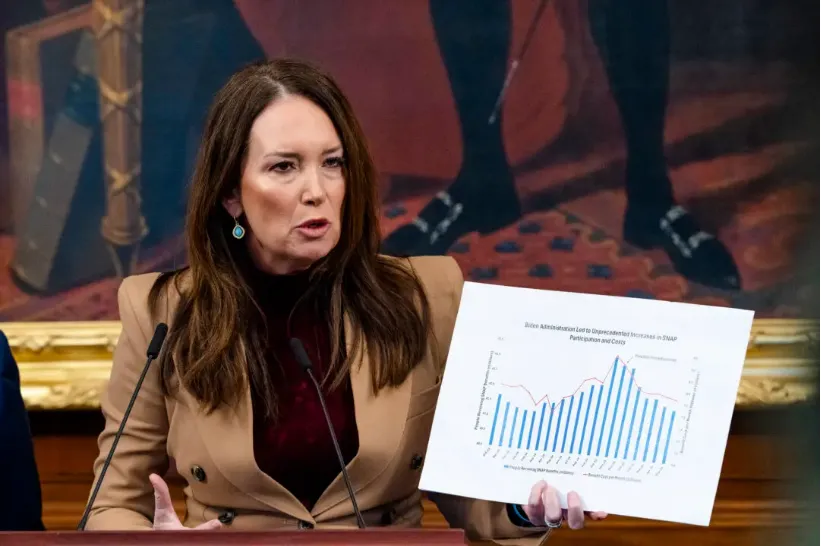
Brooke Rollins, agriculture secretary under the renewed Trump vision for America, dropped a bombshell on the American public. She exposed a rot within the federal welfare system that not only drains taxpayer dollars but also emboldens corruption and inefficiency. Rollins revealed in an interview that nearly 5,000 dead individuals were still receiving SNAP benefits and that over 500,000 instances of duplicate enrollees had been uncovered.This isn’t just a bureaucratic blunder. This is emblematic of a broken system that Democrats have allowed to fester, enabling abuse at the expense of working Americans. For decades, the left has wrapped welfare in the warm language of compassion, but what Rollins reveals is a scheme benefiting fraudsters, illegals, and career welfare recipients while punishing the responsible and the honest.
“We found one guy receiving benefits in six different states,” Rollins said. This is not just anecdotal. It’s systemic. It’s widespread. And it’s been protected by blue states that refused to cooperate with federal investigations into their welfare rolls.
Rollins’ testimony reinforces what conservatives have warned for years: that the Democratic Party is less interested in accountability and more invested in creating a permanent dependent class that can be controlled and harvested for votes.
This revelation confirms what President Trump emphasized during both his terms and campaign trail speeches: America must put its citizens first, and part of that is cleaning up fraud and prioritizing the deserving over the deceitful.
Under Rollins’ leadership, nearly 700,000 individuals have already been removed from the rolls. But the job is far from over. Democrat-led states have refused to share eligibility data and have filed lawsuits to block investigations. What are they hiding?
It’s no surprise that the Biden administration resisted such reforms. While Rollins and Trump aimed to safeguard the public trust and restore fiscal integrity, the Biden camp seems committed to open-handed spending with little oversight.
The mainstream media barely blinked at Rollins’ revelation. Had a Trump official been caught enabling such fraud, the outcry would be deafening. But when Democrats are the culprits, silence prevails.
The question Americans must ask is simple: Why is the left so afraid of transparency? Why do they fight to keep dead people on welfare and illegals on the dole?
Every fraudulent SNAP card represents dollars stolen from hard-working Americans. It means fewer resources for truly needy citizens. And it means a culture of dependency is being fostered, not the self-reliance and dignity that America First policies promote.
Rollins framed this as a national security issue as well, with illegal immigrants potentially benefitting from these systems through fraudulent documentation. This is not just an economic drain; it’s an attack on national sovereignty.
President Trump has long called for E-Verify, biometric ID, and strict eligibility rules for any federal assistance. His policies, backed by data like Rollins presented, are the only viable path forward.
What this country needs is a full audit of every entitlement program. The rot is deeper than SNAP. If dead people can draw food assistance, who else is bleeding the system dry?
The welfare state must be rebuilt from the ground up. And the only party willing to do that is the one led by Trump.
Blue states are terrified of what audits might reveal: networks of fraud, collusion, and incompetence that date back decades. They would rather sue than comply because exposure would cost them power.
This is a wake-up call to every Republican governor and lawmaker. The time for polite requests is over. Subpoenas and legislation must compel compliance. Any official obstructing this mission is complicit in theft.
Brooke Rollins has done more than expose fraud. She has given patriots the ammunition to demand change. The GOP must seize this moment.
Taxpayers must understand that the stakes are high. Every dollar wasted on a dead man’s EBT card is a dollar not spent securing the border, rebuilding infrastructure, or helping our veterans.
In the soft, sorrowful glow of a Charlotte sunset, where the Queen City’s skyline pierces the sky like jagged memories and the air carries the faint scent of magnolias mingled with fresh-dug earth, a small gathering huddled around a freshly turned grave on September 8, 2025. It was the funeral of Iryna Zarutska, the 23-year-old Ukrainian refugee whose life—once a beacon of hope amid war’s wreckage—had been snuffed out in a senseless stab of violence just weeks earlier. Friends clutched tissues, neighbors bowed heads in silent prayer, and Iryna’s mother, Olena, stood trembling beside the casket, her hand resting on its polished wood as if willing her daughter back to life. But one voice was missing from the eulogies, one face absent from the front row: Iryna’s father, Viktor, trapped thousands of miles away in the besieged heart of Ukraine, his plea echoing across oceans like a ghost’s lament—”Please bring her back to me.” In a story already laced with tragedy, this paternal heartbreak—fueled by Russia’s unyielding grip on its men of fighting age—transforms a daughter’s untimely death into a profound emblem of exile, loss, and the cruel ironies of a world at war.
Iryna Zarutska’s odyssey from the rubble-strewn streets of Kyiv to the bustling pizza kitchens of North Carolina was a testament to the unquenchable human spirit, a young woman’s defiant dance with destiny that ended far too soon. Born in 2002 in Ukraine’s vibrant capital, Iryna grew up in a modest apartment overlooking the Dnipro River, her childhood a mosaic of fairy tales, folk dances, and the distant rumble of thunder that would one day become artillery fire. A prodigy with a paintbrush, she graduated from Synergy College with a degree in art and restoration, her canvases alive with swirling abstracts that captured the chaos and color of her homeland. “She saw beauty in the broken,” her uncle, Mykola, would later say, his voice thick with pride and pain. Animals were her quiet confidantes—stray cats fed from her windowsill, neighbors’ dogs walked with her gentle hand—and her dreams? To become a veterinary assistant, healing the wounded in a world that seemed determined to inflict them.
But dreams deferred became nightmares realized in February 2022, when Russia’s full-scale invasion shattered Ukraine’s fragile peace. Explosions rocked Kyiv’s nights, air raid sirens wailed like banshees, and Iryna’s family—mother Olena, sister Sofia (18), brother Dmytro (15), and father Viktor—huddled in a bomb shelter beneath their building, the ground trembling with each incoming missile. Viktor, a 48-year-old mechanic with grease-stained hands and a heart as steadfast as the Black Sea cliffs, was the family’s anchor. “He fixed everything—cars, fears, us,” Olena recounted in a tearful video call from Charlotte. But as conscription loomed, the government’s decree barring men aged 18 to 60 from leaving the country became Viktor’s invisible chain. “Go,” he urged, shoving passports into Olena’s hands one frantic dawn. “Take the children. I’ll hold the line here.” With hearts heavier than their hastily packed suitcases, Olena, Iryna, Sofia, and Dmytro boarded a refugee train westward, the screech of wheels a requiem for the life they left behind. Viktor watched them vanish into the smoke, his final embrace a promise: “I’ll see you soon. Be strong, my dove.”
America beckoned as a sanctuary, and Charlotte, with its welcoming refugee programs and Southern warmth, became their harbor. Sponsored by a local Ukrainian Orthodox church, the family settled in a modest duplex in the Plaza Midwood neighborhood, its walls soon adorned with Iryna’s vibrant sketches—sunflowers defying concrete, blue-and-yellow flags woven into abstract dreams. Olena found work as a seamstress, stitching uniforms for a local hospital; the younger siblings enrolled in English classes at the International House, their accents softening like spring thaw. But Iryna? She bloomed. Enrolling at Rowan-Cabarrus Community College in 2023, she juggled art electives with shifts at Bella Napoli Pizzeria in trendy NoDa, where her dough-tossing flair and infectious laugh earned her quick promotions. “She’d sketch caricatures of customers on napkins, make them laugh till they cried,” her boss, Marco Rossi, shared at the funeral, holding a crumpled drawing of a smiling chef. Fluent in English by sheer will—apps by day, podcasts by night—Iryna volunteered at animal shelters, walking rescue pups through Freedom Park, her radiant smile a bridge between worlds. “America is freedom,” she posted on Instagram in June 2025, a selfie amid Charlotte’s skyline: “Here, I can dream without ducking bombs.”
Those dreams curdled into dread on August 22, 2025, aboard the Lynx Blue Line light rail snaking through Charlotte’s revitalized South End. It was nearing 10 p.m., the car half-full with weary commuters—nurses off shift, gig workers scrolling feeds—when Iryna boarded at the 7th Street Station, her pizzeria apron still dusted with flour, earbuds piping Ukrainian folk tunes. She slid into a window seat, texting her mother about a late-night study session, oblivious to the man in the orange hoodie slouched across the aisle. Decarlos Brown Jr., 34, a Charlotte native with a rap sheet longer than a CVS receipt—robbery, larceny, breaking and entering, and a litany of mental health crises including schizophrenia-fueled hallucinations—sat motionless, his eyes vacant voids. Four minutes ticked by in tense tranquility, the train’s rumble a monotonous mantra. Then, without a word, without warning, Brown rose, flicked open a pocketknife, and lunged.
Surveillance footage, released by the Charlotte Area Transit System on September 5 amid public outcry, captures the carnage in cold clarity: Iryna curls instinctively, hands shielding her face as the blade plunges—three savage strikes, one slicing deep into her neck, blood erupting in arterial arcs that paint the seats crimson. She collapses, gasping, earbuds tangled in a pool of her own lifeblood, the knife left embedded like a cruel exclamation point. Brown, blood dripping from his sleeve, strips off his hoodie and saunters to the doors, exiting at Archer Avenue Station as if fleeing a bad dream. Chaos cascades: passengers scream, some film frozen in fascination, others bolt for help. Marcus Hale, a 28-year-old graphic designer two rows back—the first witness to rush to her side—kneels, pressing his jacket to the wounds, his shouts for aid lost in the din. “Her eyes… they were pleading, like ‘Why me?’” Marcus later recounted, his voice breaking. Paramedics from Station 14 arrived in eight minutes—a praised response—but for Iryna, it was eternity too late. Pronounced dead at the scene, her final moments a stark indictment of urban anonymity.
The arrest was swift: a passenger tailed Brown to an alley, where police swarmed, finding him dazed and bloodied. Charged with first-degree murder, Brown faces federal hate crime enhancements after the knife’s handle revealed a carved swastika—a detail Marcus spotted in his desperate aid attempts, transforming random rage into ritualized revulsion. Brown’s history? A revolving door of arrests—14 priors, including a January 911 misuse where he ranted of “implanted chips” controlling him—and untreated schizophrenia that family blamed on “system failures.” “He wasn’t a monster; he was broken,” his sister Tracey pleaded. But for Iryna’s loved ones, broken blades cut deepest.
News of her death rocketed around the globe, a viral vortex of grief and fury. #JusticeForIryna trended with 7 million posts, vigils lighting Charlotte’s stations with candles and sunflowers—Ukraine’s national bloom. President Trump, in a Rose Garden address, decried “soft-on-crime Democrat disasters,” vowing federal crackdowns; Governor Roy Cooper countered with $2 million for transit cops. The footage’s release sparked debates: transparency or trauma porn? Mayor Vi Lyles urged restraint: “Out of respect for Iryna’s family, don’t share the horror—honor her light.” GoFundMe surged: $250,000 raised for Olena’s family, scholarships in Iryna’s name for refugee artists.
Yet amid the maelstrom, the deepest wound was Viktor’s exile. In war-torn Kyiv, where air raids punctuate every hour and conscription patrols snatch men from streets, Viktor Zarutsky—mechanic by trade, father by fate—received the call at dawn on August 23. Olena’s sobs crackled over a spotty line: “Our girl… she’s gone.” Viktor, 48 and drafted into a territorial defense unit since 2022, collapsed against his workbench, tools clattering like falling stars. Ukraine’s martial law, ironclad since the invasion, forbids men of fighting age to flee— a bulwark against brain drain, but a barrier to healing. “I begged the embassy,” Olena later shared, her eyes hollow. “They offered to fly him, but the rules… he’s trapped.” Viktor, manning checkpoints near Bakhmut’s ruins, could only watch via grainy Zoom as his daughter’s casket was lowered. “Please bring her back to me,” he pleaded in a recorded message, voice raw as shrapnel: “My Iryna, my light—how can I bury you from afar? The bombs take everything, even this goodbye.”
The funeral on September 8 at James Funeral Home was a tapestry of tears and tributes. Over 300 attended: pizzeria pals with flour-dusted aprons, college classmates clutching her sketches, Ukrainian expats in vyshyvankas chanting hymns. Olena’s eulogy fractured the air: “She escaped shells for safety, only to meet a knife. But Iryna loved America—her sketches sing of it. We’ll bury her here, where her dreams took root.” The Ukrainian embassy’s offer to repatriate the body was gently declined: “She’d want Charlotte’s soil,” Mykola affirmed. Viktor joined virtually, his pixelated face gaunt under helmet light, toasting with unseen vodka: “To my dove—fly free, even if I can’t.” Neighbors whispered of the irony: a father fighting faceless foes, denied the dignity of dirt on his hands at her grave.
Iryna’s legacy lingers like a half-finished canvas: a GoFundMe mural of messages, animal shelter donations in her name, art classes for refugees at Rowan-Cabarrus. Marcus Hale, the witness who couldn’t save her, founded “Rails of Remembrance,” bystander training workshops. Brown’s trial looms in November, federal charges promising the death penalty—a cold comfort to a family forever fractured. Viktor, from his frontline foxhole, sends weekly videos to Sofia and Dmytro: “Tell Mama I fight for Iryna’s peace.” But his plea—”Bring her back”—echoes eternally, a father’s cry against borders and bullets.
In Charlotte’s humming heart, where trains carry both promise and peril, Iryna Zarutska’s story isn’t just tragedy—it’s a torch. She fled war for welcome, only to find violence veiled as chance. Her father’s absent embrace at the graveside? A stark symbol of conflicts that consume across continents. As sunflowers wilt on her stone, and Viktor’s war rages on, one truth endures: in the face of such heartbreak, pleas like his demand we build bridges, not barriers. Iryna’s light, though snuffed, still guides—urging us to bring our lost ones home, in body or in unbreakable bond.
“American Pickers” star Mike Wolfe has faced a series of tough blows in recent years.
After saying goodbye to his longtime friend Frank Fritz and closing his famous Nashville antique shop, Wolfe is now recovering from a serious car accident.
It’s often said that misfortune never comes alone — and Mike Wolfe knows that better than most. The past years have been tough for the Master picker, several tragic events have deeply affected him.
And now he’s been hit by yet another misfortune.
The “American Pickers” star and his girlfriend, Leticia Cline, are now recovering after a terrifying car accident in Columbia, Tennessee on Friday.
Wolfe, 61, shared the news with fans on Instagram stories, posting a photo of his heavily damaged blue vintage car.
He wrote, “By the grace of God, we’re both safe and okay. We are both receiving excellent care and while Leticia is still in the hospital, she is expected to make a full recovery.”
Cline revealed on her own social media that she had hit her jaw on the shattered car window during the crash. She later shared the extent of her injuries:
“Broken jaw (in a few places), broken ribs, sternum, collapsed lung and a lot of swelling on my spine. My mouth will be wired shut but I still got my brain and that’s all that matters.”
Despite the trauma, Wolfe tried to reassure fans, posting later that evening:
“It’s been a rough nite but now there’s light at the end of the tunnel.”
In another photo, Wolfe could be seen reclining beside Cline in a hospital bed, where she wore a neck brace.
Cline also shared an update: “Hopefully I get surgery tomorrow.”
Wolfe thanked fans for their support, writing, “Thank you for respecting our privacy at this time and we appreciate all of your love & prayers. God bless.”
Earlier this year, Wolfe made the difficult decision to close his Nashville store, Antique Archaeology, after 15 years. In a heartfelt Instagram post, he reflected on what the shop meant to him:
”This place has meant the world to me – not just the brick and mortar, but the people. The community. The visitors from all over the world who came through those doors, shared their stories, and reminded me every day why I started this journey in the first place.”
Wolfe explained that the closure was about finding a slower pace of life in his home state of Iowa: “This isn’t goodbye – it’s just a new rhythm. I’ll forever be grateful for every moment in that Nashville space, and for all of you who made it more than just a shop. You made it home.”
He also reflected on the impact of losing his longtime co-star and friend, Frank Fritz, who passed away in September 2024 from complications following a stroke.
“Every day we think about Frank on set. He was such a big part of the show. He was my friend since 8th grade. And a lot of times when we are traveling through a property there are so many things that capture our attention that connect us to him,” Wolfe shared with the New York Post.
Mike was by his friend’s hospital bedside as Frank took his final breaths.
“I was there for about an hour before he passed, and I was holding his hand and rubbing his chest when he took his last breath. I took my fingers and I closed his eyes.”
Car accidents are unpredictable, and it doesn’t take much for things to turn seriously wrong.
We’re sending all our best wishes to Mike Wolfe and Leticia for a swift and full recovery, hoping they face no serious complications from this frightening accident!