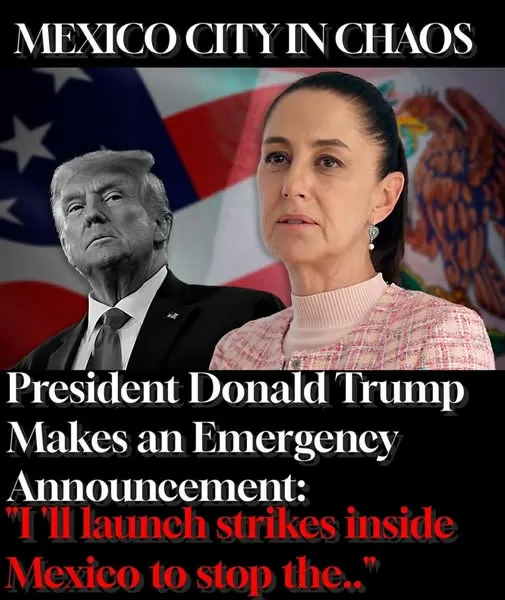
President Trump has delivered one of his strongest and most forceful messages yet regarding Mexico’s cartels and what he describes as a corrupt political system enabling them. His latest remarks leave little room for interpretation, signaling a far more aggressive posture toward the criminal networks operating along the southern border.
Trump made it clear that he is no longer speaking in hypotheticals or broad generalities. He insisted that U.S. intelligence has already mapped out cartel operations in exhaustive detail. “We know every route. We know every drug lord. We know their addresses — their front doors. We know EVERYTHING about EVERY one of them,” he declared.
Then came the line that stunned political observers on both sides of the border. When asked whether he would consider launching direct strikes inside Mexico to dismantle drug networks, Trump responded without hesitation. “Would I launch strikes inside Mexico to stop the drugs? It’s OK with me. Whatever we have to do. I’d be proud to do it. We’d save millions of American lives.”
Trump justified this stance by pointing to past operations targeting drug-smuggling vessels. He claimed that taking out a single drug boat can prevent enough fentanyl and narcotics from entering the United States to save tens of thousands of lives. By his estimate, each interdicted vessel translates to roughly 25,000 Americans spared from overdose deaths.
He then broadened the message, insisting that land-based cartel networks would face the same level of action if they continue flooding the United States with deadly substances. “Mexico has big problems,” Trump said. “If we had to do on land what we’ve already done on the waterways, we’ll do it.”
The former president then issued what many saw as a pointed warning aimed directly at Mexico’s political leadership. “I’ve been talking to Mexico. They know how I stand,” he said. “Let me just put it this way: I’m NOT happy with Mexico.”
Trump’s comments suggested that he believes the Mexican government has tolerated or even protected cartel operations for too long. His tone signaled frustration with what he sees as years of inadequate cooperation, weak enforcement, and political interference.
What stood out most was Trump’s insistence that the United States already possesses precise intelligence on cartel leadership, finances, routes, and infrastructure. He implied that this information is actionable and suggests a readiness to use it if necessary.
The message was unmistakable: Trump is openly placing cross-border strikes on the table as a potential tool for combating the drug crisis. Whether viewed as a bold security strategy or an explosive foreign-policy threat, the declaration marks a major escalation in his rhetoric.
For the cartels—and for any officials accused of being complicit in their activities—Trump’s words were designed to serve as a blunt, unmistakable warning: the period of inaction and accommodation is ending. In his view, the era of looking the other way is over.
No matter how safe air travel is deemed to be, there is always the fear of something going wrong. And on a lot of flights, things do go terribly wrong and I am not talking about the turbulence that brings your heart in your mouth or sends chills down your spine. I am talking more of, airplane engine on fire.
Some passengers onboard a Philippine Airline from Los Angeles to Manila might have peed their pants in fear for their lives after what happened to their airplane.
YouTube Screenshot
The airplane was only one hour into the journey when passengers noticed fire and smoke coming out of one of its engines. The incident was captured on video by a passenger and the video has been going viral.
Fortunately, the pilots quick thinking saved everyone on board as they turned the plane around and made an emergency landing at the Los Angeles International Airport.
In the video the passenger can be heard saying, “Never seen that before. Oh my God. It’s blowing fire out of there. I’ve never seen that before. That doesn’t sound good. It doesn’t look good.”
The plane made a safe landing even after the malfunction.
Philippine Airlines said in a statement the aircraft had suffered a ‘technical problem in one of its engines shortly after take-off’.
“All 342 passengers and 18 crew members are safe and were able to disembark from the airplane using regular airstairs. We greatly appreciate the calmness and patience of our PR113 passengers, who cooperated well with our cabin crew during the flight and the emergency landing,” the airline said in the statement.
About two months ago, a United Airlines flight from Denver to Orlando was forced to turn back after the plane’s engine suffered a mechanical issue, mid-air.
According to Aviation 24, the aircraft climbed to 10,000 feet but returned to Denver after the left hand engine’s cowling opened. A video of the incident, was posted on Twitter, which shows the left engine of the plane shaking violently mid-flight. It also shows a part of the cover partially detaching and peeling away.
Thankfully, no injuries were reported on this flight either.