The documents reveal that Summers maintained contact with Epstein until at least July 5, 2019—just one day before Epstein’s arrest on federal sex-trafficking charges. This timing has intensified public criticism, as it demonstrates that Summers continued engaging with Epstein even as Epstein remained under widespread suspicion and scrutiny for his past crimes. Within the released messages, Summers expressed trust in Epstein and even confided in him regarding a romantic pursuit involving a woman he described as his mentee. One November 2018 message shows Epstein calling himself Summers’ “wing man,” suggesting a relationship that was both personal and advisory. These revelations contrasted sharply with Summers’ public stature as an economist and academic leader, prompting his public expression of shame and full acceptance of responsibility for what he described as “misguided” decisions.
Despite the controversy, Summers continues to hold several influential roles in academia and policy circles. He remains a University Professor at Harvard and serves as director of the Mossavar-Rahmani Center for Business and Government at the Harvard Kennedy School—roles he will continue fulfilling, according to his spokesperson. Additionally, Summers serves as a senior fellow at the Center for American Progress, a paid columnist for Bloomberg, and a member of the board at OpenAI. His announcement indicated that while he will maintain his teaching obligations and institutional responsibilities, he will step back from public commentary and engagements as part of a broader process of reflection and accountability. This partial withdrawal highlights the fine line public intellectuals walk between professional duties and reputational risk, particularly when tied to figures as controversial as Epstein.
Parallel to the Summers controversy, Representative Jamie Raskin (D-MD), the ranking Democrat on the House Judiciary Committee, is facing a backlash of his own for releasing private prison emails written by Ghislaine Maxwell, Epstein’s longtime associate and a convicted human trafficker. Maxwell’s attorney, Leah Saffian, condemned the publication of the messages as “a gross abuse of power,” emphasizing that the emails had been accessed without authorization by employees at Federal Prison Camp Bryan in Texas and subsequently leaked. The Federal Bureau of Prisons confirmed that multiple employees had been terminated for the unauthorized access. Saffian argued that both the leaking of the emails and Raskin’s decision to make them public constituted severe violations of constitutional protections owed to prisoners, including First Amendment rights and due process guarantees.
The leaked emails revealed Maxwell describing her experience at the Bryan facility in unexpectedly positive terms. She wrote that the conditions were “legions better” than those at her previous facility in Florida, praising the cleanliness, food quality, and staff interactions. Maxwell described the environment as calmer and safer, free from the violence, drug activity, and chaos she claimed characterized her prior incarceration. Some of her comments were laced with sarcasm, such as her mockery of the Florida facility’s kitchen conditions, where she described possums falling from ceilings onto ovens. These emails present a rare glimpse into Maxwell’s personal reflections since her conviction, adding another contentious layer to public interest in her case. Maxwell’s team insists that the publication of the correspondence represents another instance in which her legal and human rights have been compromised during incarceration.
Together, the Summers and Maxwell controversies illustrate a broader landscape of legal, ethical, and political tensions surrounding high-profile individuals connected to Epstein, either directly or indirectly. Summers’ decision to step back from public commitments underscores the professional consequences of maintaining relationships with figures whose reputational and criminal histories carry immense public stigma. Meanwhile, the uproar surrounding Raskin’s publication of Maxwell’s emails highlights ongoing debates over privacy, accountability, and the proper conduct of public officials who handle sensitive information. As both stories unfold, they reflect the enduring and far-reaching influence of Epstein’s legacy, continuing to implicate major political, academic, and institutional actors years after his death, and forcing renewed questions about responsibility, discretion, and the boundaries of ethical conduct in public life.
Speaker Mike Johnson, R-La., told Newsmax on Monday that once the government shutdown ends, House Republicans are readying ideas to tackle rising healthcare costs.
The House on Sept. 19 passed a clean continuing resolution 217-212 that would fund the federal government through Nov. 21, but the measure quickly stalled in the Senate amid a broader fight over Affordable Care Act subsidies.
The pandemic-era subsidies, which were created by Democrats, are scheduled to expire at the end of the year, the outlet reported.
During an appearance on “The Record with Greta Van Susteren,” Speaker Mike Johnson declined to specify when the House might consider a bipartisan Senate proposal to fund the federal government through January 30.
The Senate advanced the measure Sunday night by clearing a key procedural hurdle, though a final vote is still expected to take place in the coming days.
Johnson noted that House Republicans had included provisions to address rising healthcare costs in their One Big Beautiful Bill Act, but said Democrats ultimately removed them during negotiations
“The problem is that we are subsidizing very wealthy insurance companies,” Johnson said. “That is not helping costs go down. It’s driving premiums up even higher. So, Republicans want to fix the broken system.
“We don’t want to throw good money at a broken and failing system. And the Affordable Care Act has been that since it was signed into law, passed by the Democrats alone back in 2010,” the Louisiana Republican added.
“We’ve got to reduce the cost of healthcare and the cost of living, and Republicans are the ones that have the ideas to do that,” he said.
Johnson stated that the OBBB included a provision which, according to him, would have decreased healthcare premiums by 12.7%.
“But the Democrats fought to take it out of the bill,” he said. “So, if they cared so much about healthcare costs, they shouldn’t be fighting provisions like that.
“We’re putting together some ideas that will drive the premiums down because healthcare is too expensive in this country. It’s too expensive because the Democrats built a system that doesn’t work. So, we need to look at the root causes of the costs that have skyrocketed and address that for the people,” Johnson told Van Sustren.
“Merely subsidizing something is not the is not the answer. When the government subsidizes something, it almost always means it’s not working. And that’s the problem,” he said.
With the subsidies set to expire on Dec. 31, Johnson said, “it’s an urgent matter for us, and it has been, which is why we put it into the bill that we passed in the early summer. And the Democrats fought to take it out.”
“So, we’re reintroducing some of these ideas,” he said. “There’s a lot of ideas on how to drive the cost down, and we have November and December to work on that.
“We’re going to have to get a bipartisan consensus on some of this. And so, we’ll be presenting our ideas and putting them on the table,” he continued.
“The Democrats, this is very important to point out, they don’t have any reform ideas at all. Their argument is they want a completely unreformed continuation. They would do it permanently, most of them on government just subsidizing the insurance companies. And that is not the solution,” he said.
“We’re going to be educating the population, and along the way, as we do this, come up with reforms that will actually solve the problem and not make it worse.”
Johnson, in a separate interview with Fox News, urged GOP members of the House to return to Washington before an expected vote on a measure to reopen the government on Wednesday.
“We’re going to plan on voting, on being here, at least by Wednesday,” Johnson said. “It is possible that things could shift a little bit later in the week, but right now we think we’re on track for a vote on Wednesday. So we need you here.”
Hakeem Jeffries FREAKS OUT when Kailtin Collins plays a video EXPOSING his BS Lies about SHUTDOWN
HAKEEM JEFFRIES FREAKS OUT: CNN’s Kaitlan Collins EXPOSES Democrat Shutdown Hypocrisy with Video Clip
WASHINGTON, D.C. – House Minority Leader Hakeem Jeffries (D-NY) was visibly rattled during a live television interview when CNN host Kaitlan Collins confronted him with a video clip of his past statements criticizing a government shutdown, highlighting what critics have long argued is the Democratic Party’s profound hypocrisy on fiscal and political maneuvering.
The confrontation occurred as Congress faced an imminent deadline to avert a government shutdown, placing pressure on both parties but particularly exposing the ideological shifts within Democratic leadership.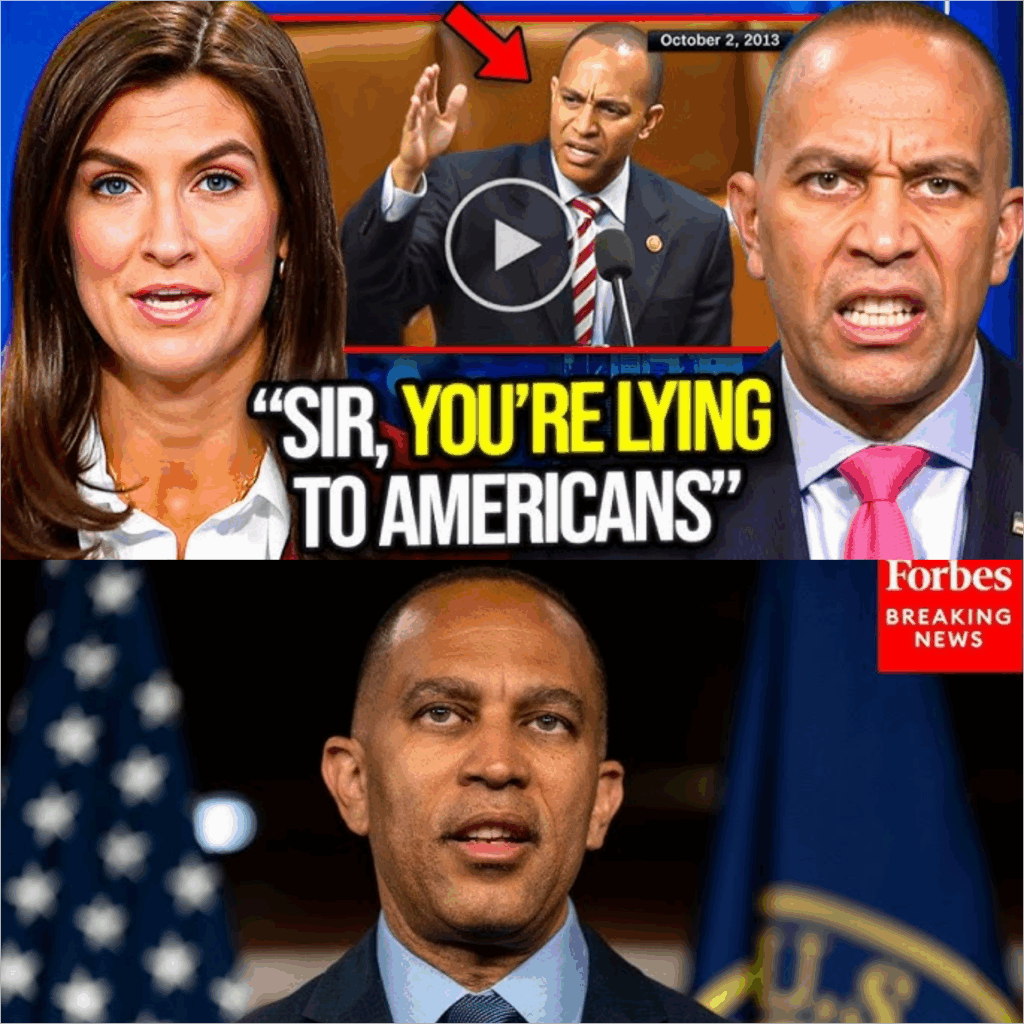
THE HYPOCRISY EXPOSED: JEFFRIES’ PAST VS. PRESENT
Kaitlan Collins introduced the segment by playing a video of Jeffries’ strong condemnation of the 2013 government shutdown, which was orchestrated by Republicans.
The 2013 Condemnation
In the archival footage, Jeffries is heard delivering a passionate speech, using harsh language to criticize the Republican actions:
“We’re in the midst of a government shutdown right now that is unnecessarily forcing pain on the American people. It’s a shutdown that was manufactured by the House GOP that has resulted in a situation where Americans all across this country have now been put in jeopardy. That’s a tragedy of epic proportions.”
The Seamless Pivot
Collins then asked Jeffries of today to comment on the Jeffries of 2013, specifically asking why he would not now support a “clean Continuing Resolution (CR)” to allow Congress to reopen the government.
Jeffries, maintaining composure, attempted to spin his current stance to align with his past statement, arguing that the Democrats were ready to negotiate and end the shutdown:
“Well, the Hakeem Jeffries of today definitively agrees with the Hakeem Jeffries of yesterday from the standpoint of, listen, we’ve said to Republicans, get to the negotiating table. We want to find a bipartisan path forward. We want to reopen the government.”
However, Jeffries quickly shifted into attacking President Trump and Republicans, using the lack of negotiations as an excuse for the ongoing stalemate, a move critics argue is designed to obscure the Democrats’ own role in using the shutdown as leverage.
THE BLAME GAME AND CONFLICTING NARRATIVES
Jeffries’ defense strategy relied heavily on aggressive deflection and highly charged, unverified accusations directed at Republicans.
1. Accusing Trump of Foreign Collusion
Jeffries made an extraordinary and unsubstantiated claim regarding the former President’s actions:
“Donald Trump over the last 29 days has spent more time talking to Hamas and to the Chinese Communist Party than to Democrats on Capitol Hill who represent half the country.”
This move, which critics quickly labeled as a desperate and baseless attempt to smear Trump, is reflective of the progressive strategy of relying on sensational, emotional accusations rather than verifiable facts in political arguments.
2. Weaponizing Essential Services
The broader political context of the confrontation centers on the Democratic Party’s strategy to weaponize the shutdown’s effects on vulnerable populations.
EBT/SNAP Benefits: The report highlights the looming crisis of 42 million Americans potentially losing their EBT and SNAP benefits (food stamps). Critics argue that Democrats are deliberately letting the shutdown continue under the Trump administration in order to manufacture chaos and blame the negative social fallout entirely on Republicans, a move labeled as cynical and politically motivated.
Refusing Accountability: Jeffries’ reluctance to answer whether he would “defer his paycheck” during the shutdown, as many federal workers were going without pay, further exposed the disconnect between political leadership and the citizens they claim to represent.
THE WIDER POLITICAL MANEUVERING
The current shutdown is seen by Republicans as a deliberate political stunt orchestrated by Democratic leadership to save their own political careers from the far-left wing of the party.
1. The Schumer Scenario
Senate Minority Leader Chuck Schumer is specifically cited for having previously voted for a “clean CR” but reversing his stance due to pressure from the far-left:
The Political Stunt: After facing an “onslaught of criticism from the far-left base” for voting to fund the government, Schumer allegedly concocted a plan to vote against the next funding measure “to show a fight to President Trump so he could save his political skin.”The Consequences: This political maneuver, driven by self-preservation, is argued to have brought the Democratic Party to its “lowest point in decades” in approval ratings.
2. The Inmate’s Asylum
The entire crisis is framed as the “inmates running the asylum,” with Democratic leadership losing control to the radical wing of their party, led by figures like Alexandria Ocasio-Cortez. This fear of the radical base, rather than sound policy, is seen as prolonging the government shutdown.
The confrontation with Kaitlan Collins serves as a powerful illustration of the current political environment, where ideological purity and self-preservation often trump principled governance.
Would you like more details on the potential consequences for the 42 million Americans relying on SNAP benefits if the shutdown is prolonged?