The House voted Tuesday to formally rebuke Rep. Jesús “Chuy” García over the timing of his retirement announcement, backing a resolution from Democratic Rep. Marie Gluesenkamp Perez and exposing a nasty split inside the party. The measure passed 236-183-4, with 23 Democrats breaking ranks.
The resolution accuses García of “undermining the process of a fair and free election” and says his move was “incompatible with the spirit” of the Constitution. Supporters framed it as a basic issue of voter rights.
“Voters decide elections, not politicians,” Rep. Greg Landsman of Ohio wrote on X. “We are the voting rights, voter protection, voter empowerment party, and there should never be an exception to that.”
But several Democrats blasted the vote as a pointless spectacle aimed at humiliating a veteran progressive.
“Chuy García is a legend and an icon in his community. His progressive record is unmatched here. … I will not question his progressive credentials. You know, he faced a situation, a personal situation. He acted within the framework of the law,” said Rep. Adriano Espaillat of New York.
García, 69, filed for reelection on Oct. 27 before abruptly reversing course. He later said he would retire to focus on his family, noting his wife was diagnosed with multiple sclerosis more than a decade ago. The announcement came after the Nov. 3 filing deadline, leaving his chief of staff, Patty García — no relation — as the sole Democrat on the primary ballot. She submitted her paperwork just before the 5 p.m. cutoff.
Chuy García endorsed her, saying she “knows the issues, knows the players in Washington, and has the talent and heart to deliver real results for working families.”
Gluesenkamp Perez said on the House floor that she respects García and believes his “reasons for retiring are noble.” She argued that the timing still crossed a line.
“You don’t get your cake and eat it, too. If you’re not going to run, you don’t get to choose your successor, no matter how noble the work you have done beforehand,” she said.
WATCH:
García’s office circulated a fact sheet before the vote insisting that “anyone, at any time before the filing deadline, could have collected petitions and filed to run.”
“Which is exactly what several candidates did, one of whom filed as a Republican and the other with the Working Class Party. Anyone willing to file as a Democrat could have filed petitions before his announcement,” the statement said.
Democratic leaders tried to shut down the resolution but failed.
House Minority Leader Hakeem Jeffries ripped the push as political theater, dismissing the uproar over García’s timing.
“I do not support this so-called resolution of disapproval. And I strongly support Congressman Chuy García,” Jeffries said. “He’s been a progressive champion in disenfranchised communities for decades — including during his time in Congress — and he’s made life better for the American people.”
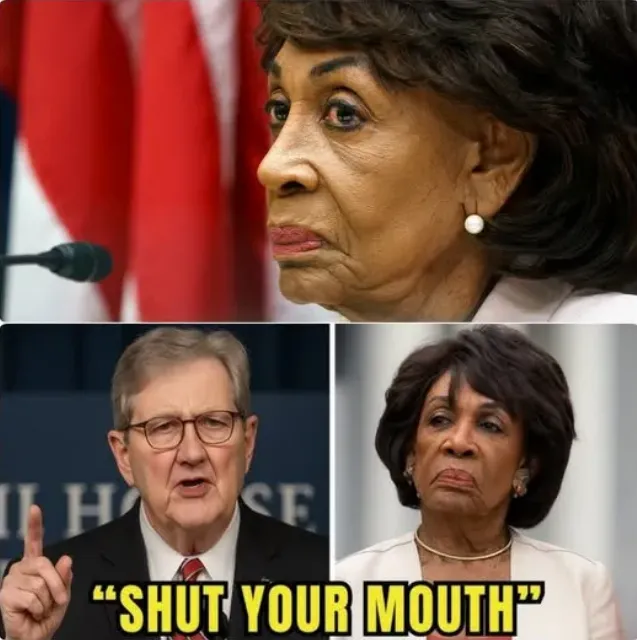
In a dramatic Senate Banking Committee hearing that captivated the nation, Senator John Kennedy of Louisiana confronted Congresswoman Maxine Waters with a series of pointed questions and damning evidence, leaving her visibly shaken and struggling to maintain her composure. What was intended to be a routine discussion on financial regulations quickly escalated into a high-stakes showdown that exposed the fragility of unchecked political power.
The hearing began with Waters, a seasoned lawmaker known for her fierce advocacy and commanding presence, entering the room with the confidence of a queen. For over three decades, she had been a titan of Washington’s financial policy, adept at dismantling opponents with her sharp rhetoric. However, unbeknownst to her, Kennedy had spent weeks preparing for this moment, armed with a deep understanding of constitutional law and a folder filled with evidence that would soon turn the tide.
As the hearing commenced, Waters attempted to assert her dominance by questioning Kennedy’s qualifications. “Did your time in law school cover banking policy or were you too busy chasing folksy anecdotes?” she asked, her tone dripping with condescension. This calculated move was designed to put him on the defensive, but Kennedy remained unfazed, a faint smile playing on his lips.
Kennedy responded not with indignation but with a measured inquiry that would set the tone for the rest of the hearing. He pulled out his well-worn pocket Constitution and posed a critical question: “What specific constitutional authority gives Congress the power to regulate every corner of American banking?” This question landed like a grenade, momentarily cracking Waters’s confident facade.
As the tension in the room escalated, Kennedy continued to press Waters on the limits of federal power. He challenged her to justify the existence of agencies like the Consumer Financial Protection Bureau (CFPB), which she had long championed. His calm demeanor contrasted sharply with Waters’s increasingly defensive responses, revealing a vulnerability she had not anticipated.
With the audience on the edge of their seats, Kennedy shifted gears, opening his folder to reveal evidence of potential conflicts of interest involving Waters and OneUnited Bank. He disclosed that Waters had arranged a meeting with Treasury officials to discuss the bank during a time when her husband held a significant stake in it. “Your husband owned $350,000 worth of stock in OneUnited Bank. After that meeting, the bank received $12 million in taxpayer bailout funds,” Kennedy stated, his tone steady but laced with accusation.
Waters’s expression changed as she realized the implications of Kennedy’s revelations. She attempted to deflect, insisting that her actions were aimed at helping minority-owned banks, but Kennedy was relentless. He pointed out the stark contrast between her professed commitment to public service and the financial benefits her family had reaped from her political influence.
As the hearing progressed, it became clear that Waters was losing control of the narrative. Kennedy’s methodical approach and mastery of constitutional principles dismantled her authority piece by piece. He highlighted the CFPB’s structure and its implications for the separation of powers, questioning how an unelected agency could wield such authority without accountability.
Waters, increasingly desperate, resorted to emotional appeals, asserting her long-standing commitment to fighting for working families. However, Kennedy countered with cold, hard facts, reminding her that the Constitution was not merely a suggestion but a framework designed to limit government power. “If the Constitution means whatever Congress wants it to mean at any given moment, then it doesn’t actually limit government power, does it?” he asked, his voice unwavering.
The climax of the hearing came when Kennedy pulled out a series of documents detailing Waters’s family’s financial gains tied to her political career. “Your family has profited handsomely from your political influence. How do you square that with your claim of fighting for working families?” he pressed, his words echoing in the silent room.
Waters, now visibly shaken, struggled to respond. Her usual fiery rhetoric was replaced by defensive sputters as she attempted to pivot back to her record of advocacy. But Kennedy’s calm, unyielding demeanor exposed the flaws in her arguments, leaving her credibility in tatters.
As the hearing drew to a close, Kennedy delivered a powerful closing statement that resonated with viewers across the country. “The Constitution isn’t just a document. It’s the guardrail that keeps power in check. When you use your position for personal gain, you’re not serving the people. You’re serving yourself,” he asserted, driving home the importance of accountability in governance.
The exchange, broadcast live, became a defining moment in American politics—a stark reminder that no one is above the law. Waters, who had entered the hearing expecting to humiliate Kennedy, left the room defeated, her legacy tarnished by the revelations of her conflicts of interest and the constitutional challenges she could not adequately address.
Senator John Kennedy’s performance in the Senate Banking Committee hearing was a masterclass in accountability, showcasing how knowledge, preparation, and principled argumentation can triumph over decades of entrenched authority. The event served as a call to action for Americans to demand more from their leaders, emphasizing the necessity of upholding the Constitution and ensuring that power remains in check.
As Kennedy exited the room, he left behind a powerful truth: in a republic, no one is untouchable, and the Constitution remains the ultimate arbiter of justice. The hearing may have been just one moment in time, but its implications will resonate in the halls of power for years to come.