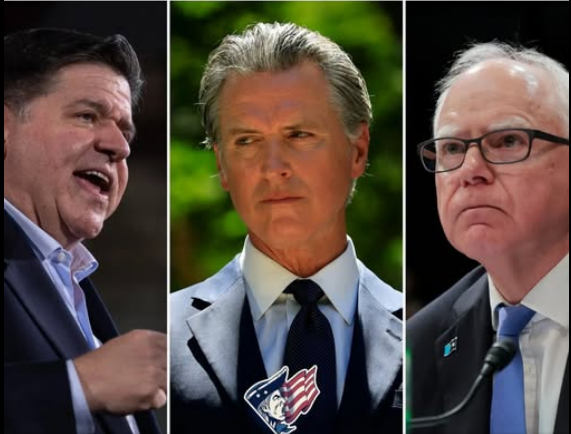
Governor J.B. Pritzker has once again proven that political allegiance outweighs public safety in Illinois. His latest move, effectively calling off local police from assisting ICE agents, sends a chilling message: protecting illegal immigrants takes priority over protecting American citizens.
Under his leadership, state laws now prevent officers from cooperating with immigration authorities unless a criminal warrant is involved. This has turned Illinois into a sanctuary state where ICE agents are left isolated in dangerous situations.
The TRUST Act, which Pritzker proudly upholds, forbids law enforcement from even providing support or information to federal agents. It’s a radical departure from traditional cooperation between local and federal law enforcement.
Officers who once stood side by side in pursuit of justice are now being forced apart by political gamesmanship. Local police can no longer answer ICE’s calls for help, even when agents face violent mobs.
This breakdown in unity puts lives at risk. When officers hesitate to respond because of political red tape, criminals gain the upper hand.
Frontline law enforcement officials have expressed outrage, calling the policy reckless and demoralizing. They say it violates the unspoken rule of the badge: when an officer calls for help, you respond—no matter what agency they wear.
The governor’s office, meanwhile, remains silent on the growing anger within police ranks. Instead of backing the men and women who keep the state safe, Pritzker doubles down on protecting illegal entrants.
Illinois State Police have been seen maintaining distance from ICE operations, even when protests erupt into chaos. Officers are reportedly told to observe, not engage—an order that defies common sense.
For most Americans, this approach handcuffs local enforcement, leaving ICE agents to face mobs and violent agitators without backup. It’s a dangerous game with real-world consequences.
Pritzker continues to frame his actions as “compassionate governance,” insisting that Illinois is simply following the law. But his interpretation of compassion looks a lot like dereliction of duty.
By shielding illegal immigrants from accountability, his administration fuels the very chaos it claims to prevent. Violent offenders who should be detained are released back into communities.
Federal officials have accused the governor of distorting the truth, saying state leaders are obstructing lawful immigration operations and creating unnecessary conflict.
Tensions between state and federal authorities have reached a breaking point, with Illinois officials attempting to block federal deployments meant to restore order.
During one controversial ICE operation in Chicago, military helicopters were reportedly used as agents faced violent resistance from protesters. Instead of condemning the lawlessness, Pritzker attacked the operation itself.
He called the deployment “political theater,” criticizing the use of tactical equipment and claiming the federal government was trying to “manufacture chaos.”
Rather than acknowledging the threats faced by law enforcement, the governor accused federal authorities of overreach and fearmongering.
His rhetoric paints ICE agents as aggressors while portraying illegal immigrants as victims—a narrative that ignores the strain on American communities and taxpayers.
Local sheriffs throughout Illinois are growing frustrated. Many want to help federal officers but are barred by state law from doing so. They believe Pritzker’s rules are undermining their duty to uphold the law.
Officers who once viewed cooperation with ICE as common sense now face disciplinary threats if they even respond to calls for assistance.
This is the new Illinois: a state where politics dictate law enforcement priorities, and public safety takes a back seat to virtue signaling.
Pritzker’s sanctuary laws have become shields for repeat offenders and a magnet for illegal crossings, turning the state into a safe haven for those who flout immigration law.
The White House on Wednesday denounced Democrats for what it called a “selective and bad-faith” release of Jeffrey Epstein documents after emails surfaced showing celebrity biographer Michael Wolff privately advised Epstein to attack Donald Trump during the 2016 campaign to gain “political cover.”
Press Secretary Karoline Leavitt said the newly released materials were “a deliberate distraction from the Democrats’ shutdown fiasco” and accused the minority of “manufacturing a smear against President Trump.”
Leavitt said the “unnamed victim” referenced in Epstein’s 2011 correspondence was the late Virginia Giuffre, who had repeatedly stated Trump “was not involved in any wrongdoing whatsoever and couldn’t have been friendlier” in their limited interactions. She added that Trump banned Epstein from Mar-a-Lago decades ago for harassing female employees and called the document release “a desperate effort to rewrite history.”
Republicans on the House Oversight Committee echoed the White House’s statement, accusing Democrats of “cherry-picking documents to generate headlines” while withholding other records that name prominent Democratic officials. A GOP committee spokesperson said Democrats “should stop politicizing this investigation and focus on full transparency and justice for the victims.”
The controversy erupted hours after Democrats released a new batch of documents from the ongoing bipartisan Epstein investigation, including 2016 email exchanges between Epstein and Michael Wolff, the journalist known for his anti-Trump bestsellers Fire and Fury and Siege.
The emails show Wolff repeatedly advising Epstein to use anti-Trump messaging to repair his image as scrutiny mounted over his earlier sex-trafficking conviction and connections to powerful figures.
In early 2016, Wolff told Epstein that both The New York Times and the Hillary Clinton campaign were investigating his ties to Trump and advised him to “preempt” the narrative. Weeks later, Wolff wrote that “becoming an anti-Trump voice gives you a certain political cover which you decidedly don’t have now.”
He warned that James Patterson’s upcoming book “Filthy Rich,” about Epstein’s crimes, would draw intense attention because of the election and said the “Trump-Clinton angle will amplify the attention tenfold.”
When Epstein asked how to handle questions about Trump, Wolff replied that if Trump denied visiting Epstein’s home or flying on his plane, it would provide “valuable PR and political currency.” Wolff said Epstein could “hang him in a way that generates a positive benefit,” or “save him” if it appeared Trump would win, “generating a debt.”
The emails also show Wolff asking Epstein to connect him with Tom Barrack, who chaired Trump’s inaugural committee, and Kathy Ruemmler, a former Obama administration prosecutor, while researching his later book on Trump’s presidency. He also asked whether Bill Clinton would confirm that he had never been to Epstein’s private island — something Clinton has repeatedly denied.
The two men remained in contact through May 2019, months before Epstein’s arrest on federal sex-trafficking charges. Epstein died in jail that August, officially ruled a suicide.
Democrats on the committee, led by Rep. Robert Garcia (D-CA), said the new disclosures underscored the need for the Department of Justice to release all Epstein files. Garcia said the Oversight Committee “will not stop until we get justice for the victims” and argued that “the more Donald Trump tries to cover up the Epstein files, the more we uncover.”
Republican leaders rejected that claim, calling the release a “political stunt” meant to distract from the administration’s recent battles with Congress.
The House is preparing to vote on a discharge petition that would force the DOJ to release the Epstein records in full. The measure is expected to gain enough signatures to proceed once newly sworn-in Rep. Adelita Grijalva (D-AZ) signs on.
Epstein, a financier with ties to Trump, Clinton, and Prince Andrew, was first convicted in 2008. He was arrested again in 2019 on federal trafficking charges but died before trial. His longtime associate Ghislaine Maxwell is now serving a 20-year sentence for aiding his operation.
The Wolff correspondence adds a new political dimension to the investigation, showing that one of Trump’s most prominent critics in the media was privately advising Epstein on how to weaponize anti-Trump sentiment for personal rehabilitation during the height of the 2016 election.