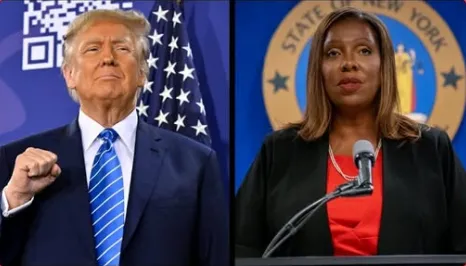
New York Attorney General Letitia James was indicted on federal bank fraud charges after prosecutors alleged she lied on a mortgage application to obtain favorable loan terms on a Virginia property she later rented out.
The indictment, returned by a federal grand jury, centers on a single-family home in Norfolk, Virginia, that James co-purchased in August 2020 for roughly $137,000. Most of the purchase was financed with a $109,600 loan that prohibited the home from being used as a rental or investment property, according to prosecutors.
By misrepresenting the property as a second home, James received a lower interest rate and saved “approximately $18,933 over the life of the loan,” prosecutors said in a five-page filing.
Federal Housing Finance Agency (FHFA) Director William Pulte referred the case to the Department of Justice earlier this year, prompting a criminal probe that led to Thursday’s indictment.
According to financial disclosure forms reviewed by the
James repeatedly listed the Norfolk property as an “investment” from 2020 through 2023 in filings with the New York State Commission on Ethics and Lobbying in Government. In 2024, she changed the classification to “real property,” just weeks after the FHFA referral was made.
“The indicted attorney general also estimated the value of the property anywhere between $150,000 and $200,000,” the Post reported.
Despite the loan’s clear prohibition against rental use, prosecutors allege James used the property as a rental investment and earned thousands of dollars in income that she failed to report on multiple disclosure forms.
In her 2020 disclosure, James did list an “investment real property” in Norfolk that generated between $1,000 and $5,000 in revenue, but it is unclear if that referred to the same home named in the indictment.
According to prosecutors, James agreed to a “Second Home Rider” when taking out the loan, which required her to occupy the home as her secondary residence and forbade any rental or shared ownership arrangement.
“Despite these representations,” the indictment reads, “the Norfolk property was not occupied or used by James as a secondary residence and was instead used as a rental investment property.”
Prosecutors also said James made false statements on her homeowners’ insurance application, claiming the home would be “owner occupied,” and on her federal tax filings, where she classified the house as “rental real estate” and reported “thousand(s) of dollars in rents received.”
The federal indictment charges James with two counts: bank fraud and making false statements to a financial institution. If convicted on both counts, she faces up to 60 years in prison and fines totaling as much as $2 million.
The judge presiding over James’ mortgage fraud case on Friday rejected a motion seeking to compel federal prosecutors to maintain a log of all their communications with the media.
Defense attorney Abbe Lowell had filed the request last week, following James’ arraignment on charges of bank fraud and making false statements. The motion cited a report alleging that U.S. Attorney Lindsey Halligan exchanged a series of encrypted Signal messages with a reporter regarding the case,
“[T]he defendant does not demonstrate that it is necessary for the Court to order the government to track communications with the media in any particular form,” wrote US District Judge Jamar Walker in his six-page order.
“The defendant’s request that the government be required to keep a communication log is DENIED,” the Biden-appointed judge ruled.
Walker further wrote that while Halligan’s Signal chat with Lawfare senior editor Anna Bower earlier this month was “unusual,” he nevertheless declined to offer an opinion “on whether they were improper in any sense, either legal or ethical.”
Halligan’s Signal messages to the reporter were configured to automatically disappear after eight hours, The Post reported.
The judge did not address whether Halligan’s communications — which reportedly disputed a New York Times story revealing that James’ grandniece told a grand jury she had never paid rent on the Norfolk, Va., property at the center of the case — constituted material subject to discovery requirements.
James pleaded not guilty last week to one count of bank fraud and one count of making a false statement to a financial institution.
Washington’s Most Brutal Political Takedown: How Kash Patel Nuked Adam Schiff’s Reputation and Changed American Politics Forever
In the cutthroat world of Capitol Hill, political theater is a daily routine. But on one crisp autumn morning, the Senate Judiciary Committee chamber became the stage for a massacre that would go down as the most devastating political takedown in modern American history. Adam Schiff, the self-anointed guardian of truth, swaggered into the hearing, ready to humiliate FBI Director Kash Patel. By the end, Schiff’s career lay in ruins, eviscerated by a decorated combat veteran wielding classified evidence like a sledgehammer.
The room buzzed with anticipation as cameras zeroed in, expecting the usual grandstanding. Schiff, master of media manipulation, had orchestrated the moment for weeks. Friendly outlets had already drafted headlines accusing Patel of Kremlin ties. Schiff’s plan? Call the FBI Director a Russian agent on live TV, trigger a media feeding frenzy, and cement his legacy as the man who “saved democracy.” What happened next was a nuclear-level backfire.
FBI Director Kash Patel entered the chamber with the calm of a man who’d stared down terrorists, not Twitter mobs. His credentials weren’t built on campaign cash or cocktail parties—they were forged in the fires of national security. Prosecutor. Defense official. Intelligence officer. Combat veteran. Patel didn’t need to prove his patriotism; he’d lived it.
Schiff arrived last, flashing his trademark smirk, the kind that had gotten him through a thousand cable news segments. When his turn came, he ditched any pretense of discussing FBI reforms. He leaned forward, eyes blazing, and dropped his bomb:
A gasp rippled through the chamber. Republican senators objected. Schiff doubled down, waving his “evidence” like a death sentence. “I believe you are a Kremlin agent working against American interests.” The media sharks smelled blood. Phones lit up. The viral moment was here.
Patel didn’t flinch. He didn’t stammer. He didn’t blink. He sat still, eyes locked on Schiff, the same look he’d given Al-Qaeda operatives in interrogation rooms. Then, with surgical precision, Patel opened his briefcase and laid five folders on the table, each marked with classification stamps that made staffers squirm.
“Senator Schiff,” Patel said, voice like steel, “since you’ve chosen to abandon the hearing’s purpose and attack my patriotism, perhaps we should instead discuss your fraudulent mortgage applications, fabricated Russia collusion claims, Ukraine whistleblower coordination, classified intelligence leaks, and undisclosed foreign financial connections.”
The room froze. Schiff’s smirk evaporated. The blood drained from his face. Patel held a royal flush and everyone knew it.
He opened the first folder: Financial Fraud—Classified.
“Shall we begin with your five fraudulent Fannie Mae mortgage applications, or would you prefer we start with the recording of you admitting you had no actual evidence of Russian collusion despite your public claims?”
Schiff tried to object, but the chairman waved him off. Patel was in control now.
Patel unleashed a tsunami of evidence:
Five primary residence mortgages claimed simultaneously, each a federal crime.
“While ordinary Americans lost homes, you committed systematic mortgage fraud,” Patel spat, his voice cutting through the chamber like a buzzsaw.
Schiff’s face contorted. “This is an outrageous violation of privacy!”
“These are federal crimes, Senator,” Patel replied. “18 U.S. Code, up to 30 years in prison.”
The evidence was overwhelming. Then Patel dropped the hammer:
The audience was stunned. But Patel was just warming up.
He opened the second folder: Russia Collusion Fabrication—Classified.
For three years, Schiff had told America he had “direct evidence” of Trump-Russia collusion. Patel played tape after tape of Schiff’s TV appearances, each more damning than the last. But then came the kill shot:
Audio recordings of Schiff privately admitting “the actual intelligence doesn’t get us there on collusion, but perception is reality. We need to keep pushing the narrative, even if the Mueller investigation comes up empty.”
Five authenticated recordings.
Internal emails showing Schiff received intelligence assessments stating “insufficient evidence to establish coordination,” yet went on TV claiming the opposite.
“This isn’t political disagreement,” Patel said. “It’s deliberate deception. You divided this nation with lies you knew were false.”
Schiff tried to protest, but Patel played more tapes, more emails, more timelines. The chamber was silent, except for the sound of careers imploding.
Next came the third folder: Ukraine Whistleblower Coordination—Classified.
Patel revealed emails, meeting logs, and text messages showing Schiff’s staff coached the Ukraine whistleblower weeks before the complaint was filed.
“Focus on quid pro quo angle,” they wrote. “Emphasize national security.”
Yet Schiff went on TV claiming, “We have not spoken directly with the whistleblower.” Patel played the video, then the emails. The contradiction was irrefutable.
“This wasn’t a misstatement,” Patel said. “It was calculated deceit.”
Fourth folder: Classified Intelligence Leaks—Counterintelligence Assessment.
Patel displayed a timeline linking 42 classified leaks to Schiff’s office.
Bank records showing $4.7 million in consulting fees, book advances, and speaking honoraria flowing to Schiff after major leaks.
One leak aborted a hostage rescue, resulting in death and trauma.
Patel’s voice broke for the first time. “When you leak intelligence for personal gain, you’re not just breaking the law. You’re putting American lives at risk.”
The room was beyond shocked. Even Schiff’s Democratic allies shrank away.
Final folder: Foreign Financial Connections—Counterintelligence Assessment.
Patel exposed a web of shell companies, Chinese state-owned enterprises, and foreign-linked funding vehicles channeling $7.2 million to organizations tied to Schiff.
Surveillance footage, bank records, and legislative timelines showed Schiff’s votes shifting to benefit foreign interests after the money flowed.
Recorded conversations with Chinese liaisons confirmed quid pro quo arrangements.
“Senator, you’ve built your career accusing others of foreign influence,” Patel said. “But the evidence suggests you’ve maintained your own network of foreign financial relationships, deliberately structured to evade disclosure.”
For two hours, Patel eviscerated Schiff with evidence, not rhetoric. The committee was stunned. Veterans in the gallery stood in silent respect. Schiff slumped in his chair, isolated and defeated.
Within hours, the media landscape shifted. “Schiff Exposed” trended worldwide. The Senate Ethics Committee suspended Schiff and launched investigations. The DOJ appointed a special counsel. Fannie Mae froze accounts. The evidence was too damning to ignore.
Patel didn’t celebrate. He returned to the FBI, told his team, “No one, regardless of position or party, should be above accountability.” He implemented the most sweeping reforms in FBI history. Public trust soared. The “Patel Standard” became the new benchmark for accountability.
Schiff resigned within a year, facing federal indictments. His network of staffers and associates turned state’s witness. The era of weaponized accusations was over. In its place, a new principle: evidence, not rhetoric, determines truth.
As Patel reflected in his only interview, “True patriotism sometimes requires difficult choices. The American people deserve leaders whose public commitments match their private actions.”
The day Adam Schiff tried to humiliate Kash Patel became the day America discovered the truth. The systematic exposure of mortgage fraud, fabricated Russia claims, whistleblower coaching, intelligence leaks, and foreign financial ties didn’t just end a career—it changed the game. For too long, politicians weaponized accusations while hiding their own corruption. Patel’s revelation shattered that paradigm.
America’s political landscape will never be the same. Accountability is back. The truth still matters. And the era of untouchable politicians is over.
Share this story before they try to memory-hole what really happened. This is just the tip of the iceberg. God bless our veterans. God bless the patriots who choose truth over politics. And God bless everyone who still believes America is worth fighting for.
A phone call that lasted just minutes may have set in motion one of the most unconventional political strategies in modern American history. The conversation between two of the most powerful Republicans in Washington has sparked discussions about rewriting the playbook for how political parties approach midterm elections, potentially creating a spectacle that could reshape the entire electoral landscape.
The implications of this strategic shift extend far beyond typical campaign tactics, representing a fundamental reimagining of how political momentum is built and sustained in the modern era. What started as a spontaneous idea during a brief phone conversation could evolve into a game-changing moment that defines not just the 2026 midterms, but the future of American political campaigning itself.
House Speaker Mike Johnson found himself in Detroit on what seemed like a routine political trip when his phone rang. On the other end was President Donald Trump, and what followed was a conversation that would soon capture the attention of political strategists, party leaders, and observers across the nation.
“He called me 15 minutes before that Truth and he said, ‘Mike, I’ve got a great idea,’” Johnson recounted during a Fox News interview, his enthusiasm evident as he described the moment that could mark a turning point in Republican political strategy.
The idea Trump proposed was audacious in its simplicity and unprecedented in its scope: hold a presidential-style Republican National Convention before the 2026 midterm elections. Not a rally, not a series of campaign events, but a full-scale national convention designed to generate the kind of energy and media attention typically reserved for presidential nomination contests.
Johnson’s immediate response revealed the kind of political instinct that has made him one of Trump’s most trusted allies in Congress. “Let’s have it. I’m so excited about this. I said, ‘Mr. President, let’s go.’ Because I think that would be such a great rallying point right before the midterm election for us to tout all the great successes we’ve had,” Johnson explained.
The spontaneity of the conversation belies the calculated political thinking behind the concept. Both leaders understand that midterm elections traditionally favor the opposition party, and they’re looking for ways to break that historical pattern through unprecedented means.
The confidence behind this ambitious proposal stems from what Republicans view as their comprehensive victory in the 2024 elections. Johnson didn’t hesitate to frame the previous election cycle in the most favorable terms possible, declaring that Republicans won “every aspect” of the 2024 presidential election.
This interpretation of electoral success has become a cornerstone of Republican messaging as they look toward the 2026 midterms. The party’s leadership believes they have found a winning formula that transcends traditional campaign approaches, and they’re eager to replicate and amplify that success.
“The GOP is poised to perform well in next year’s midterms,” Johnson predicted with the confidence of someone who has seen his party’s recent electoral performance and believes the momentum is sustainable.
This optimism isn’t based solely on the 2024 results. Republican leaders point to a series of indicators that suggest their party has achieved something more substantial than a typical electoral victory – they believe they’ve engineered a fundamental shift in American political alignment that will have lasting consequences.
The proposed convention represents an attempt to institutionalize and celebrate this perceived transformation, creating a moment that crystallizes Republican achievements while building energy for future contests.
President Trump’s enthusiasm for the convention concept was evident in his Truth Social post, where he laid out both the rationale for the idea and his assessment of the current political landscape. His message revealed a leader confident in his party’s trajectory and eager to capitalize on what he sees as unprecedented momentum.
“We have raised far more money than the Democrats, and are having a great time fixing all of the Country Destroying mistakes made by the Biden Administration, and watching the USA heal and prosper,” Trump wrote, framing the current moment as both a celebration of Republican governance and a vindication of his political approach.
before” – reveals his continued attraction to breaking political norms and creating spectacles that dominate news cycles. Throughout his political career, Trump has demonstrated an intuitive understanding of how to generate attention and maintain relevance, and this convention idea fits perfectly within that strategic framework.
Trump’s reference to “Millions of people have joined us in our quest to MAKE AMERICA GREAT AGAIN” suggests that the convention would serve multiple purposes: celebrating existing supporters, attracting new ones, and demonstrating the breadth of the Republican coalition.
The “STAY TUNED!!!” conclusion to his post, complete with multiple exclamation points, reveals Trump’s showman instincts and his understanding that political anticipation can be almost as powerful as political action itself.
Speaker Johnson’s public response to Trump’s proposal was swift and unambiguous. His post on X – “YES, Mr. President! Let’s go!!!!” accompanied by American flag emojis – demonstrated both his political alignment with Trump and his understanding of how to communicate enthusiasm in the social media age.
But Johnson’s support goes beyond simple political loyalty. As Speaker of the House, he has a vested interest in maintaining Republican control of Congress, and he clearly sees the convention as a tool that could help achieve that goal.
“The president loves the idea of it. I do as well. We got to pick the right location,” Johnson explained, revealing that the concept has already moved from abstract possibility to concrete planning considerations.
“Kash Patel and Pam Bondi confirm massive arrest — details shake political scene”. You can adjust tone or length as you like:
Headline: Kash Patel and Pam Bondi Confirm Massive Arrest — Details Shake U.S. Political Landscape
In a dramatic joint announcement, FBI Director Kash Patel and Attorney General Pam Bondi
The pair touted a large-scale enforcement action against structures linked to drug trafficking, child exploitation, and organized crime.
Among the claims were:
Seizure of millions of fentanyl pills
Arrest of 205 alleged sexual predators tied to more than 100 child victims, with charges ranging from trafficking to child pornography offenses.
In a particularly high-profile case, Pam Bondi confirmed that Judge Hannah Dugan of Milwaukee was arrested by the FBI inside a courthouse on obstruction charges — accused of helping an undocumented immigrant evade agents. She tweeted:
Patel’s handling of some investigations has already drawn scrutiny. For example, his premature announcement of a suspect’s arrest in the
Sources have signaled friction between Patel and Bondi, with rumors of distrust and political maneuvering behind closed doors. Some insiders suggest the White House is monitoring their relationship closely.
Three former senior FBI officials have filed a lawsuit alleging retaliatory firings by Patel and Bondi, claiming that decisions were made under political pressure rather than standard justice protocols.
This legal challenge may put the DOJ’s internal practices under judicial review and intensify Congressional oversight.
Public trust is at stake: Massive arrests tied up in political drama may strengthen people’s confidence in law enforcement — or sow doubts about fairness and selective justice.
Power dynamics are shifting: Patel’s rise and Bondi’s assertiveness reflect an effort to remodel how the DOJ and FBI function under the current administration.
Precedent for future cases: The way this operation proceeds — transparency, evidence, prosecutorial strategy — could set new benchmarks for how politically sensitive federal cases are handled.