Donald Trump’s hostility toward journalists has been on full display multiple times this week.
But his latest outburst at a female Bloomberg reporter may have crossed the line, according to his critics, who say it was one of his most extreme attacks lately.
Just days before reversing his stance on releasing Jeffrey Epstein’s files, President Donald Trump found himself in yet another explosive clash with the press — this time calling a female reporter “piggy” after she asked about his name appearing in emails from the late financier and convicted sex offender.
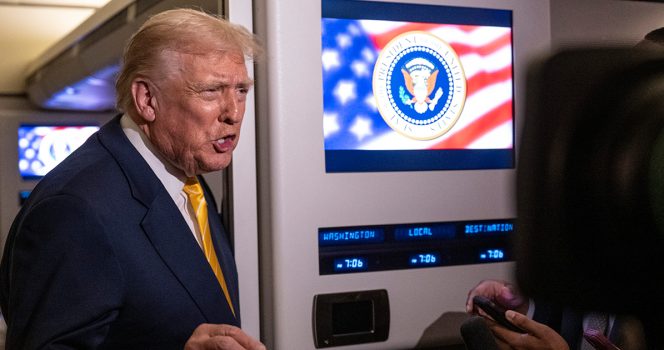
According to the confrontation occurred on Air Force One on November 14, as Trump faced questions about recently released emails from Epstein, who died in prison in 2019.
Trump dismissed the inquiry, saying he knew nothing about the messages and insisting the focus should be on others named in the files — including former President
When a Bloomberg reporter, Catherine Lucey, attempted a follow-up, Trump abruptly turned to her and said: “Quiet! Quiet, piggy.”
The brief exchange was caught on camera and quickly went viral, sparking outrage online. The footage shows Trump leaning in, pointing his finger, and delivering the remark in a sharp, unusual tone.
The reporter had begun asking: “If there’s nothing incriminating in the files, sir, why not…” before Trump cut her off.
Trump’s remark comes amid growing calls for the Justice Department to release all records related to Epstein. Over the weekend, he reversed his position, urging Republicans to back a bill demanding the release of the files.
The online reaction was swift and fierce.
One Twitter/X user wrote: “This is the president of the United States, who himself is overweight, calling another person piggy,” even posting a picture of the Muppet Miss Piggy alongside the comment.
Another added: “Just imagine ANY OTHER President saying that to a female journalist in a gaggle.”
Reddit users piled on, some using humor to highlight the moment. “Female reporters should from here on out start addressing him as Mr. Fat F*,”** one wrote, while another slammed the press:
“The fact that the whole White House Press Corps just silently sits by and lets Trump do this to their colleagues is one of the most spineless things happening in Washington today.”
On Tuesday, MSNBC senior White House correspondent Vaughn Hillyard posted on X that the administration had weighed in on the growing backlash.
According to Hillyard, officials defended Trump’s behavior by shifting blame to the reporter herself, saying: “This reporter behaved in an inappropriate and unprofessional way towards her colleagues on the plane. If you’re going to give it, you have to be able to take.”
What exactly Lacey was accused of doing to fellow reporters remains unclear. But critics note that this kind of deflection is entirely in line with how the Trump team typically responds to press controversies—and mirrors the president’s long-running hostility toward the media.
This isn’t Trump’s first public clash with reporters. Over the weekend, he also fired a sharp four-word rebuke at a journalist who interrupted one of his impromptu briefings: “You are the worst. I don’t know why they even have you.”
And earlier this week, Trump targeted ABC correspondent Mary Bruce after she brought up the 2018 killing of Jamal Khashoggi by Saudi agents.
He suggested that his ally, FCC Chairman Brendan Carr, should consider taking action against ABC over its reporting.
“I think the license should be taken away from ABC because your news is so fake and it’s so wrong,” he said.
The latest incident has reignited concerns about how Trump engages with the press, drawing condemnation for his choice of words and his targeting of a female journalist in particular.
The first signs didn’t roar—they whispered. They came like missing keys, like tiny cracks in the surface of an ordinary day. Mark forgot a line in a script, misplaced his keys twice in one morning, or paused mid-sentence as if the thread of thought had suddenly snapped.
At first, the family laughed it off. They blamed it on a packed schedule, the stress of constant work, the frantic rhythm of life scattering the maps we carry in our pockets. But laughter eventually thinned to silence. When Mark started losing more than time—when meals became only a few reluctant bites, when evenings dissolved into long, heavy naps—shadows stretched longer across the walls of their home.
Tests were ordered as a precaution, but the results came like a sharp blade. The diagnosis arrived in a language both sterile and brutal: cancer. That word sat between Kelly and Mark like a hot plate, something that required gloves, deliberation, and a kind of fragile tenderness to approach.
This is the story of that week—and the weeks that bruised around it. The quickening of hospital lights, the collapse in a rain-streaked corridor, the media circus that tried to turn private grief into public headlines, and the small, stubborn rituals that kept a family from dissolving into the noise.
The decision to admit him felt sudden because fear never respects calendars. One day they were discussing scripts and the family dog’s house-training rebellion. The next, the walls of their home felt the wrong color for the mood they carried.
The oncologist used the word “aggressive.” It moved faster than they had hoped. There was no melodrama in the clinic—only the practiced cadence of professionals who know how to deliver devastating news without coating it in false optimism.
Mark, who had lived much of his life under bright studio lights, met the verdict with a calm so practical it might have been mistaken for denial. “Okay,” he said. One word. Not a small one.
Kelly looked at him with the quiet terror of someone who knows how fragile the scaffolding of daily life can be when one bolt comes loose.
The kids—Michael, Lola, and Joaquin—rearranged their lives with the disciplined tenderness that made Kelly both proud and heartbroken. Michael juggled college commitments and hours in hospital waiting rooms. Lola wrote questions on small slips of paper and pressed them into her mother’s hand like charms. The family’s world became a map of calls, calendars, and contingency plans.
At the hospital, Kelly learned a new language—one written in lab values, machine names, and medical jargon. She memorized the nurses’ faces, the rhythm of shift changes, the logic behind medication charts. Every day was a vocabulary test she could not afford to fail.
Outside the hospital, the media tide surged. Photographers camped at the entrance. Social feeds exploded with speculation. A photograph of Kelly walking out of the hospital, head bowed, mascara streaking down her cheeks, ricocheted across platforms with captions screaming: “Kelly Ripa Collapses in Tears.”
The family issued a brief statement—gratitude for the concern, a plea for privacy, a promise to share updates when possible. Words like these are thin armor, a blanket thrown into a storm, hoping it will stay put.
On the third night, Mark’s condition spiraled. A fever spiked. Blood pressure plunged. The soft hum of monitors erupted into alarms. Nurses moved with the kind of choreography that looks rehearsed only because it has been practiced for years.
He was wheeled into the ICU—a geometry of fear shaped by glass doors, sterile light, and the relentless hiss of machines. Doctors spoke of secondary infections and organ strain, the cascading effects that catch even seasoned professionals off guard. They threw everything at it—broad-spectrum antibiotics, targeted therapies, aggressive supportive care. But no one offered promises.
Kelly’s world shrank to the narrow orbit around an ICU bed. One hand answered calls, the other rested on her husband’s wrist, keeping time with his pulse. She found rhythm in small gestures: straightening a blanket, smoothing his hair, asking a nurse about the meaning behind a number glowing green on a screen.
In the quiet hours, she slipped notes into his hospital gown: recipes for his favorite meals, embarrassing family anecdotes, reminders to water the plants. Little lifelines tethered to a future she refused to let go of.
One afternoon, while stepping into the corridor to take a call, Kelly’s body gave way. Weeks of vigilance, stress, and sleepless nights drained her like an unplugged battery. She crumpled to the cold linoleum floor.
The next morning, photos of her being helped into an ambulance plastered newsfeeds with headlines screaming: “Kelly Ripa Hospitalized Amid Husband’s Health Crisis.” The public speculated. Commentators demanded statements. Social media, hungry for verdicts, offered no space for the slow breathing of grief.
And yet, between these violent storms, moments of light slipped through. Mark opened his eyes and smirked at a joke. A monitor’s line tilted favorably. These were treated like holy days. The kids celebrated with secret handshakes in the waiting room and pizza deliveries that tasted like normal life.
But illness is a road of hairpin turns. After hope came setbacks: a spike of pain, a bout of rapid breathing, a night where nothing seemed enough. The family learned to make the small choices that mattered when the big ones felt immovable: which flowers to accept, which questions to ask now versus later, when to sleep and when to keep watch.
They talked about wills and medical proxies in voices flat with practicality. College plans. Projects on hold. Conversations that felt both brutal and necessary.
Then, without fanfare, the tide began to shift. The antibiotics, fluid management, and targeted therapies aligned like constellations. The fever broke. The numbers steadied. The alarms hushed back to a soft hum.
No one called it victory—only a fragile reprieve. But in that small, still moment, Kelly curled her fingers through his and whispered—not for cameras, not for headlines, only for him:
“We still have time.”