The impact of the ongoing government shutdown has reached new and alarming heights as Burbank Airport’s air traffic control tower went unmanned Monday evening.
Federal officials confirmed that air traffic controllers have begun calling out in large numbers, citing financial strain, exhaustion, and uncertainty caused by the Democrat-led shutdown now grinding into its third week.
The situation has raised serious concerns about air safety, delays, and the cascading effect across America’s aviation infrastructure.
By Monday evening, the control tower at Hollywood Burbank Airport—one of the busiest regional hubs in Southern California—was left without staff, forcing operations into a state of near paralysis.
According to aviation sources, controllers began walking off the job earlier that afternoon, citing the impossibility of continuing to work without pay. Some flights were diverted to nearby Los Angeles International Airport, while others were delayed indefinitely as pilots awaited clearance that never came.
“This is not a drill. The tower is empty,” a source within the Federal Aviation Administration (FAA) told reporters. “Controllers have been working double shifts since the shutdown began. They’re overworked, underpaid, and now unpaid. Some simply can’t afford to show up anymore.”
The FAA had already warned of potential disruptions to air traffic control services as the shutdown continued to drag on. However, few expected the crisis to reach this point—where major airfields in metropolitan areas like Burbank would effectively lose their tower personnel.
The situation unfolding in Burbank is emblematic of the human toll caused by the shutdown. With thousands of federal employees furloughed or forced to work without pay, many essential services have been crippled.
Air traffic controllers, in particular, have been among the hardest hit. Responsible for managing millions of passengers every day, these federal workers have been stretched to their breaking point.
Several controllers spoke anonymously to local media, describing the strain of working under such conditions. “We’ve gone two pay periods without a paycheck,” said one controller based in Burbank. “I have a mortgage, kids in school, bills to pay. I love my job, but I can’t keep working for nothing while politicians argue.”
Their sentiments are echoed across the country. Reports from Atlanta, Dallas, and New York indicate that increasing numbers of controllers are calling in sick or resigning entirely, leaving critical control rooms understaffed.
Many are forced to take temporary jobs to cover rent and groceries while trying to balance their professional responsibilities.
Aviation experts warn that the situation could soon spiral into a full-blown national safety crisis. Without adequate staffing, flight delays are increasing, and the potential for midair incidents is growing.“
Air traffic control isn’t a system you can partially operate,” said retired FAA supervisor Michael Hanley. “If you don’t have enough eyes on the radar, people could die. Every hour that tower stays empty at Burbank increases the risk exponentially.”
Even when the shutdown ends, Hanley noted, the damage may already be done. “Controllers are like surgeons. They rely on precision, rhythm, and teamwork. After weeks of stress and chaos, even the most experienced personnel will need time to recalibrate. The system doesn’t just switch back on.”
As with every government shutdown, the blame has become a political football in Washington. Republicans accuse Democrats of orchestrating the shutdown as part of a pressure campaign to reverse recent Republican budget legislation and restore funding for policies benefiting illegal immigrants.
Democrats, meanwhile, continue to insist that Republicans are responsible for failing to meet their demands on healthcare and spending priorities.
Senate Majority Leader John Thune denounced what he called a “Democrat-manufactured crisis,” arguing that the minority party is holding the government hostage for political gain.“
The Democratic Party’s leadership has decided that the suffering of American workers and travelers is acceptable collateral damage for their political theater,” Thune said in a statement.
House Speaker Mike Johnson echoed those concerns, saying, “The scenes from Burbank Airport are exactly what happens when you prioritize ideology over governance. Air traffic controllers should never be forced to choose between feeding their families and keeping the skies safe.”
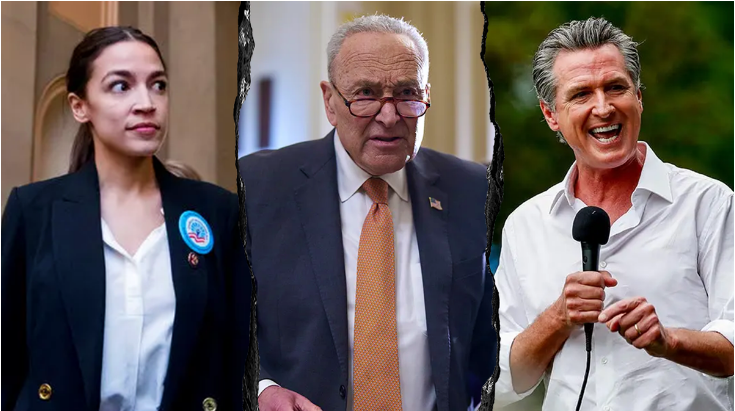
Democratic leaders, however, pushed back, accusing Republicans of fearmongering. Senate Minority Leader Chuck Schumer stated that “Republicans have refused to compromise on a funding plan that keeps Americans healthy and safe,” referring to the GOP’s refusal to accept Democratic demands tied to Medicaid expansion and environmental projects.
The shutdown’s effect on air travel has struck a nerve with the American public, as millions of travelers face delays, cancellations, and uncertainty. Social media has been flooded with accounts from stranded passengers, with many posting videos showing chaotic airport scenes and frustrated travelers demanding answers.
“Three canceled flights, zero communication, and no one in the tower,” wrote one passenger stuck at Burbank Airport. “We’re watching the system collapse in real time.”
The outrage has spread beyond travelers. Business leaders and tourism officials have warned that prolonged disruptions to air traffic could inflict severe economic damage.
The Los Angeles Chamber of Commerce issued a statement Monday night urging Congress to “immediately restore funding to critical federal operations.”
“Los Angeles County depends on efficient air travel for commerce and tourism,” the statement read. “This shutdown jeopardizes our economy, our safety, and our reputation as a global hub.”
The Department of Homeland Security (DHS) and the FAA have both been scrambling to contain the fallout. DHS Secretary Kristi Noem acknowledged the crisis in a brief press conference late Monday.
“We are working around the clock to stabilize air operations and ensure public safety,” she said. “We are moving qualified supervisors and retired personnel to critical control towers to prevent further disruption.”
However, officials admit that such measures are only stopgaps. “You can’t just plug in retirees and expect normal operations,” said one FAA insider. “Most of them haven’t been on live control boards in years. This is like trying to replace a brain surgeon with a medical student.”
In Burbank, local airport authorities have issued a temporary Notice to Air Missions (NOTAM), warning pilots that tower operations may be intermittent or unavailable until further notice.
Several commercial carriers, including Southwest Airlines and Alaska Airlines, announced partial schedule adjustments to reduce congestion around the airport.
The shutdown’s impact is not limited to aviation. Economists are warning that prolonged disruption to federal operations could cause ripple effects throughout the national economy.
According to recent projections, every week of shutdown costs the U.S. economy approximately $1.8 billion in lost productivity and consumer confidence. The aviation industry alone accounts for roughly $150 billion in annual economic activity, much of which depends on seamless coordination between federal agencies.
If the current shutdown persists, travel analysts warn that the consequences could mirror or exceed those of the 2019 shutdown, which cost the U.S. an estimated $11 billion.
“We’re looking at an enormous economic domino effect,” said transportation economist Dr. Amelia Grant. “From small businesses that rely on cargo shipments to tourism operators, everyone feels it.”
As the shutdown drags on, the political consequences are mounting. Polls suggest growing frustration among voters, with many blaming Democrats for prolonging the crisis. Analysts say that the images of empty air traffic towers and stranded passengers could become defining symbols of political dysfunction.
“The optics are disastrous,” said political strategist Henry Lawson. “You have federal workers not being paid, airports descending into chaos, and leaders in Washington pointing fingers. This is exactly the kind of crisis that erodes public trust.”
Republicans are seizing on the moment to frame the situation as a failure of Democratic leadership. “The Democrats said they’d govern responsibly,” said Representative Elise Stefanik. “Instead, they’ve shut down the government and endangered Americans. The chaos in Burbank is just the beginning.”
For now, Burbank Airport remains partially operational, with air traffic handled remotely through neighboring control centers—a temporary and less efficient measure. Passengers are being urged to check flight statuses before arriving at the airport and to expect delays.
Federal officials say they are working to restore staffing levels, but until Congress reaches a funding agreement, there are no guarantees. “If the shutdown continues through the week, more towers could go dark,” said an FAA spokesperson. “It’s not a question of if, but when.”
As darkness fell over Burbank on Monday night, the airfield lights still blinked across the tarmac, but the control tower’s windows remained dark—an ominous symbol of a government in paralysis.
For travelers, workers, and pilots alike, the message was clear: the cost of political gamesmanship is now measured not only in dollars but in danger.
For years, one name haunted the political establishment — a man once praised as incorruptible, later accused of weaponizing the highest law enforcement agency in the nation.
Now, that same man faces a criminal indictment.
And in the hours after the news broke, a powerful message echoed across Fox News: “The weaponization of the legal system has ended.”
Those words came from Attorney General Pam Bondi, who appeared on Hannity Friday night — a segment that instantly went viral, not only for her fiery tone but for what it symbolized.
A turning point. A reckoning. The end of an era that had once placed former FBI Director James Comey at the center of American politics.
When the Justice Department confirmed the indictment Thursday afternoon, it sent shockwaves through Washington.
Comey — the man whose public image once rested on a reputation for integrity — now stood accused of lying to Congress and obstructing an investigation.
Two felony counts.
One fallen icon.
And a nation watching.
For many Americans, especially those who had followed the saga of the Russia probe from the beginning, the moment felt surreal.
How had the country gone from lionizing James Comey as a defender of democracy to seeing him booked on federal charges?
Bondi’s answer was blunt.
“You shouldn’t be nervous any longer,” she told Sean Hannity. “Because Donald Trump is in office — and the weaponization has ended.”
Her words cut through the noise.
Bondi’s statement wasn’t just a soundbite — it was a declaration.
For years, conservatives had accused the FBI and DOJ of becoming political weapons, targeting Trump and his allies while protecting the Washington elite.
Comey, who once led the FBI during some of the most divisive political investigations in modern history, had become a symbol of that imbalance.
Now, Bondi was promising accountability.
“Whether you’re a former FBI director, whether you’re a former head of an intel community, whether you’re a current state or local elected official, whether you’re a billionaire funding organizations to try to keep Donald Trump out of office — everything is on the table,” she said.
Her message was clear: no one, not even a man who once ran the FBI, would be above the law.
It’s been almost a decade since Comey first dominated national headlines.
In 2016, he was the man who publicly reopened the investigation into Hillary Clinton’s private email server just days before the presidential election — a move that infuriated Democrats and stunned the media.
Months later, he became the man who helped ignite the Russia investigation, authorizing the use of the Steele dossier, a collection of unverified claims about then-candidate Donald Trump’s alleged ties to Moscow.
That dossier, now widely discredited, became the backbone of Crossfire Hurricane, the FBI’s 2016 probe into Trump’s campaign.
The investigation dragged on for years, damaging public trust and deepening the partisan divide.
When Trump fired Comey in May 2017, the political world erupted. His dismissal became the catalyst for the appointment of Special Counsel Robert Mueller, whose two-year investigation ended without charging Trump or any of his aides with collusion.
But the damage was done — and Comey’s name became forever linked to one of the most controversial chapters in U.S. political history.
According to the indictment filed Thursday, Comey faces two federal charges:
One count of making a false statement within the jurisdiction of Congress
One count of obstruction of a congressional investigation
Prosecutors allege that Comey lied under oath when he claimed during a 2020 Senate Judiciary Committee hearing that he had not authorized anyone at the FBI to act as an anonymous source for media leaks.
They also accuse him of obstructing a congressional inquiry into the origins of the Russia investigation by concealing evidence and misleading lawmakers about the FBI’s use of the Steele dossier.
If convicted, Comey could face up to 10 years in federal prison.
But beyond the legal implications, the indictment has reignited a national debate — one that stretches far beyond the courtroom.
To Bondi, the indictment represented more than a criminal case — it represented a moral correction.
“We will investigate you, and we will end the weaponization,” she told Hannity. “No longer will there be a two-tier system of justice.”
“We are working hand-in-hand — Director Kash Patel, Todd Blanche, DNI Tulsi Gabbard, CIA Director John Radcliffe — going non-stop around the clock. People will be held accountable.”
It was a rare moment of unity among the Trump administration’s top law enforcement officials.
Each had played a role in unraveling the complex web of investigations that had once targeted the president — from Patel’s work uncovering suppressed FBI records to Gabbard’s recent declassification of Obama-era intelligence reports.
Now, that same team was turning the spotlight back on the agencies that once investigated them.
Just weeks before the indictment, FBI Director Kash Patel had made a startling discovery.
Inside the bureau’s Washington headquarters, agents found several “burn bags” — containers typically used to destroy sensitive materials.
But these weren’t empty.
Inside were thousands of pages of documents tied to Crossfire Hurricane, including internal memos, classified annexes, and even intelligence reports that had never been shared with the Trump administration.
“We just uncovered burn bags filled with hidden Russiagate files,” Patel wrote on X. “They were buried — literally.”
Among the documents, Patel said, was a classified annex to Special Counsel John Durham’s final report, which further discredited many of the claims used to justify the Russia investigation.
That annex, Patel claimed, contained proof that senior FBI officials had knowingly used false intelligence to obtain surveillance warrants against members of Trump’s campaign.
The discovery reportedly accelerated the Justice Department’s decision to bring the case against Comey.
The indictment centers around Comey’s 2020 Senate testimony, during which he told lawmakers he was unaware of any internal problems with the Steele dossier and claimed he “did not authorize” anyone to leak information from the FBI to the media.
Prosecutors allege that both statements were false.
Court documents show that Comey not only received multiple internal warnings about the dossier’s lack of credibility but that he had personally approved at least one FBI official to serve as an anonymous source for several media outlets.
The indictment cites internal communications from 2016 showing that Comey had been briefed on the political origins of the Steele dossier — specifically, that it was funded by the Democratic National Committee and the Clinton campaign.
Despite that knowledge, prosecutors allege, Comey allowed the FBI to continue using the dossier to justify surveillance of Trump adviser Carter Page.
For Comey, the legal battle marks a stunning reversal.
He was once the man leading investigations.
Now, he is the one being investigated.
It’s a fall that many conservatives view as poetic justice — the closing of a long and bitter chapter in American politics.
“This is accountability,” Bondi said. “For years, Americans watched people like Comey, Brennan, and Clapper lie under oath with no consequences. That era is over.”
The indictment of Comey also casts a long shadow over the Justice Department itself, forcing a new wave of scrutiny over how the FBI operated during the final months of the Obama administration.
Bondi’s remarks touched on a phrase that has become central to the Trump movement: the two-tier system of justice.
To millions of Americans, it represents a perceived imbalance — one where elites escape punishment while ordinary citizens face the full force of the law.
Bondi’s vow to “end the weaponization” resonated deeply among Trump supporters who see the Comey indictment as validation that the system can still correct itself.
On social media, conservative commentators hailed the indictment as “the most significant since Watergate.”
Others saw it as the long-awaited unraveling of the “deep state” that Trump had warned about since 2016.
The FBI launched Crossfire Hurricane in the summer of 2016, based on information from a foreign diplomat alleging that a Trump campaign adviser had prior knowledge of Russian hacking operations.
The investigation soon expanded into a sprawling counterintelligence operation, relying heavily on the Steele dossier — a collection of opposition research that has since been discredited.
When Special Counsel Robert Mueller released his report in 2019, he concluded that Russia had interfered in the 2016 election to help Trump but found no evidence of criminal coordination between the campaign and Moscow.
Despite that finding, the political fallout lasted for years.
Now, the tables have turned.
One of the most explosive new voices in the Trump administration is Director of National Intelligence Tulsi Gabbard — a former Democrat who broke with her party and joined Trump’s national security team.
Last month, Gabbard declassified documents she said “undercut” the 2017 intelligence report that accused Russia of favoring Trump.
“We now know that Obama-era officials coordinated a treasonous conspiracy to undermine a sitting president,” Gabbard said. “It was a years-long coup.”
She vowed to refer the matter to the Justice Department for potential criminal charges — a move that, according to insiders, may have played a key role in the decision to indict Comey.
As the legal case against Comey moves forward, America finds itself once again split down the middle.
Supporters of the former FBI director argue that the indictment is politically motivated — an act of revenge by a president long obsessed with clearing his name.
Trump’s allies, meanwhile, see it as long-overdue accountability.
Either way, the implications are enormous.
If Comey is convicted, it would mark the first time in U.S. history that a former FBI director has been criminally charged for actions taken while in office.
If he is acquitted, it could fuel claims that the “deep state” remains untouchable.
When Bondi said the weaponization of the legal system has ended, she wasn’t just referring to Comey’s indictment.
She was signaling a broader shift — one that Trump’s team sees as the restoration of fairness in a justice system long accused of bias.
“People will be held accountable,” Bondi repeated. “No matter how powerful they are. No matter who they worked for. No matter how long it takes.”
That message resonated across conservative media, with supporters framing the moment as the political and moral reversal of the entire Russiagate era.
For them, it’s not just about Comey — it’s about closure.
James Comey once called himself “the last honest man in Washington.”
He wrote a memoir titled A Higher Loyalty.
He told Congress that “no one is above the law.”
Now, those very words have come back to haunt him.
As one commentator wrote online after the indictment was announced:
“Comey’s higher loyalty turned out to be to himself. And justice finally caught up.”
The Justice Department has not announced when Comey’s trial will begin, but insiders expect pre-trial motions to start within weeks.
Bondi, Patel, and Gabbard have all promised that this is just the beginning — not the end.
“The days of immunity for the powerful are over,” Patel said. “The same justice system that was used to attack a president will now hold his attackers accountable.”
For the millions of Americans who watched the Russia investigation unfold in real time, the sight of James Comey facing charges may feel like vindication.
For others, it is a chilling reminder of how deeply politics has penetrated every corner of the American justice system.
Either way, history has turned a page.
And the name James Comey, once synonymous with power and integrity, will now be remembered as the symbol of a system that finally met its reckoning.