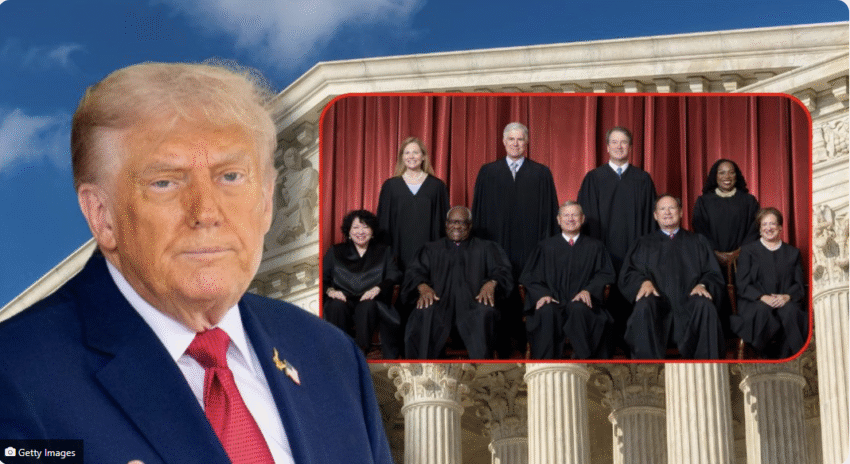

The Supreme Court has cleared the path for the Trump administration to deport a group of immigrants held at a U.S. military base in Djibouti to South Sudan.
In a brief opinion issued on Friday, the justices affirmed that their prior order, which stayed a federal judge’s ruling in Massachusetts that had restricted the government’s ability to deport immigrants to countries not explicitly named in their removal orders, applies in full to the eight immigrants currently in U.S. custody in Djibouti.
The order came less than two weeks after the high court temporarily stayed a ruling by U.S. District Judge Brian Murphy, whose order barred the federal government from deporting immigrants to “third countries”—those not explicitly named in their removal orders—without first ensuring, through a series of safeguards, that the individuals would not face torture upon deportation.
Murphy’s May 21 ruling found that the government violated his April 18 order by attempting to deport eight men to South Sudan. The U.S. has evacuated all non-emergency personnel from South Sudan, and the State Department advises against travel there due to “crime, kidnapping, and armed conflict.”
The flight carrying the immigrants bound for South Sudan instead landed in nearby Djibouti, where the men have since been held at a U.S. military base.
On May 27, the Trump administration appealed to the Supreme Court to stay Murphy’s April 18 order, seeking permission to proceed with “third country” removals while the legal battle over the practice unfolds.
U.S. Solicitor General D. John Sauer contended that Murphy’s “judicially created procedures are currently wreaking havoc on the third-country removal process” and “disrupt[ing] sensitive diplomatic, foreign policy, and national-security efforts.”
Lawyers representing the immigrants facing potential third-country removals urged the justices to uphold Murphy’s order. They emphasized that the government could still proceed with these deportations, but Murphy’s order “simply requires” the Trump administration “to comply with the law” in doing so.
Several hours after the Supreme Court responded to the Trump administration’s first request, made on June 23, Murphy then claimed that his May 21 order remained unaffected by the high court’s decision.
The Trump administration returned to the Supreme Court the following day, requesting that the justices clarify the federal government’s authority to proceed with deporting the immigrants currently held in Djibouti. Sauer urged the court to act swiftly to address what he called Murphy’s “unprecedented defiance” of the court’s authority.
In Thursday’s brief, an unsigned 7-2 opinion, the majority indicated that the court’s “June 23 order stayed the April 18 preliminary injunction in full. The May 21 remedial order cannot now be used to enforce an injunction that our stay rendered unenforceable.”
Two of the Supreme Court’s liberals, Justices Sonia Sotomayor and Ketanji Brown Jackson, dissented, while the third liberal, Justice Elena Kagan, sided with the court’s conservative majority.
She noted that she had previously disagreed with the Supreme Court’s original ruling permitting third-country removals to proceed. “But a majority of this court saw things differently, and I do not see how a district court can compel compliance with an order that this court has stayed,” she wrote.
The eight illegal immigrants include individuals from Cuba, Vietnam, and Laos, reports noted.
Sotomayor’s dissent contended that “[w]hat the Government wants to do, concretely, is send the eight noncitizens it illegally removed from the United States from Djibouti to South Sudan, where they will be turned over to the local authorities without regard for the likelihood that they will face torture or death.”
She argued that the court should not have considered the government’s request at all, as the government should have made its arguments in the lower courts first. Moreover, she suggested that the Supreme Court’s “continued refusal to justify its extraordinary decisions in this case, even as it faults lower courts for failing to properly divine their import, is indefensible.”
Senate Minority Leader Chuck Schumer on Tuesday proposed a one-year extension of federal subsidies under the Affordable Care Act (ACA)
Schumer’s plan would temporarily preserve ACA subsidies set to expire at the end of the fiscal year, ensuring that millions of Americans who rely on federal assistance to afford health insurance would not see their premiums rise. In addition, he called for the creation of a
bipartisan committee tasked with developing a longer-term compromise on healthcare and budget policy. The Democratic leader described his proposal as a “good-faith effort” to reopen the government while maintaining vital health protections.
“Republicans should just say yes,” Schumer said during remarks from the Senate floor. “This is a responsible path forward that keeps the government open, protects families’ healthcare, and allows both sides to continue negotiating in good faith.” His comments were aimed at
Republican leaders, who have been pushing their own plan to fund the government while making broader cuts to domestic spending and entitlement programs.
Democrats have so far resisted the Republican proposal, arguing that it would weaken healthcare coverage, reduce social safety nets, and impose long-term harm on working families. They maintain that the ACA subsidies, first expanded during the COVID-19 pandemic, have become a cornerstone of affordable healthcare for millions of Americans. Allowing them to lapse, Schumer and his allies warn, could lead to widespread coverage losses and premium spikes nationwide.
Republican leaders, however, have accused Democrats of using the government shutdown to advance partisan policy goals. They argue that Schumer’s proposal represents a short-term fix rather than a genuine effort to address the underlying fiscal issues driving the budget crisis. Some GOP senators have also expressed frustration over what they describe as the White House’s unwillingness to negotiate on spending reforms and energy policy provisions included in the Republican plan.
Despite the political tension, both parties have signaled interest in continuing talks to reach a funding agreement before federal operations are further disrupted. Essential services have remained operational, but a prolonged shutdown could affect pay for federal workers, slow economic growth, and disrupt a wide range of government programs. The White House has called on Congress to approve a temporary spending measure to avoid deeper fallout.
As negotiations continue, Schumer’s offer appears aimed at shifting the pressure back onto Republican lawmakers by combining a politically popular healthcare measure with a call for bipartisan cooperation. Whether the proposal gains traction remains uncertain, but it adds a new dimension to the high-stakes standoff on Capitol Hill — one that could determine not only how soon the government reopens but also the future of healthcare policy heading into the next election year.
Iceland’s Relentless Awakening: When Fire and Ice Collide Beneath Grindavik’s Skies
Iceland — a nation sculpted by glaciers and volcanoes — has once again found itself balancing on the edge of awe and anxiety.
What began as a breathtaking display of nature’s artistry has evolved into a long and uncertain ordeal for those living closest to the Earth’s fiery core. In the small coastal town of Grindavik, where nearly 4,000 residents once led peaceful lives between ocean waves and steaming lava fields, the ground now quivers with restless energy. The once-stable soil has fractured, homes have been threatened, and a community has learned what it truly means to live in the shadow of creation itself.
A Region Stirring from Centuries of Silence
For hundreds of years, the Reykjanes Peninsula had remained quiet — its volcanoes dormant, its fissures sealed. Then, in 2021, the Earth began to stir. A faint hum of earthquakes signaled a reawakening deep below the crust. Scientists at the Icelandic Meteorological Office watched in fascination as magma began moving upward, hinting at a new volcanic chapter in the nation’s long and storied geological history.
The early eruptions were spectacular yet merciful. They illuminated the night skies without claiming lives, drawing scientists, photographers, and tourists eager to witness the rebirth of Iceland’s fiery heart. But as the activity persisted into 2023 and 2024, excitement gave way to unease. What had begun as a distant wonder had crept dangerously close to people’s homes.
When the Earth Opened Beneath Grindavik
By late October 2023, the tremors beneath Grindavik had grown impossible to ignore. The town’s streets cracked, water pipes burst, and the ground itself seemed to breathe. Then, in December, a fissure tore open northeast of the town — a violent reminder that Iceland lives upon moving ground. Molten rock surged upward, spilling across barren plains toward inhabited zones. Although the eruption ended after three days, it served as an unmistakable warning: the peninsula’s dormant power was awake again.
Another eruption in January 2024 reinforced the threat. Lava surged perilously close to Grindavik, destroying three evacuated homes on the outskirts. Thankfully, no one was harmed — a testament to Iceland’s advanced alert systems and swift evacuations. Through satellite imagery, ground-based sensors, and real-time drone surveillance, authorities managed to stay one step ahead of disaster, ensuring that what could have been a national tragedy became a remarkable story of preparedness.
A Year Under Fire
As 2024 unfolded, the volcanoes refused to rest. The Sundhnúksgígar crater row — a long chain of fissures and vents — became the epicenter of ongoing eruptions. The Earth erupted intermittently throughout the year: brief outbursts in February and August, followed by continuous flows from March through April and again in May.
Each eruption brought awe-inspiring spectacles — glowing fountains of lava leaping into the air, rivers of molten rock snaking through the darkness — but also logistical nightmares. Roads were blocked, air quality declined, and residents endured weeks of uncertainty. For scientists, these events provided an unprecedented opportunity to study how Iceland’s crust behaves under pressure. For locals, however, it was a year defined by vigilance, adaptation, and the constant hum of the planet beneath their feet.