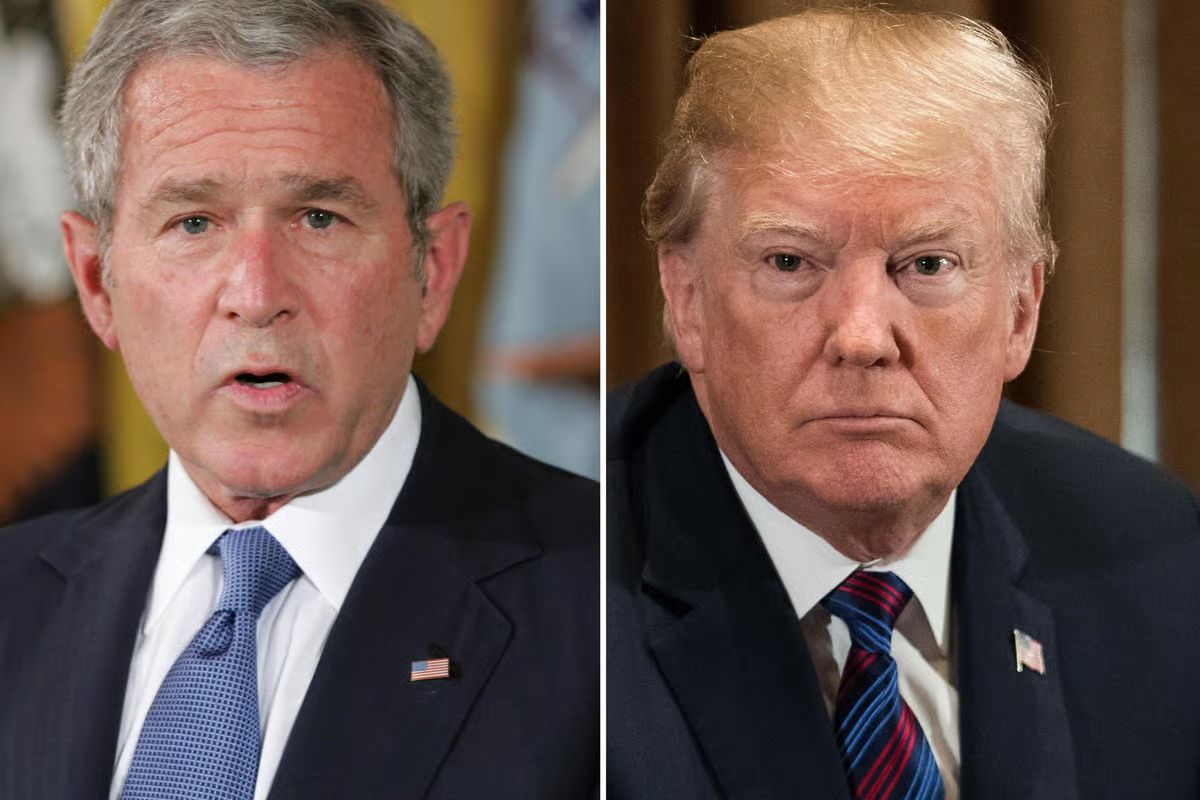
Rumors are circulating once again in Washington that the Bush political dynasty is quietly preparing a comeback, aiming to reclaim control of the Republican Party from President Donald Trump once he eventually leaves office. According to a recent report, members of the Bush family and their network of operatives are positioning themselves to revive the establishment brand of Republicanism that voters overwhelmingly rejected in favor of Trump’s America First movement.
The Daily Mail reported that a “shadow Republican Party” connected to the Bush family is “lying in wait” to reassert itself after years of political exile. These operatives, bundlers, and longtime strategists reportedly believe the party will be vulnerable to takeover the moment Trump is no longer on the ballot.
Sources close to the Bush network told the outlet that former President George W. Bush has no plan to openly criticize Trump. But behind the scenes, they say, he may be willing to help shape what they hope will be a post-Trump future. The reported effort suggests the establishment wing of the GOP believes the populist realignment that began in 2016 can be reversed.
A former Bush official reportedly told the outlet that Trump “knows that there’s no third term option,” framing the end of Trump’s presidency as an opening for a return to pre-Trump Republicanism. But they also acknowledged that Vice President JD Vance, Trump’s chosen successor, already has “a head start” for the 2028 nomination.
The official predicted that the GOP field in 2028 would be “wide open,” a suggestion that Trump’s enduring influence may weaken as new contenders emerge. Establishment Republicans appear to be banking on Vance failing to maintain the movement or Trump stepping aside entirely.
Michael Steele, the former Republican National Committee chair who has long opposed Trump and sided with Democrats on many issues, reportedly urged Bush to “get involved” to pull the party back toward the establishment. Steele claimed Bush “has a voice that would resonate with a lot more Americans,” reflecting the view that the country wants a return to the pre-Trump status quo.
Steele’s remarks underscore what many conservatives see as the real goal. It is not about unity or stability. It is about restoring the old guard that spent decades losing elections, empowering global institutions, and entangling the nation in foreign wars that cost thousands of American lives.
The report also resurfaced past comments from Bush aimed at undermining Trump. In a 2021 CBS interview, Bush criticized the president for lacking what he called “humility.” Bush used similar rhetoric throughout Trump’s first term, often echoing Democrat talking points about norms and leadership tone.
Bush also blasted Trump’s America First foreign policy as “isolationist” and “dangerous for the sake of peace,” despite presiding over the destabilizing wars in Afghanistan and Iraq. More than 4,500 American service members died in Iraq under Bush’s leadership, a fact that the America First movement frequently cites when contrasting the two visions of Republican foreign policy.
Trump’s supporters say Bush’s criticism reveals the broader divide between the establishment and the post-2016 GOP. One side favors endless war, open borders, and corporate trade deals. The other prioritizes American workers, strong borders, and peace through strength.
The fact that the Bush family is reportedly plotting a political comeback is seen by many conservatives as proof that the America First movement remains a threat to the old power structures. These structures flourished for decades before Trump but have struggled to remain relevant as the party’s base shifted dramatically.
The idea of a “Bush Exile” highlights the sharp decline of a family once seen as untouchable in Republican politics. Their influence collapsed almost overnight when Trump defeated Jeb Bush in the 2016 primaries and dismantled the policies that defined the Bush era.
Trump’s ongoing popularity has effectively kept the Bush brand sidelined. The former president remains the dominant force within the GOP, with polling consistently showing that Republican voters overwhelmingly prefer the America First direction over establishment nostalgia.
The report suggests that the Bush network hopes the 2028 cycle will be its opportunity to reemerge. But with JD Vance already solidifying his credentials and maintaining strong support among Trump voters, establishment Republicans face an uphill battle if they intend to challenge the movement.
Conservative voters largely view the Bush family’s reemergence as a threat. Many see it as an attempt to reverse the political revolution that put American workers ahead of globalist priorities. They argue that any effort to retake the GOP from Trump is really an effort to retake it from the voters.
The Bush family’s silence after the death of former Vice President Dick Cheney raised additional questions. Neither Trump nor Vance attended Cheney’s funeral, highlighting the widening gap between the establishment wing and the current leadership of the Republican Party.
The report paints a clear picture of a political dynasty waiting for the right moment to reinsert itself. But it also highlights the reality that the party has moved on. The policies, worldview, and legacy of the Bush era have little support among the current Republican base.
In one of the most talked-about political moments of the year, Senator John Kennedy of Louisiana responded to a provocative tweet from Representative Alexandria Ocasio-Cortez (D-NY) with a move that stunned the nation — not with insults or outrage, but with receipts. During a live, nationally televised forum, Kennedy read aloud every tweet AOC had posted in a recent thread, line by line, without commentary, spin, or interruption. What followed wasn’t a debate. It was, as many observers called it, a reckoning.
The moment was sparked by a fiery exchange on social media earlier in the week. In a now-viral tweet, Ocasio-Cortez referred to Kennedy as “dangerous” and claimed that his rhetoric “needs to be silenced before it spreads further disinformation.” Though the tweet has since been deleted, screenshots circulated widely, igniting fierce commentary on both sides of the aisle.
Rather than respond online or through a standard press release, Kennedy chose a bold stage for his rebuttal: a prime-time appearance on America Tonight, a bipartisan forum on policy, media, and public discourse. Sitting beneath the studio lights, Kennedy opened a folder, pulled out a printed copy of AOC’s full Twitter thread, and addressed the audience.
“I’m not here to insult anyone,” he began, calmly. “I’m here to let the Congresswoman speak for herself — in her own words.”
He then read the entire thread out loud, including the tweet stating he “needs to be silenced,” as well as several others accusing him of perpetuating “right-wing extremism” and “toxic Southern populism.” Kennedy didn’t react. He didn’t mock. He didn’t even raise his voice. He simply read each tweet, pausing between them to let the words settle.
The silence in the studio was heavy.
After reading the thread, Kennedy closed the folder and spoke plainly to the camera.
“You may not like me. You may disagree with me. But in this country, we don’t silence each other. We argue. We debate. We persuade. That’s the American way,” he said, referencing the First Amendment.
Without raising a finger in retaliation, Kennedy flipped the discussion to a higher plane: “Congresswoman Ocasio-Cortez is free to call me anything she wants. That’s her right. But when you say someone needs to be silenced, you’re not just disagreeing with them — you’re threatening the foundation of this republic.”
The moment quickly gained traction on social media, where clips from the broadcast were shared across platforms with hashtags like #SilenceIsNotDemocracy and #KennedyVsAOC trending within the hour.
As expected, the political world erupted. Conservatives praised Kennedy for his restraint and clarity, calling the segment a “textbook lesson in free speech and constitutional values.”
“He didn’t attack her. He exposed her — with her own words,” Fox News host Jesse Watters said.
On the other side, progressives rallied around AOC, with some suggesting the Senator had taken the tweets out of context, even though he had read them in full. “Kennedy’s dramatics don’t change the fact that disinformation is real and dangerous,” tweeted one prominent AOC supporter.
Still, even some liberal commentators admitted that Kennedy’s move was effective.
“You may not agree with Kennedy, but you have to admit — that was a power move,” said CNN contributor Van Jones. “He didn’t yell. He didn’t deflect. He made people listen to what was actually said.”
Interestingly, AOC has yet to comment directly on Kennedy’s televised rebuttal. Her official Twitter and Instagram accounts have remained focused on legislative updates and community events, without reference to the incident. Whether she is regrouping, planning a formal response, or choosing to move on remains to be seen.
Meanwhile, Kennedy has seen a surge in public support, especially from moderates who view his actions as a defense of civil discourse at a time when it often seems under siege.
Beyond the partisan reactions, the moment struck a chord with everyday Americans weary of the toxicity in political debate. Kennedy’s decision to let AOC’s own words speak for themselves — and to then pivot to a principled defense of the First Amendment — gave many viewers something they hadn’t expected from politics: a sense of clarity.
In an age of soundbites and spin, the most powerful move may have been the simplest one — telling the truth, without commentary, and letting the public decide.
Whether this moment will shift the narrative or become just another viral flash in the endless culture war remains to be seen. But for one night, a U.S. Senator reminded the nation what democracy sounds like — unfiltered and unapologetic.