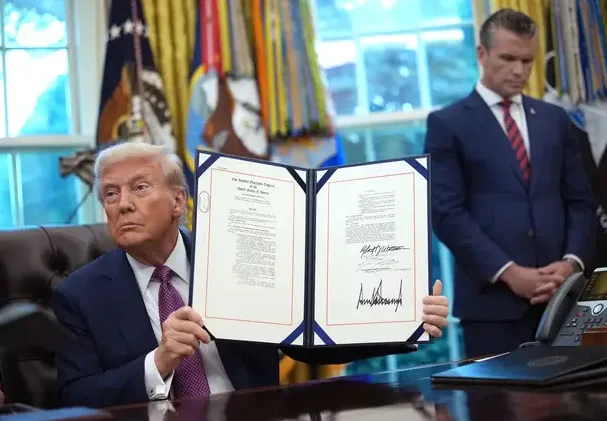
In a recent move to combat anti-Semitism, former U.S. President Donald Trump signed an executive order that has significant implications for foreign students and individuals involved in pro-Palestinian protests. This order authorizes the deportation of international students who participate in demonstrations perceived as anti-Israel, aligning with the administration’s broader strategy to address campus activities deemed supportive of organizations like Hamas.
The executive order, signed in late January 2025, directs federal agencies to identify and potentially revoke the visas of non-citizen students involved in such protests. The administration justifies this action by referencing immigration laws that permit deportation of non-citizens who “endorse or espouse” terrorist organizations, with Hamas being designated as such by the U.S. since 1997.
Critics argue that this policy conflates legitimate political expression with support for terrorism, potentially infringing upon free speech rights. Legal experts and civil rights groups warn that using immigration enforcement to suppress protected speech could be unconstitutional and may lead to overreach by law enforcement.
In response to the executive order, some university alumni groups have taken proactive measures. For instance, an alumni group from Columbia University has reportedly discussed efforts to identify students involved in pro-Palestinian protests, aiming to facilitate their deportation.
This development has sparked a broader debate about the balance between combating anti-Semitism and preserving free speech on college campuses. As the Justice Department moves to implement the executive order, educational institutions and civil rights advocates are closely monitoring its impact on student activism and international student communities across the nation.
In a sweeping move that has stunned historians, academics, and government officials alike, President Donald Trump has dismissed all members of the Advisory Committee on Historical Diplomatic Documentation, the nonpartisan panel tasked with overseeing the integrity and accuracy of America’s official record of foreign policy.
The dismissal was carried out last month via email, according to reports, and caught members by surprise. The advisory committee, often referred to as the HAC, is traditionally composed of professional historians, scholars, and former officials who guide the State Department in compiling and publishing the Foreign Relations of the United States (FRUS) series — the government’s most comprehensive and authoritative account of U.S. diplomacy.
The Sudden Dismissals
The move was communicated by Cate Dillon, the White House’s liaison to the State Department.
“On behalf of President Donald Trump, I am writing to inform you that your position on the Advisory Committee on Historical Diplomatic Documentation is terminated effective immediately,” Dillon wrote in the termination email, as reported by The Washington Post.
No official reason was provided in the correspondence. However, speculation quickly mounted after Timothy Naftali, a Canadian-American historian and former committee member, revealed the dismissal publicly on X (formerly Twitter). Critics of Naftali pointed to his past remarks, which they argued displayed an overt anti-Trump and even anti-American bias.
Criticism of Committee Members
The controversy intensified when attention shifted to the committee’s chairman, James Goldgeier, a professor at American University’s School of International Service. Goldgeier, like Naftali, has been outspoken in his criticism of Trump, particularly during the COVID-19 pandemic and the unrest of 2020.
On July 20, 2020, Goldgeier posted on X:
“It wasn’t enough for Trump to kill Americans through his incompetence and disinterest in dealing with the pandemic. Now he’s got DHS attacking peaceful Americans to distract from his failure to care about the pandemic. It’s startling that he has enablers in this effort.”
Such statements resurfaced after the dismissals and were cited by conservatives as evidence that the panel, far from being nonpartisan, had been infiltrated by scholars who allowed their political biases to influence their work.
What the Committee Does
For decades, the HAC has played a crucial but often overlooked role in preserving America’s diplomatic history. By law, the committee ensures that the FRUS volumes — collections of declassified cables, memos, letters, and reports — present a comprehensive and accurate picture of U.S. foreign policy. The FRUS series is often referred to as the “gold standard” of government transparency because it provides future policymakers, journalists, and academics with a trustworthy account of how the United States has conducted its affairs abroad.
The committee’s duties also extend to advising on the declassification process. By statute, U.S. foreign policy records can only be released to the public after 30 years. As a result, the HAC currently oversees the gradual publication of records from the Ronald Reagan administration, even as newer administrations wait in line.
“Right now, the office is still trying to get volumes out from the Reagan era,” Goldgeier noted in a recent interview. “It’s painstaking work, but it’s vital for accountability and for the historical record.”
Why Trump May Have Acted
While the White House has not issued an official explanation, the dismissals fit into a broader pattern of Trump’s approach to institutions he views as biased or hostile. From his earliest days in politics, Trump has positioned himself as an outsider battling entrenched elites — a stance that extends beyond the press and intelligence agencies to include academia.
Critics argue that Trump has consistently clashed with scholars and historians who cast his presidency in a negative light, often accusing them of distorting history through a partisan lens. To his supporters, however, firing the HAC represents a necessary step in cleansing the bureaucracy of entrenched hostility toward conservative policies and leadership.
“Why should taxpayer money go to academics who openly hate America and its leaders?” asked one commentator on a conservative forum. “If these so-called historians can’t keep their politics out of their work, they don’t belong in positions of influence.”
Supporters vs. Critics
Supporters of Trump’s decision believe the committee was tainted by members who saw their role less as guardians of history and more as activists intent on shaping narratives. They point to public statements by Naftali and Goldgeier as proof of bias and argue that Americans deserve a historical advisory body that approaches its work with neutrality.
Critics, however, warn that the wholesale dismissal of the panel undermines both transparency and historical integrity. Without expert oversight, they argue, the FRUS series could become vulnerable to political interference, with documents selectively released or withheld to fit partisan goals.
“This is more than an attack on a few historians,” one academic told The Post. “It’s an attack on the historical record itself. The whole point of the HAC is to ensure that history is not written by politicians, but by objective scholars working with the facts.”
Historical Parallels
This is not the first time American administrations have clashed with the HAC. During the Cold War, the committee often found itself in disputes with government agencies reluctant to declassify sensitive materials, particularly relating to covert operations. However, mass firings of the entire committee are virtually unprecedented.
Observers note that the dismissals come at a time of heightened debate over America’s past, with culture wars increasingly spilling into classrooms, museums, and archives. Trump himself has been vocal about what he describes as “anti-American narratives” in education, accusing historians and teachers of focusing too heavily on slavery, racism, and America’s shortcomings instead of its achievements.
The removal of the HAC, some suggest, may reflect Trump’s broader effort to reshape how the nation remembers and interprets its past.
The Road Ahead
What comes next remains uncertain. The State Department will almost certainly need to appoint a new advisory committee to fulfill its legal mandate regarding the FRUS series. The key question is whether the new panel will be composed of professional historians willing to work within Trump’s framework, or whether it will include more politically sympathetic appointees.
If the latter, critics fear the FRUS series could lose credibility internationally, as foreign governments and scholars alike rely on the volumes as an authoritative record.
For now, Trump’s dismissal of the HAC highlights the growing struggle over history itself — who gets to write it, who gets to preserve it, and how it will be remembered by future generations.