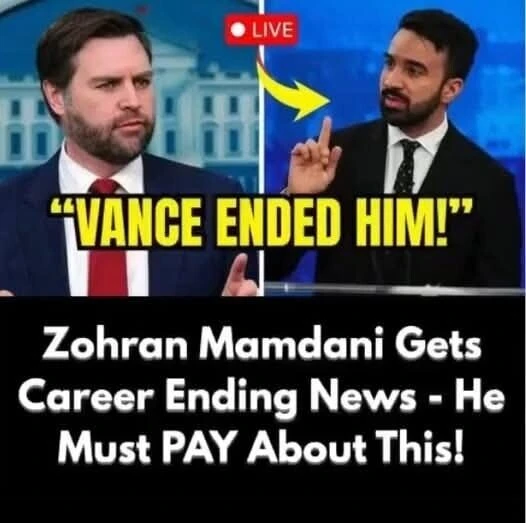
Zohran Mamdani, a 33-34-year-old democratic-socialist lawmaker and immigrant-background candidate, unexpectedly secured the Democratic nomination for the New York City mayoral race. His campaign emphasised affordability, tenant protections, free transit proposals, and progressive change.
Against that backdrop, Trump — who retains both personal and political ties to New York City — entered the race in force, framing Mamdani as a dangerous radical, threatening federal intervention and even law-enforcement action.
Trump repeatedly called Mamdani a “communist” despite Mamdani’s self-description as a democratic socialist. Al Jazeera+2aol.com+2
He questioned Mamdani’s legal status, suggesting scrutiny into his citizenship and stating that he would “look at everything” including the possibility of arrest if Mamdani obstructed federal operations such as those by U.S. Immigration and Customs Enforcement (ICE).
Trump announced that if Mamdani wins the mayoral election, New York City may receive only the “bare minimum” federal funds. Al Jazeera
+1
Further, he floated the notion of a federal takeover of NYC—saying during a Cabinet meeting:
“If a communist gets elected to run New York, it can never be the same… We have tremendous power at the White House to run places when we have to.”
At a July 1, 2025 appearance, Trump told reporters in reference to Mamdani’s pledge to stop masked ICE agents from deporting “our neighbours” that he would “have to arrest him” if necessary. He referenced rumours about Mamdani’s immigration status and said “we’re going to look at everything.”
Mamdani’s campaign strongly condemned Trump’s remarks as intimidation and as an assault on democratic norms. He called the funding-threats illegal and unsafe for democracy.
Legal analysts noted that while the president has influence, actual power to cut or redirect federal funding is largely controlled by Congress; unilaterally withholding spending the legislature has approved could raise constitutional issues.
For NYC governance: If Mamdani wins and Trump follows through on threats, it could spark a constitutional confrontation over local vs federal authority, funding flows, and the balance of power.
For national politics: The situation underscores growing tensions between the executive branch and local governments when politics diverge. It also highlights how mayoral races are being seen through a national lens.
For Mamdani: His victory has made him a lightning rod. The threats could either galvanise his coalition (by framing him as under attack) or hamper his ability to deliver if federal cooperation is withheld.
For Trump: His heavy involvement in a city-mayoral race (especially his hometown) shows how he views local races as part of his political brand and as battlegrounds in the broader culture/power wars.
Whether Trump actually moves to withhold federal funds or initiate a takeover — and how courts, Congress and legal experts respond.
How Mamdani performs in the general election (and if he becomes mayor) and how much he is able to implement his agenda under the spotlight of federal opposition.
How this fight affects wider relations between the federal government and other large U.S. cities whose leadership diverges politically from the White House.
In a bold strike against what he calls “astroturfed chaos,” Senator Ted Cruz (R-TX) has reignited his push for the Stop Financial Underwriting of Nefarious Demonstrations and Extremist Riots (Stop FUNDERs) Act, directly targeting billionaire philanthropist George Soros and his network for allegedly bankrolling a wave of anti-Trump protests sweeping the nation. The legislation, first introduced in July but gaining fresh urgency amid the explosive “No Kings” rallies, would amend the Racketeer Influenced and Corrupt Organizations (RICO) Act to classify funding violent or coordinated riots as a predicate offense—potentially unleashing a torrent of federal prosecutions, asset seizures, and overnight account freezes on implicated donors and organizations.
Cruz, fresh off a fiery Fox News appearance where he laid out the “receipts” on Soros’ involvement, declared on X: “There’s considerable evidence that George Soros and his network are funding the ‘No Kings’ rallies. That’s exactly why I’ve introduced the Stop FUNDERs Act. It lets law enforcement prosecute those funding acts of political violence.” The senator’s podcast,
Verdict with Ted Cruz, dedicated an episode to tracing the money trail, revealing that Soros’ Open Society Foundations funneled over $7.6 million to Indivisible—the grassroots group coordinating the “No Kings” events—since 2017, including a $3 million grant in 2023 for “social welfare activities.” Public IRS filings confirm the ties, with Indivisible managing participant data and logistics for protests expected to draw millions across 2,500 locations this weekend, from the National Mall to city streets nationwide.
The Stop FUNDERs Act would supercharge the DOJ’s arsenal, adding “rioting” under the federal Anti-Riot Act to RICO’s list of racketeering crimes. This means prosecutors could pursue joint liability against funders, hit them with conspiracy charges, and seize assets mid-operation—turning checkbooks into crime scenes. Co-sponsors like Sen. John Cornyn (R-TX) hailed it as a bulwark against “radical left-wing groups who fund acts of violence, coordinate attacks against law enforcement, and spearhead the destruction of property.” Heritage Action’s Steve Chartan echoed the sentiment: “This bill targets those inciting violent riots nationwide, ensuring First Amendment rights for peaceful protest while cracking down on the paymasters of anarchy.”
Soros, the Hungarian-born financier whose foundations have donated over $32 billion to progressive causes globally, has long been a lightning rod for conservative ire. Critics, including President Trump, have accused him of underwriting everything from campus antisemitic unrest to anti-ICE demonstrations and now the “No Kings” pushback against Trump’s second-term agenda. “Follow the money. Cut off the money,” Cruz urged on
Hannity, warning that without intervention, these “fake” rallies could spiral into riots mirroring the 2020 summer of unrest. FBI Director Kash Patel, during a recent Senate hearing, voiced support for the bill, affirming it would equip agents to dismantle funding networks fueling political violence.
The timing couldn’t be more charged. As “No Kings” organizers—branded by Cruz as “Soros operatives”—ramp up for Saturday’s nationwide showdown, reports of heightened security at protest sites underscore the stakes. Conservative outlets like Fox News and Townhall have amplified the narrative, citing Capital Research Center analyses that, while finding no direct evidence of Soros knowingly backing illegal acts, highlight the indirect flow of funds to activist hubs. On X, #StopFUNDERs is trending, with users sharing clips of Cruz’s takedown and memes dubbing Soros the “puppet master of mayhem.”
Democrats, predictably, are crying foul. Senate Minority Leader Chuck Schumer, a “No Kings” participant, slammed the bill as “McCarthyite overreach” designed to “chill free speech.” The ACLU warned it “dangerously lowers the bar for government investigations into peaceful demonstrations,” potentially ensnaring everyday donors in sprawling probes. Open Society Foundations fired back: “Neither George Soros nor the Open Society Foundations fund protests, condone violence, or foment it in any way. Claims to the contrary are false.” Progressive voices on X decry it as a “fascist fantasy,” pointing to the bill’s acronym—implying even “nefarious” nonviolent demos could fall under scrutiny.
Yet, with Republicans holding the Senate and a sympathetic DOJ under Attorney General Pam Bondi, passage seems plausible. Trump has floated similar RICO threats against “left-wing groups,” and insiders whisper of IRS audits targeting Soros-linked entities. If enacted, the bill could ripple far beyond protests: freezing accounts tied to election interference claims or border chaos funding. As one GOP strategist put it, “This isn’t just about Soros—it’s about sovereignty. No foreign billionaire gets to buy America’s streets.”
Cruz’s gambit taps into a deep well of public frustration. Polls show 58% of Americans believe big-money influence corrupts activism, per a recent Rasmussen survey. From Texas to the heartland, constituents are rallying behind the senator’s battle cry: Drain the funders’ swamp. Whether this freezes Soros’ empire overnight or sparks a First Amendment firestorm, one thing’s clear—Ted Cruz has thrown down the gauntlet, and the echoes are shaking Pennsylvania Avenue.
JD VANCE LAUNCHES NATIONWIDE INVESTIGATION INTO VOTER FRAUD — AND POINTS THE FINGER THAT STUNNED AMERICA
The Capitol chamber was silent when it happened. The tension in the room was heavy, the kind that only comes before a political earthquake. Vice President
JD Vance, known for his calm but unflinching demeanor, had just announced what could become the largest election integrity investigation in U.S. history. The subject: alleged voter fraud in the New York City mayoral race
.
For weeks, rumors had been circulating about irregularities in ballot counts, missing voter ID checks, and digital inconsistencies. Most dismissed them as noise. But then Vance stepped forward with what he called “irrefutable evidence” — evidence, he claimed, that could “shake the very foundation of public trust.”
“Fairness must always come before politics,” he declared. “If America loses faith in its elections, then we’ve already lost everything else.”
It was a statement that drew both applause and alarm. But no one expected what would happen next.
It all began quietly — a few reports of discrepancies from poll workers in New York City. Several precincts had flagged suspicious patterns: duplicate ballots, misprinted barcodes, and unexplained entries in digital voter logs. At first, local officials brushed them aside as “technical errors.”
But when one whistleblower came forward claiming that certain absentee ballots were being “processed twice” through the scanning system, the situation escalated.
Within 48 hours, the Department of Justice had been alerted. Within a week, Vice President JD Vance personally requested access to the case files. And within a month, he was standing in front of Congress, calling for a
full-scale federal investigation into voter fraud — not just in New York, but nationwide.
“This isn’t about one election,” Vance said during his address. “It’s about ensuring that every American vote — Republican or Democrat — is counted honestly.”
Vance’s tone that day was calm, but the fire behind his words was unmistakable.
He laid out a series of documents, displaying charts, timestamps, and digital records allegedly showing inconsistencies in vote counts across multiple boroughs. According to him, the data pointed to “a systematic manipulation of ballot entries,” though he stopped short of naming individuals.
“Whether it’s an error, negligence, or deliberate fraud,” he said, “we will find out. No one is above accountability — not politicians, not officials, not anyone.”
The room buzzed with tension. Democrats accused him of fearmongering. Republicans rallied behind him, demanding transparency. But as the minutes passed, Vance’s evidence began to paint a chilling picture.
He claimed that some ballot boxes had been tampered with before collection, and others were linked to private organizations with partisan affiliations. “We have receipts,” he added, “and we’re not afraid to use them.”
Just when it seemed the hearing had reached its peak, Vance paused mid-sentence. He looked across the chamber, his eyes narrowing.
Then, slowly, he raised his hand and pointed — directly at someone sitting in the audience.
Gasps filled the room. Cameras swiveled. Every eye turned to see who it was.
At first, the figure looked calm, even dismissive. But as Vance’s gaze remained fixed, whispers began to ripple through the crowd. The person in question was a high-ranking New York election official
, someone who had publicly dismissed all allegations of voter fraud as “conspiracy theories.”
“You told this nation there was nothing to see,” Vance said firmly. “But the evidence says otherwise.”
The official’s face went pale. Reporters scrambled to capture the moment. Within seconds, social media exploded. Clips of Vance’s finger-pointing were trending under the hashtag #VanceExposesTruth.
The hearing devolved into chaos. Security moved in as reporters shouted questions. Members of both parties exchanged accusations across the aisle. And through it all, Vance remained steady, his expression unreadable.
In the days that followed, the documents Vance referenced were released to the public. They included internal emails between election supervisors discussing “ballot batch irregularities,” time-stamped photos of double-processed envelopes, and forensic data showing unusual access patterns in New York’s electronic voter registration system.
Independent analysts confirmed that while not all the data proved deliberate fraud, the sheer number of irregularities was “highly unusual.”
“This is not a small discrepancy,” said one cybersecurity expert. “This is systemic. It points to either gross mismanagement or something far more intentional.”
Vance seized on that conclusion, calling for bipartisan oversight committees in every state. “We need to rebuild trust,” he said. “And trust only comes from transparency.”
Predictably, the fallout was immediate.
Democrats accused Vance of politicizing the issue, claiming his investigation was an attempt to discredit their string of recent victories in mayoral races across the country.
“Every time Democrats win, Republicans cry fraud,” one senator said. “This is just another political stunt.”
But the evidence made that argument harder to sustain. Even neutral observers began demanding answers.
Meanwhile, the Republican base hailed Vance as a hero — a man willing to confront what others ignored. His approval ratings surged, and calls for him to lead a national election reform task force began circulating within hours.
Conservative commentator Jeanine Pirro praised the move as “a defining moment for justice in American democracy,” while others warned that the investigation could spark a constitutional crisis if wrongdoing was proven at higher levels.
In a follow-up press conference, Vance reiterated his stance.
“This investigation isn’t about party lines,” he said. “It’s about one principle — fairness. Every citizen deserves to know that their vote carries equal weight, and I will not rest until that’s guaranteed.”
He emphasized that those found guilty of tampering with ballots or violating election law would face the maximum federal penalty.
“Anyone caught undermining democracy will pay the highest price — prison, public disgrace, and the permanent loss of trust,” he stated. “This isn’t a warning. It’s a promise.”
The firmness of his tone sent chills through the press room.
JD Vance’s rise to political prominence has been anything but conventional. Once a venture capitalist and author, he entered politics with a reputation for candor and an unyielding sense of accountability. His brand — part populist reformer, part traditionalist conservative — has resonated deeply with voters disillusioned by establishment politics.
But this investigation has elevated him to a new level entirely.
Supporters call him “the watchdog America needed.” Critics call him “dangerous.” Either way, his move has reignited a national debate about how far the government should go to ensure election integrity.
As the federal probe expands, more officials are expected to be questioned, and state legislatures across the country are already reviewing their own voting systems.
But the public remains divided. Some see Vance’s crusade as the dawn of accountability. Others fear it will deepen mistrust and polarization.
For now, one thing is certain: the nation is watching. Every word, every document, every new piece of evidence is being scrutinized by a population desperate to know the truth.
And as for the moment when JD Vance pointed across that crowded hearing room — that single gesture has already entered political history. It was more than a dramatic flourish. It was a message.
A message that someone, somewhere, had finally decided to stop looking the other way.
As Vance himself put it in closing:
“Democracy doesn’t collapse when people cheat. It collapses when good people stay silent. I refuse to stay silent.”
Whether history remembers this as the start of a reckoning or another chapter in America’s endless political battles, one thing is undeniable: JD Vance has set something in motion that no one can ignore — and the truth, whatever it is, will have consequences far beyond New York.