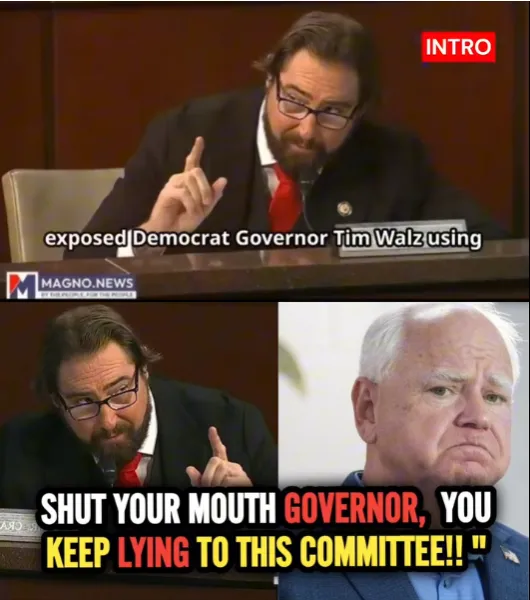
The recent congressional hearing was a masterclass in political confrontation, featuring GOP Congressman
Eli Crane absolutely torching Democrat Governor Tim Walz on a variety of issues, ranging from immigration policy to incendiary rhetoric. Crane didn’t just ask questions; he delivered an execution via the Governor’s own words, showcasing a perceived disconnect between Walz’s statements and the hard realities of his state’s policies.
The exchange began with a direct challenge to the Governor’s opening statement, where Walz claimed that “nothing Minnesota has done stands in the way of federal government managing its border security policy.” Crane immediately called him out, asking,
“Why are you lying to this committee?”
The core of Crane’s attack was the public stance of Minnesota’s Attorney General, Keith Ellison, the state’s top law enforcement official. Crane submitted an article stating that AG Ellison “will not enforce federal immigration laws,” even as the DOJ threatens prosecution for officials who resist. Walz’s defense—claiming state law requires officials to ask for immigration status of convicted felons—was swiftly dismissed by Crane as a misrepresentation, insisting that the AG’s public defiance stands as a clear contradiction to the Governor’s assurance of non-interference.
Crane then moved to the argument that Minnesota’s policies actively create a border magnet, citing a list of state benefits: free healthcare, food assistance, free college tuition, driver’s licenses, and cash assistance.
In Crane’s judgment, these policies are not “helping” border security but are rather creating an irresistible incentive, effectively making Minnesota a “sanctuary state” in practice, regardless of official designation.
The scrutiny intensified as Crane addressed the Governor’s rhetoric, particularly Walz’s past characterization of ICE (Immigration and Customs Enforcement) agents.
Crane grilled Walz on his decision to call federal law enforcement agents
“modern-day Gustapo,” a deeply offensive historical parallel. Crane challenged the Governor directly: “You think that calling them Gustapo is helping?” Walz attempted to pivot to a defense of “due process” and “best practice in law enforcement,” but Crane hammered the point that such inflammatory language from a state executive actively hurts the federal government’s ability to carry out its mandated enforcement.
Further damaging the Governor’s credibility was an unverified quote where Walz allegedly told Anderson Cooper, regarding the border wall, “If it’s 25 ft, then I’ll invest in a 30-foot ladder factory.” Walz claimed not to remember the comment, which Crane seized upon as evidence of “so many outlandish things that you can’t even keep track of them.”
Crane saved his most powerful and judgmental rebuke for the end, focusing on what he labeled Walz’s “radical left-wing agenda.” He dismissed Walz’s previous podcast boast that he scares MAGA voters “because they know I can fix a truck” and could “kick most of their asses,” countering that the fear stems purely from his policies.
Crane’s list of “radical” policies included:
Supporting tampons in boys’ bathrooms.
Advocating for disarming Americans of their Second Amendment rights.
Being pro-sanctuary city.
Claiming there is “no guarantee to free speech”
Finally, Crane weaponized Walz’s political aspirations against him, referencing a quote where Walz allegedly said Kamala Harris picked him for Vice President to “code talk to white guys.” Crane closed the interrogation with a decisive blow, stating Walz
The entire spectacle, as the transcript concludes, was a decisive, one-sided clash where Congressman Crane used facts, undeniable quotes, and logic to demonstrate, in his judgment, the severe consequences of Governor Walz’s radical ideology and inflammatory rhetoric.
Mr. Kennedy appeared onstage briefly with Mr. Trump at a rally in Arizona hours after Mr. Kennedy announced, in a news conference nearby, that he was pausing his troubled independent presidential bid.
Robert F. Kennedy Jr., left, and former President Donald J. Trump at a Trump campaign rally in Glendale, Ariz., on Friday.Credit…Evan Vucci/Associated Press
One of the most attention-grabbing days of Robert F. Kennedy Jr.’s independent presidential bid was also its last.
After toiling for months as an electoral afterthought, Mr. Kennedy suspended his long-shot campaign on Friday and endorsed former President Donald J. Trump in a speech in Phoenix carried live by television networks. Then, he traveled across town to speak in front of the largest rally audience since he began his third-party run last year: an audience of 17,000 at a Trump event at an arena in Glendale, Ariz.
As he shook hands with Mr. Trump amid bursts of fireworks, Mr. Kennedy was, briefly, the star of the show, a new attraction for the Trump campaign. But it was unclear what impact, if any, Mr. Kennedy’s endorsement of Mr. Trump would have on the 2024 race.
Framing his third-party bid as an outsider movement and a breath of fresh air for Americans fed up with partisan politics, Mr. Kennedy initially attracted significant support — more than 20 percent in some early polls — and was especially popular with Hispanic voters. Many voters had said they were frustrated with the lack of choice between two unpopular and familiar candidates: Mr. Trump and President Biden.
But Mr. Kennedy had been falling recently in polls, and plummeted further after Vice President Kamala Harris took the mantle of Democratic nominee from Mr. Biden, luring some wayward Democrats back home. Even those supporters who have remained steadfast to Mr. Kennedy are less likely than others to say they will vote in November, and polls have not provided a consistent answer as to whether Mr. Kennedy’s supporters would prefer Ms. Harris or Mr. Trump.
Still, Mr. Trump and his allies on Friday relished the fact that the former president had won the backing of a member of America’s most storied Democratic family, albeit one who has had many of his relatives denounce him and his endorsement of Mr. Trump. Of all the outlandish political news stories of the summer, mused Charlie Kirk, the founder of Turning Point USA, which helped organize the rally, “maybe most remarkable of all: A Kennedy has endorsed a Republican.”
Mr. Trump predicted that Mr. Kennedy was “going to have a huge influence on this campaign,” promising that “Bobby and I will fight together to defeat the corrupt political establishment.”
But it is hard to know whether he will make a dent in the larger problem Mr. Trump has newly faced: regaining the spotlight and the narrative after several weeks of momentum for Ms. Harris.
As the vice president has surged ahead in fund-raising and tightened the race, according to polls, Mr. Trump has bemoaned the ouster of Mr. Biden, whom his allies viewed as an easier opponent, held a series of rambling news conferences and offered a freewheeling rebuttal on Fox News to Ms. Harris’s acceptance speech on Thursday night.
Mr. Trump has traded barbs with Mr. Kennedy in the past, but they have similar grievances that they could easily weave together on the campaign trail. They both blame a shadowy, bureaucratic deep state for many of the nation’s ills, and they argue that technology companies and Democrats want to suppress free speech.
“We talked not about the things that separated us — because we don’t agree on everything — but on the values and the issues that bind us together,” Mr. Kennedy told the crowd in Glendale, recalling a previous conversation he had with Mr. Trump. “Don’t you want a president that’s going to make America healthy again?”
Mr. Trump’s campaign stop in Glendale was his final event in a five-day swing through battleground states, timed to coincide with the Democratic National Convention in Chicago in an attempt to avoid ceding the spotlight to Ms. Harris.
For decades, Arizona was a reliably conservative state, but Democrats have taken advantage of Republican infighting in recent years to capture statewide offices, including for governor and both U.S. Senate seats. Joseph R. Biden Jr., then a presidential candidate, turned Arizona blue in 2020, but the state appeared to be trending back toward Mr. Trump earlier this year, as voters expressed concern about Mr. Biden’s age and the direction of the country.
Ms. Harris, though, has revitalized the Democratic base and made the state competitive again. Recent polls suggest a deadlocked race, and the party showcased its deep bench of prominent Arizona supporters at its convention, with speeches by Senator Mark Kelly, former Representative Gabrielle Giffords and others.
Republicans offered a rebuttal of sorts at Mr. Trump’s rally on Friday, featuring a litany of big names of their own, including Representatives Paul Gosar, Eli Crane and Andy Biggs. Another speaker was Kari Lake, a prominent Trump ally who is running for Senate and who became a leading proponent of his false stolen-election claims.
The choice of venue was another retort to Democrats. Ms. Harris rallied at the same location, Desert Diamond Arena, several weeks ago, and her campaign said the crowd numbered 15,000 people. Turning Point said the crowd in the arena on Friday was 17,000. Mr. Trump has flinched at Ms. Harris’s crowd sizes and falsely claimed that she was using artificial intelligence to inflate them in photos.
In his speech, Mr. Trump again broke with advisers who have urged him to focus on policy rather than veering into personal attacks. In recent weeks, he has taken events billed as opportunities to discuss components of his platform and set off on wide-ranging tangents filled with insults of Democrats.
“You say, ‘Don’t get personal.’ I have to get personal,” Mr. Trump said on Friday, proceeding to launch insults against the Obamas, Ms. Harris, Mr. Biden and Representative Ruben Gallego of Arizona, now a U.S. Senate candidate, whom he called a “maniac” and a “loser.” In fact, the only non-Republican he praised was Mr. Kennedy, whom he had once called a “Democrat plant” and a “radical left liberal” — to which Mr. Kennedy had responded that Mr. Trump was a “frightened” man who sounded “unhinged.”
But when Mr. Trump shared the stage with his former rival, those spars went unmentioned.
In welcoming his endorsement on the rally stage, the Trump campaign is betting that Mr. Kennedy can bring his supporters with him. In a memo earlier on Friday, the Trump campaign’s lead pollster, Tony Fabrizio, described the end of Mr. Kennedy’s candidacy as a clear benefit to the Republican nominee.
“This is good news for President Trump and his campaign — plain and simple,” Mr. Fabrizio wrote, describing a majority of Mr. Kennedy’s voters as overwhelmingly breaking in Mr. Trump’s favor.
Just how significant those percentages will be remains to be seen. The polling that exists about where Mr. Kennedy’s voters might go is based on the hypothetical scenario of his leaving the race. The actual impact of his departure will not be clear for many days or weeks.
Onstage on Friday, Mr. Trump renewed, “in honor of Bobby,” an unfinished pledge from his first term to create a commission that would release the remaining sealed files related to the assassination of John F. Kennedy, Mr. Kennedy’s uncle. Less than 1 percent of the records remain sealed, according to the Central Intelligence Agency.
Mr. Trump, who has said he would pardon those who rioted at the Capitol on Jan. 6, 2021, suggested at the rally that his supporters needed to take the country back from Democrats. “We have to take our country away from these people that are going to destroy our country,” he told the audience.
Earlier in the day in Phoenix, at his speech announcing the suspension of his campaign, Mr. Kennedy said Mr. Trump had offered him a role in a second Trump administration, dealing with health care and food and drug policy. In Glendale, Mr. Trump said that, if elected to a second term, a panel of experts “working with Bobby” would investigate obesity rates and other chronic health issues in the United States.
Mr. Kennedy later said he was “choosing to believe” that “this time” Mr. Trump would honor the agreement. During the transition period before Mr. Trump took office in 2017, Mr. Kennedy said Mr. Trump had offered him a spot on a vaccine safety commission, only to have the president-elect’s team distance itself from such claims hours later.
Mr. Kennedy’s remarks on Friday sought to cement what he saw as a legacy: pitching his policies on food, health and the environment and railing against the Democratic Party, which he believed treated him unfairly.
Maggie Haberman and Chris Cameron contributed reporting.
Trump has handed the podium over to Kennedy, who acknowledged their ideological differences but said their values overlap in “having safe food and ending the chronic disease epidemic.”
Former President Donald J. Trump on Friday fumed over the fact that when it comes to exempting tips from being taxed, he and his rival, Vice President Kamala Harris, are on the same page.
Mr. Trump, before a gathering of supporters at a Las Vegas restaurant, complained that Ms. Harris had stolen his idea and sought to cast her as an opportunist who was pandering to service industry workers by cribbing from one of his signature proposals.
Democratic-aligned voting rights organizations are bracing for what they describe as a potential crisis if the U.S. Supreme Court moves to weaken a central provision of the Voting Rights Act, one of the nation’s cornerstone civil rights laws.
The concern centers on Louisiana v. Callais, a case the justices heard on October 15. The outcome could determine the future of Section 2 of the Voting Rights Act, which prohibits redistricting plans that dilute the voting power of racial minorities.
Two prominent voting rights groups have warned that striking down or narrowing Section 2 would allow Republican-controlled legislatures to redraw as many as 19 congressional districts in their favor, Politico reported.
That projection — outlined in a new report from Fair Fight Action and the Black Voters Matter Fund and shared exclusively with POLITICO — suggests that striking down Section 2 of the Voting Rights Act could all but ensure continued Republican control of the House of Representatives.
While a ruling before next year’s midterm elections remains uncertain, the organizations behind the report said it is still possible. In total, the groups identified 27 congressional seats nationwide that could be redrawn to favor Republicans if current legal and political conditions hold — with 19 of those shifts directly tied to the potential elimination of Section 2 protections.Doing so would “clear the path for a one-party system where power serves the powerful and silences the people,” Black Voters Matter Fund co-founder LaTosha Brown claimed, without addressing the constitutional impropriety of drawing congressional districts based solely on race – which is the issue before the high court.
Republicans have for years sought to limit or dismantle Section 2 of the Voting Rights Act, which bars racial discrimination in voting laws and redistricting. They argue that the provision unfairly benefits Democrats by requiring the creation of minority-majority districts that often lean Democratic.
The Supreme Court has previously rejected those arguments, but voting rights advocates fear the upcoming Louisiana v. Callais case could mark a turning point.
Democrats, meanwhile, could also seek to capitalize on any changes to the law by redrawing district lines in deeply Democratic states where VRA protections still apply. However, analysts say such opportunities would be limited compared with the broader redistricting advantages that Republican-controlled legislatures could gain, Politico added.
Under current law, the Voting Rights Act is used in redistricting to prevent racial gerrymandering that weakens the influence of minority voters. States typically comply by drawing districts that give racial and ethnic minority communities a fair opportunity to elect their preferred candidates.
However, many election law experts anticipate that the Supreme Court could narrow the scope of the VRA in its upcoming ruling, potentially triggering significant shifts in congressional representation across the South, noted Politico.
According to the report, such a decision could result in Democratic lawmakers being ousted entirely from states such as Alabama, South Carolina, Tennessee, and Mississippi. Other states — including Louisiana, Georgia, North Carolina, Texas, and Florida — would likely retain at least one Democratic member of Congress, but their overall Democratic representation would shrink considerably.
The report is being released as Republicans undertake a nationwide redistricting push ahead of the midterm elections — a strategy that has received strong backing from the White House and could help the GOP preserve its slim House majority. The mid-cycle redraws, while uncommon, are not without precedent and have already produced six additional Republican-leaning districts across two states.
Several other GOP-led states are expected to follow suit, a number that could grow substantially if key protections under the Voting Rights Act are rolled back.
In response, Fair Fight Action and the Black Voters Matter Fund are urging Democrats to mount an “aggressive and immediate” counterstrategy to combat Republican redistricting maneuvers already in motion.
Kentucky State Sen. Robin Webb has switched her party from Democrat to Republican.
“First and foremost, I’m a mother, a rancher and a lawyer with deep personal and professional roots in Kentucky’s coal country,” the former Democrat said. “As the Democratic Party continues its lurch to the left and its hyperfocus on policies that hurt the workforce and economic development in my region, I no longer feel it represents my values.”
“It has become untenable and counterproductive to the best interests of my constituents for me to remain a Democrat,” she said. “While it’s cliché, it’s true: I didn’t leave the party — the party left me.”
It is a tough hit for the Democratic Party in the state, as Webb is from a rural area of Kentucky, which has been a stronghold for the blue party because of its union ties and coal mining industry.
The news was celebrated by Robert Benvenuti, Chairman of the Republican Party of Kentucky.
“Like countless other Kentuckians, [Webb] has recognized that the policies and objectives of today’s Democratic Party are simply not what they once were, and do not align with the vast majority of Kentuckians,” he said.
“I always respected that [Webb] approached issues in a very thoughtful and commonsense manner, and that she never failed to keenly focus on what was best for her constituents,” he said. “It is my pleasure to welcome Sen. Robin Webb to the Republican Party.”
But the state’s Democratic Party lashed out at Webb, saying that she is “not a Democrat,” which may not be the burn they think it is.
“Senator Webb has chosen to join a political party that is currently working around the clock to take health care away from over a million Kentuckians, wipe out our rural hospitals, take food off the table of Kentucky families, and take resources away from our public schools,” Kentucky Democratic Party Chair Colmon Elridge said to Fox News Digital. “If those are her priorities, then we agree: she isn’t a Democrat.”
This comes amid the federal government shutdown, which is approaching almost 40 days.
The Democratic House and Senate leaders sent a letter to President Trump on Wednesday morning, a day after elections nationwide saw their party pick up gains in blue regions, demanding “bipartisan” talks to reopen the government.
“We write to demand a bipartisan meeting of legislative leaders to end the GOP shutdown and decisively address the Republican healthcare crisis,” the short letter began. “Democrats stand ready to meet with you anytime, anyplace.”
The letter comes after most Senate Democrats have voted 14 times against a GOP-led spending bill to reopen the government.
Meanwhile, a new report suggests that key elements of a potential deal to end the federal government shutdown are beginning to take shape — though it remains uncertain when, or even if, all sides will reach an agreement.
According to Axios, the proposed “three-legged” plan includes three main components: a Senate vote on Affordable Care Act tax credits, a short-term continuing resolution to give negotiators more time to finalize a full-year budget for the fiscal year that began October 1, and a separate vote to fund military construction, the legislative branch, and agriculture programs.
“I think we’re getting close to an off-ramp here,” Senate Majority Leader John Thune, a Republican from South Dakota, told the outlet.
One sticking point, however, remains the duration of the continuing resolution to keep the government funded.
Before Senate Democrats forced the government into a shutdown, the House had already passed a bill to keep it funded through November 21.
If the Senate now strikes a deal to reopen the government
Humans and horses share a bond that often needs no words, and Thomas Hale knew this better than anyone. For sixty years, he lived a quiet, kind life on his countryside farm, tending the land, raising horses, and helping neighbors whenever they needed him. But among all his companions, there was one who held a special place in his heart: Storm, a magnificent white stallion Thomas had raised from a foal.
When Thomas passed suddenly from a heart condition, Storm seemed to sense it before anyone else. For two days, the horse refused food and rest, pacing his stable in grief.
But then, as mourners gathered around the small church and the coffin was lifted, a long, haunting whinny could be heard from across the valley. Everyone turned around and saw Storm coming from the woods. There was mud streaked across his sides, his mane was tangled, and he was visibly exhausted. While everyone looked at him, Storm only gazed at his owner’s coffin.
Slowly, he approached and lowered his head, resting his muzzle gently against the wooden coffin. For a long moment, nothing moved except the rain tapping on umbrellas and the muffled sobs of the crowd. Then Storm let out a low, broken sound that resembled a human cry. He nudged the coffin gently, as if recalling the treats Thomas had once held in his hand. The mourners could not hold back their tears.
After the ceremony, Storm refused to leave the graveyard. After some time, Thomas’ son, Daniel, approached and took Storm home. That evening, he finally rested, but still looked at the door of the stables hoping to see his master.
People were stunned by Storm’s love for Thomas. Even the parish priest wrote, “In all my years, I have seen devotion and sorrow—but never such pure love as that between a man and his horse.”
When Storm passed away some time later, the family decided to bury him close to Thomas’ grave, just under the oak tree.
Some bonds are meant to last forever, and sometimes, the deepest farewells need no words.
Please SHARE this article with your family and friends on Facebook.