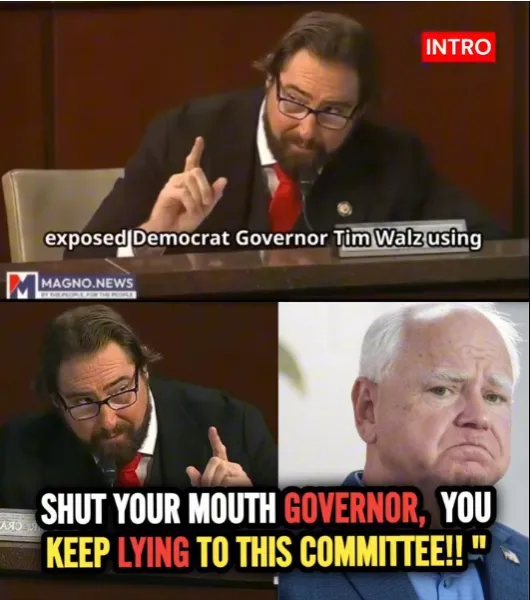
The recent congressional hearing was a masterclass in political confrontation, featuring GOP Congressman
Eli Crane absolutely torching Democrat Governor Tim Walz on a variety of issues, ranging from immigration policy to incendiary rhetoric. Crane didn’t just ask questions; he delivered an execution via the Governor’s own words, showcasing a perceived disconnect between Walz’s statements and the hard realities of his state’s policies.
The exchange began with a direct challenge to the Governor’s opening statement, where Walz claimed that “nothing Minnesota has done stands in the way of federal government managing its border security policy.” Crane immediately called him out, asking,
“Why are you lying to this committee?”
The core of Crane’s attack was the public stance of Minnesota’s Attorney General, Keith Ellison, the state’s top law enforcement official. Crane submitted an article stating that AG Ellison “will not enforce federal immigration laws,” even as the DOJ threatens prosecution for officials who resist. Walz’s defense—claiming state law requires officials to ask for immigration status of convicted felons—was swiftly dismissed by Crane as a misrepresentation, insisting that the AG’s public defiance stands as a clear contradiction to the Governor’s assurance of non-interference.
Crane then moved to the argument that Minnesota’s policies actively create a border magnet, citing a list of state benefits: free healthcare, food assistance, free college tuition, driver’s licenses, and cash assistance.
In Crane’s judgment, these policies are not “helping” border security but are rather creating an irresistible incentive, effectively making Minnesota a “sanctuary state” in practice, regardless of official designation.
The scrutiny intensified as Crane addressed the Governor’s rhetoric, particularly Walz’s past characterization of ICE (Immigration and Customs Enforcement) agents.
Crane grilled Walz on his decision to call federal law enforcement agents
“modern-day Gustapo,” a deeply offensive historical parallel. Crane challenged the Governor directly: “You think that calling them Gustapo is helping?” Walz attempted to pivot to a defense of “due process” and “best practice in law enforcement,” but Crane hammered the point that such inflammatory language from a state executive actively hurts the federal government’s ability to carry out its mandated enforcement.
Further damaging the Governor’s credibility was an unverified quote where Walz allegedly told Anderson Cooper, regarding the border wall, “If it’s 25 ft, then I’ll invest in a 30-foot ladder factory.” Walz claimed not to remember the comment, which Crane seized upon as evidence of “so many outlandish things that you can’t even keep track of them.”
Crane saved his most powerful and judgmental rebuke for the end, focusing on what he labeled Walz’s “radical left-wing agenda.” He dismissed Walz’s previous podcast boast that he scares MAGA voters “because they know I can fix a truck” and could “kick most of their asses,” countering that the fear stems purely from his policies.
Crane’s list of “radical” policies included:
Supporting tampons in boys’ bathrooms.
Advocating for disarming Americans of their Second Amendment rights.
Being pro-sanctuary city.
Claiming there is “no guarantee to free speech”
when it comes to misinformation and hate speech—a view Crane acidly suggested Walz may have picked up during one of his alleged trips to “communist China.”
Finally, Crane weaponized Walz’s political aspirations against him, referencing a quote where Walz allegedly said Kamala Harris picked him for Vice President to “code talk to white guys.” Crane closed the interrogation with a decisive blow, stating Walz
“lost by 22 points to white guys” and promising: “If you want to continue that rhetoric, go on, brother. Keep doing it. We’ll keep destroying you in election.“
The entire spectacle, as the transcript concludes, was a decisive, one-sided clash where Congressman Crane used facts, undeniable quotes, and logic to demonstrate, in his judgment, the severe consequences of Governor Walz’s radical ideology and inflammatory rhetoric.
Mr. Kennedy appeared onstage briefly with Mr. Trump at a rally in Arizona hours after Mr. Kennedy announced, in a news conference nearby, that he was pausing his troubled independent presidential bid.
Robert F. Kennedy Jr., left, and former President Donald J. Trump at a Trump campaign rally in Glendale, Ariz., on Friday.Credit…Evan Vucci/Associated Press
One of the most attention-grabbing days of Robert F. Kennedy Jr.’s independent presidential bid was also its last.
After toiling for months as an electoral afterthought, Mr. Kennedy suspended his long-shot campaign on Friday and endorsed former President Donald J. Trump in a speech in Phoenix carried live by television networks. Then, he traveled across town to speak in front of the largest rally audience since he began his third-party run last year: an audience of 17,000 at a Trump event at an arena in Glendale, Ariz.
As he shook hands with Mr. Trump amid bursts of fireworks, Mr. Kennedy was, briefly, the star of the show, a new attraction for the Trump campaign. But it was unclear what impact, if any, Mr. Kennedy’s endorsement of Mr. Trump would have on the 2024 race.
Framing his third-party bid as an outsider movement and a breath of fresh air for Americans fed up with partisan politics, Mr. Kennedy initially attracted significant support — more than 20 percent in some early polls — and was especially popular with Hispanic voters. Many voters had said they were frustrated with the lack of choice between two unpopular and familiar candidates: Mr. Trump and President Biden.
But Mr. Kennedy had been falling recently in polls, and plummeted further after Vice President Kamala Harris took the mantle of Democratic nominee from Mr. Biden, luring some wayward Democrats back home. Even those supporters who have remained steadfast to Mr. Kennedy are less likely than others to say they will vote in November, and polls have not provided a consistent answer as to whether Mr. Kennedy’s supporters would prefer Ms. Harris or Mr. Trump.
Still, Mr. Trump and his allies on Friday relished the fact that the former president had won the backing of a member of America’s most storied Democratic family, albeit one who has had many of his relatives denounce him and his endorsement of Mr. Trump. Of all the outlandish political news stories of the summer, mused Charlie Kirk, the founder of Turning Point USA, which helped organize the rally, “maybe most remarkable of all: A Kennedy has endorsed a Republican.”
Mr. Trump predicted that Mr. Kennedy was “going to have a huge influence on this campaign,” promising that “Bobby and I will fight together to defeat the corrupt political establishment.”
But it is hard to know whether he will make a dent in the larger problem Mr. Trump has newly faced: regaining the spotlight and the narrative after several weeks of momentum for Ms. Harris.
As the vice president has surged ahead in fund-raising and tightened the race, according to polls, Mr. Trump has bemoaned the ouster of Mr. Biden, whom his allies viewed as an easier opponent, held a series of rambling news conferences and offered a freewheeling rebuttal on Fox News to Ms. Harris’s acceptance speech on Thursday night.
Mr. Trump has traded barbs with Mr. Kennedy in the past, but they have similar grievances that they could easily weave together on the campaign trail. They both blame a shadowy, bureaucratic deep state for many of the nation’s ills, and they argue that technology companies and Democrats want to suppress free speech.
“We talked not about the things that separated us — because we don’t agree on everything — but on the values and the issues that bind us together,” Mr. Kennedy told the crowd in Glendale, recalling a previous conversation he had with Mr. Trump. “Don’t you want a president that’s going to make America healthy again?”
Mr. Trump’s campaign stop in Glendale was his final event in a five-day swing through battleground states, timed to coincide with the Democratic National Convention in Chicago in an attempt to avoid ceding the spotlight to Ms. Harris.
For decades, Arizona was a reliably conservative state, but Democrats have taken advantage of Republican infighting in recent years to capture statewide offices, including for governor and both U.S. Senate seats. Joseph R. Biden Jr., then a presidential candidate, turned Arizona blue in 2020, but the state appeared to be trending back toward Mr. Trump earlier this year, as voters expressed concern about Mr. Biden’s age and the direction of the country.
Ms. Harris, though, has revitalized the Democratic base and made the state competitive again. Recent polls suggest a deadlocked race, and the party showcased its deep bench of prominent Arizona supporters at its convention, with speeches by Senator Mark Kelly, former Representative Gabrielle Giffords and others.
Republicans offered a rebuttal of sorts at Mr. Trump’s rally on Friday, featuring a litany of big names of their own, including Representatives Paul Gosar, Eli Crane and Andy Biggs. Another speaker was Kari Lake, a prominent Trump ally who is running for Senate and who became a leading proponent of his false stolen-election claims.
The choice of venue was another retort to Democrats. Ms. Harris rallied at the same location, Desert Diamond Arena, several weeks ago, and her campaign said the crowd numbered 15,000 people. Turning Point said the crowd in the arena on Friday was 17,000. Mr. Trump has flinched at Ms. Harris’s crowd sizes and falsely claimed that she was using artificial intelligence to inflate them in photos.
In his speech, Mr. Trump again broke with advisers who have urged him to focus on policy rather than veering into personal attacks. In recent weeks, he has taken events billed as opportunities to discuss components of his platform and set off on wide-ranging tangents filled with insults of Democrats.
“You say, ‘Don’t get personal.’ I have to get personal,” Mr. Trump said on Friday, proceeding to launch insults against the Obamas, Ms. Harris, Mr. Biden and Representative Ruben Gallego of Arizona, now a U.S. Senate candidate, whom he called a “maniac” and a “loser.” In fact, the only non-Republican he praised was Mr. Kennedy, whom he had once called a “Democrat plant” and a “radical left liberal” — to which Mr. Kennedy had responded that Mr. Trump was a “frightened” man who sounded “unhinged.”
But when Mr. Trump shared the stage with his former rival, those spars went unmentioned.
In welcoming his endorsement on the rally stage, the Trump campaign is betting that Mr. Kennedy can bring his supporters with him. In a memo earlier on Friday, the Trump campaign’s lead pollster, Tony Fabrizio, described the end of Mr. Kennedy’s candidacy as a clear benefit to the Republican nominee.
“This is good news for President Trump and his campaign — plain and simple,” Mr. Fabrizio wrote, describing a majority of Mr. Kennedy’s voters as overwhelmingly breaking in Mr. Trump’s favor.
Just how significant those percentages will be remains to be seen. The polling that exists about where Mr. Kennedy’s voters might go is based on the hypothetical scenario of his leaving the race. The actual impact of his departure will not be clear for many days or weeks.
Onstage on Friday, Mr. Trump renewed, “in honor of Bobby,” an unfinished pledge from his first term to create a commission that would release the remaining sealed files related to the assassination of John F. Kennedy, Mr. Kennedy’s uncle. Less than 1 percent of the records remain sealed, according to the Central Intelligence Agency.
Mr. Trump, who has said he would pardon those who rioted at the Capitol on Jan. 6, 2021, suggested at the rally that his supporters needed to take the country back from Democrats. “We have to take our country away from these people that are going to destroy our country,” he told the audience.
Earlier in the day in Phoenix, at his speech announcing the suspension of his campaign, Mr. Kennedy said Mr. Trump had offered him a role in a second Trump administration, dealing with health care and food and drug policy. In Glendale, Mr. Trump said that, if elected to a second term, a panel of experts “working with Bobby” would investigate obesity rates and other chronic health issues in the United States.
Mr. Kennedy later said he was “choosing to believe” that “this time” Mr. Trump would honor the agreement. During the transition period before Mr. Trump took office in 2017, Mr. Kennedy said Mr. Trump had offered him a spot on a vaccine safety commission, only to have the president-elect’s team distance itself from such claims hours later.
Mr. Kennedy’s remarks on Friday sought to cement what he saw as a legacy: pitching his policies on food, health and the environment and railing against the Democratic Party, which he believed treated him unfairly.
Maggie Haberman and Chris Cameron contributed reporting.
Trump has handed the podium over to Kennedy, who acknowledged their ideological differences but said their values overlap in “having safe food and ending the chronic disease epidemic.”
Governor Greg Abbott sent social media into overdrive this week after jokingly warning that he would impose a “100 percent tariff” on anyone fleeing New York City for Texas if progressive candidate Zohran Mamdani wins the mayor’s race.
Abbott’s post on X (formerly Twitter) captured the mood of many Texans frustrated by what they view as the consequences of liberal policies—high taxes, crime, and economic decline—driving residents away from blue states.
While the governor’s remark drew headlines, supporters say it underscores a serious message: Texas’s economic strength and public safety record did not happen by accident.
Abbott’s office clarified that the statement was tongue-in-cheek but reflected the governor’s growing concern over the influx of residents from Democrat-run cities who then vote for the same policies they left behind.
“Texas has become America’s economic engine because we protect freedom, keep taxes low, and back the blue,” Abbott said in a follow-up statement.
“If people want to enjoy that success, they should embrace the principles that built it.”
Texas continues to lead the nation in job creation and business relocations, even as cities like New York and San Francisco struggle with population losses and rising costs of living.
Economists credit the state’s balanced budgets, energy independence, and pro-growth regulations as key to its stability during national downturns.
Conservatives argue that liberal leaders have undermined once-thriving cities with soft-on-crime policies and aggressive tax hikes, prompting families and businesses to seek refuge in Republican-led states.
Abbott’s playful “tariff” line resonated widely across social media, where thousands of users echoed the sentiment that Texas should protect its way of life.
“Texans built something worth preserving,” wrote one supporter. “We just don’t want outsiders bringing failed ideas with them.”
Democratic critics seized on the governor’s remark, calling it divisive. But Republicans counter that Abbott’s record—on border security, energy independence, and job creation—speaks for itself.
The governor has repeatedly urged new arrivals to respect local laws and values, emphasizing Texas’s unique blend of liberty and responsibility.
Under Abbott’s leadership, the state has attracted major employers such as Tesla, Oracle, and Samsung, while maintaining some of the nation’s lowest overall tax burdens.
Supporters say those achievements validate conservative governance in action and justify Abbott’s defense of Texas’s model.
“Texas doesn’t need to import New York’s problems,” said state Senator Bryan Hughes. “We need to keep exporting our solutions.”
The exchange comes amid growing national debate over population shifts from blue states to red, with U-Haul reporting record demand for one-way moves to Texas and Florida.
Mayor-elect Zohran Mamdani, the 34-year-old democratic socialist who narrowly won New York City’s mayoral race this week, will face steep challenges when he takes office on Jan. 1, 2026, political strategists told the Daily Caller News Foundation.
Mamdani captured 50.4% of the vote Tuesday, edging out former Gov. Andrew Cuomo, who ran as an independent and finished with 41.6%. The tight margin fell well below pre-election polls that showed Mamdani with leads of up to 25 points, The Daily Caller
After the race was called, Mamdani delivered a fiery victory speech at the Brooklyn Paramount Theater that took aim at both Cuomo and President Donald Trump. The tone, political observers said, raised questions about his leadership style before he even begins his term.
“Last night was an angry Mamdani, was a bitter Mamdani. He wasn’t magnanimous,” political strategist Adam Weiss told the outlet. “He was calling Trump all sorts of names. I don’t know why he’s going off on Trump, the sitting president of the United States. Be magnanimous, say, ‘We’d love to work together.’”
Weiss said the remarks showed poor political judgment and a lack of grace after a divisive campaign. “If anyone can show a nation betrayed by Donald Trump how to defeat him, it is the city that gave rise to him,” Mamdani said in his speech, drawing cheers from his supporters.
The socialist also took a shot at Cuomo, saying, “I wish Andrew Cuomo only the best in private life. But let tonight be the final time I utter his name.”
“It’s not the way you treat people in our society, it’s really a bad look,” Weiss said. “If Trump or any Republican had done that, there would be wall-to-wall negative coverage.”
Veteran Democratic consultant Hank Sheinkopf said Mamdani’s rhetoric reflects his movement’s confidence. “He doesn’t have to [moderate], because he doesn’t have to do anything,” Sheinkopf said. “The issue will be does he disappoint his constituency if he moderates his rhetoric?”
Sheinkopf said Mamdani’s far-left platform — which includes free citywide bus service, rent freezes, and city-run grocery stores — will likely hit hard limits once he takes office.
“He doesn’t have the power at the MTA to get free buses, necessarily, because he’s only got four votes on the board,” Sheinkopf explained. “He doesn’t have all the power he thinks he has on the rent stabilization board either. It’s not so simple.”
Still, Sheinkopf credited Mamdani’s campaign strategy. Running as the Democratic nominee in deep-blue New York gave him a major advantage, while Cuomo’s name appeared at the bottom right of the ballot on his independent “Fight and Deliver” line.
“Also what advantaged Mamdani was the changing nature of the city’s population,” Sheinkopf said, pointing to growth in African, Muslim, and Chinese communities.
A Patriot Polling survey conducted two weeks before the election found 62% of foreign-born New Yorkers supported Mamdani, compared with just 31% of American-born voters.
Weiss said the mayor-elect’s narrow victory leaves him with a divided city and a skeptical electorate. “He doesn’t really have a crazy mandate,” Weiss noted, pointing out that outgoing Mayor Eric Adams won in 2021 with nearly 70% of the vote.
Weiss added that Democratic Socialists of America (DSA) members like Mamdani are “great at organizing” and inspiring young, idealistic voters but struggle when it comes to governing.
“When it comes to governing, their ideas stink,” Weiss said. “You can’t just give away things, tax rich people, and think they’ll just sit there and say, ‘OK, tax me to death.’ They’re going to leave.”
As Mamdani prepares to lead America’s largest city, analysts say his success may depend on whether he can temper his rhetoric, build coalitions, and prove his socialist agenda can function in a capitalistic economy.