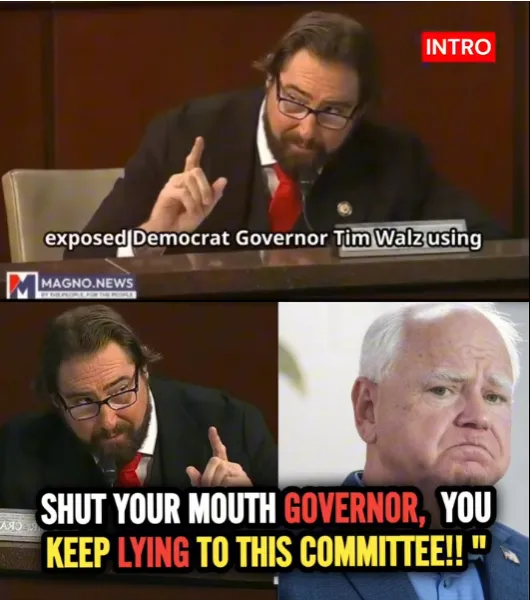
The recent congressional hearing was a masterclass in political confrontation, featuring GOP Congressman
Eli Crane absolutely torching Democrat Governor Tim Walz on a variety of issues, ranging from immigration policy to incendiary rhetoric. Crane didn’t just ask questions; he delivered an execution via the Governor’s own words, showcasing a perceived disconnect between Walz’s statements and the hard realities of his state’s policies.
The exchange began with a direct challenge to the Governor’s opening statement, where Walz claimed that “nothing Minnesota has done stands in the way of federal government managing its border security policy.” Crane immediately called him out, asking,
“Why are you lying to this committee?”
The core of Crane’s attack was the public stance of Minnesota’s Attorney General, Keith Ellison, the state’s top law enforcement official. Crane submitted an article stating that AG Ellison “will not enforce federal immigration laws,” even as the DOJ threatens prosecution for officials who resist. Walz’s defense—claiming state law requires officials to ask for immigration status of convicted felons—was swiftly dismissed by Crane as a misrepresentation, insisting that the AG’s public defiance stands as a clear contradiction to the Governor’s assurance of non-interference.
Crane then moved to the argument that Minnesota’s policies actively create a border magnet, citing a list of state benefits: free healthcare, food assistance, free college tuition, driver’s licenses, and cash assistance.
In Crane’s judgment, these policies are not “helping” border security but are rather creating an irresistible incentive, effectively making Minnesota a “sanctuary state” in practice, regardless of official designation.
The scrutiny intensified as Crane addressed the Governor’s rhetoric, particularly Walz’s past characterization of ICE (Immigration and Customs Enforcement)
agents.
Crane grilled Walz on his decision to call federal law enforcement agents
“modern-day Gustapo,” a deeply offensive historical parallel. Crane challenged the Governor directly: “You think that calling them Gustapo is helping?” Walz attempted to pivot to a defense of “due process” and “best practice in law enforcement,” but Crane hammered the point that such inflammatory language from a state executive actively hurts the federal government’s ability to carry out its mandated enforcement.
Further damaging the Governor’s credibility was an unverified quote where Walz allegedly told Anderson Cooper, regarding the border wall, “If it’s 25 ft, then I’ll invest in a 30-foot ladder factory.” Walz claimed not to remember the comment, which Crane seized upon as evidence of “so many outlandish things that you can’t even keep track of them.”
Crane saved his most powerful and judgmental rebuke for the end, focusing on what he labeled Walz’s “radical left-wing agenda.”
He dismissed Walz’s previous podcast boast that he scares MAGA voters “because they know I can fix a truck” and could “kick most of their asses,” countering that the fear stems purely from his policies.
Crane’s list of “radical” policies included:
Supporting tampons in boys’ bathrooms.
Advocating for disarming Americans of their Second Amendment rights.
Being pro-sanctuary city.
Claiming there is “no guarantee to free speech”
when it comes to misinformation and hate speech—a view Crane acidly suggested Walz may have picked up during one of his alleged trips to “communist China.”
Finally, Crane weaponized Walz’s political aspirations against him, referencing a quote where Walz allegedly said Kamala Harris picked him for Vice President to “code talk to white guys.” Crane closed the interrogation with a decisive blow, stating Walz
“lost by 22 points to white guys” and promising: “If you want to continue that rhetoric, go on, brother. Keep doing it. We’ll keep destroying you in election.“
The entire spectacle, as the transcript concludes, was a decisive, one-sided clash where Congressman Crane used facts, undeniable quotes, and logic to demonstrate, in his judgment, the severe consequences of Governor Walz’s radical ideology and inflammatory rhetoric.
Since its premiere in 2017, The Handmaid’s Tale has captivated audiences with its powerful storytelling, striking visuals, and a stellar ensemble cast. Set in the chilling totalitarian society of Gilead, the show tackles themes of freedom, resistance, and survival. At the heart of its success lies the compelling performances by
In this post, we’ll dive into the main cast of The Handmaid’s Tale, explore their roles, and highlight the real people behind these iconic characters.
At the center of The Handmaid’s Tale cast is Elisabeth Moss, portraying the rebellious and resilient June Osborne. Once a free woman, June is now forced into servitude as “Offred.” Moss delivers a masterful performance filled with rage, sorrow, and unwavering defiance.
Elisabeth Moss has won several awards for her role, including a Primetime Emmy. Outside Gilead, Moss is known for her roles in Mad Men, Top of the Lake, and
Joseph Fiennes plays Commander Fred Waterford, one of the architects of Gilead and June’s original “owner.” Fiennes captures the character’s chilling duality—charming on the surface but deeply controlling and manipulative underneath.
Fiennes has also starred in acclaimed films like Shakespeare in Love and Enemy at the Gates. His portrayal adds complexity and tension to the Handmaid’s Tale cast.
Yvonne Strahovski portrays Serena Joy, Fred’s wife and a conflicted character who helped shape Gilead but suffers under its own rules. Strahovski’s performance brings both cold elegance and emotional vulnerability to the screen.
Previously known for roles in Chuck and Dexter, Strahovski has been praised for her layered and evolving character in The Handmaid’s Tale.
Formerly known for Gilmore Girls, Alexis Bledel stuns as Emily, also known as Ofglen. A fellow handmaid and quiet rebel, Emily’s journey is one of survival, pain, and eventual freedom. Her role is powerful and often heart-wrenching.
Bledel won an Emmy for her performance, cementing her place as a standout among the Handmaid’s Tale cast.
Few characters are as memorable—or terrifying—as Aunt Lydia, played by Ann Dowd. As the primary enforcer of Gilead’s brutal rules for handmaids, Aunt Lydia is both feared and oddly sympathetic at times.
Dowd’s performance is commanding, earning her both an Emmy win and a devoted fanbase. She has also appeared in films like Hereditary and Compliance.
Samira Wiley brings strength and heart to Moira, June’s best friend and one of the few who manages to escape Gilead. Moira’s character represents hope and resistance, fighting for justice from the outside.
Wiley, also known for her role in Orange is the New Black, adds depth to the cast of the Handmaid’s Tale with her emotional and inspiring performance.
Max Minghella plays Nick Blaine, a driver for the Waterfords and a secret operative in Gilead’s underground resistance, Mayday. His relationship with June is complicated—part romance, part alliance.
Minghella’s quiet intensity has made Nick one of the most intriguing characters in the series. Outside of the show, he’s known for roles in The Social Network and The Internship.
While the main cast shines, The Handmaid’s Tale is also supported by a talented ensemble that adds richness to its dystopian world:
Bradley Whitford as Commander Lawrence: A mysterious and morally complex character.
Amanda Brugel as Rita: A Martha with a quiet strength and crucial role in June’s plans.
O.T. Fagbenle as Luke: June’s husband, living in Canada and fighting to reunite with her.
Madeline Brewer as Janine: A fellow handmaid whose tragic arc is filled with trauma and courage.
Together, this group forms one of the most critically acclaimed casts in modern television.
The performances of the Handmaid’s Tale cast have been instrumental in making the show a global phenomenon. They’ve helped bring Margaret Atwood’s terrifying vision to life while grounding it in raw, human emotion.
Each actor has carved out a unique space in the show’s dark yet compelling narrative. Whether portraying pain, power, or rebellion, the cast of The Handmaid’s Tale continues to elevate the series to new heights.
From Elisabeth Moss’s powerful portrayal of June to Ann Dowd’s chilling Aunt Lydia, the Handmaid’s Tale cast brings unmatched depth and complexity to every scene. As we await more from Gilead in potential future seasons, there’s no denying that the performances are a key reason fans remain captivated.
If you’ve yet to experience the gripping world of The Handmaid’s Tale, the incredible cast alone is reason enough to start watching.