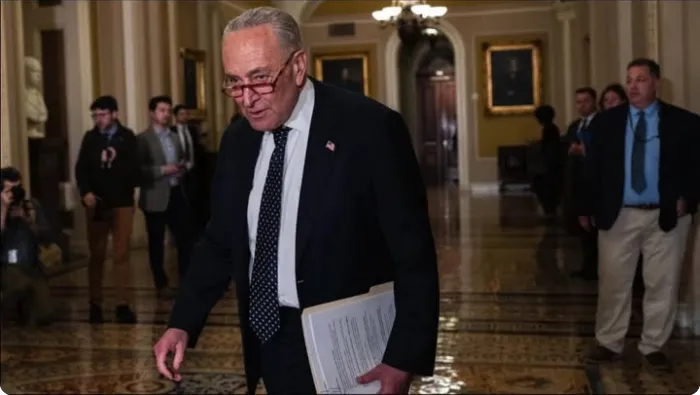
Hours after President Donald Trump told Senate Majority Leader Chuck Schumer to “go to hell” in a fiery social media post Saturday, the Senate adjourned for summer break without reaching an agreement on confirming his pending nominees.
Sources familiar with the talks told CNN that Senate GOP Leader John Thune (R-S.D.), Schumer (D-N.Y.), and White House officials had been locked in tense negotiations aimed at breaking the impasse and allowing lawmakers to return to their home states.
According to the sources, Schumer had demanded the release of certain federal funds and sought assurances that Trump would not pursue another budget-cutting legislative package before agreeing to any deal, CNN noted.
But, on social media, Trump called Schumer’s demands “egregious and unprecedented,” a sign that talks had gotten nowhere.
Trump had pushed for the Senate to confirm his nominees, even if it meant forgoing the August recess, but his post made clear he had no intention of conceding to the Democrats’ demands.
“Senator Cryin’ Chuck Schumer is demanding over One Billion Dollars in order to approve a small number of our highly qualified nominees, who should right now be helping to run our Country. This demand is egregious and unprecedented, and would be embarrassing to the Republican Party if it were accepted. It is political extortion, by any other name,” Trump wrote on his Truth Social platform.
“Tell Schumer, who is under tremendous political pressure from within his own party, the Radical Left Lunatics, to GO TO HELL! Do not accept the offer, go home and explain to your constituents what bad people the Democrats are, and what a great job the Republicans are doing, and have done, for our Country. Have a great RECESS and, MAKE AMERICA GREAT AGAIN!!!,” Trump added.
On Saturday night, Thune took to the Senate floor to request unanimous consent for the chamber to vote on a select group of nominations before adjourning for a month-long recess.
Democrats had been slow-walking President Trump’s lower-level nominees, prompting Senate GOP Leader John Thune to keep the chamber in session over the weekend to push them through. Though in the minority, Democrats wield procedural tools that can force Republicans to clear time-consuming hurdles before votes can take place.
According to sources familiar with the talks, Senate Majority Leader Chuck Schumer made several demands in exchange for expediting a batch of confirmations. These included unfreezing federal funds for programs like the National Institutes of Health and foreign aid, as well as securing a promise from Trump not to pursue another round of spending cuts—following a $9 billion rescissions package passed earlier this summer.
At a Saturday night press conference, Schumer said Democrats were “serious” about negotiating a “reasonable path” to bipartisan confirmation of nominees, but said the president refused to accept their terms, CNN said.
All said, however, Democrats are finding themselves in an increasingly perilous situation some 15 months before the midterm elections. The party is at historically low levels of approval, according to a series of polls this year, and fundraising has fallen far short of GOP efforts.
In fact, Trump’s campaign and allied political committees have already met his ambitious $1.4 billion fundraising goal — more than a year ahead of schedule — setting the stage for what insiders say will be record-breaking spending in the midterms.
Trump set the goal shortly after securing a second term, vowing to use his political operation to protect House and Senate Republicans and ensure one-party control of Congress throughout his presidency, The New York Post reported.
The $1.4 billion target was first revealed in May, when Trump’s team disclosed a $600 million haul — already a historic figure. On Friday, they announced the goal had been met in full through a combination of cash on hand and pledged donations, funneled through the Republican National Committee and his super PAC, Make America Great Again, Inc.
The political and legal drama that has simmered for years between a former FBI director and his fiercest adversary reached a new milestone this week with the announcement of the judge who will preside over the explosive criminal case.
The assignment of a relatively new federal judge has already sparked intense debate across legal and political circles, raising questions about how his background, career choices, and judicial philosophy may influence one of the most consequential prosecutions in recent memory.
The case stems from a sweeping indictment that charges the former FBI director with lying to Congress and obstructing a congressional proceeding. According to court filings, the indictment is the culmination of years of criticism, recriminations, and political tension that followed the tumultuous 2016 election and the investigations that shadowed the first years of the Trump presidency.
The defendant, who led the FBI from 2013 until his abrupt dismissal in 2017, has long insisted that his actions were guided by principle, not politics. Since the indictment, he has reiterated his defiance, publicly declaring, “I’m not afraid,” and proclaiming his innocence.
His arraignment is scheduled for October 9 in Alexandria, Virginia, a jurisdiction well-known for handling high-profile and politically charged cases.
The courtroom proceedings will now unfold under the gavel of a judge who has only recently risen to the federal bench but whose long and varied career suggests both a deep commitment to defense work and a familiarity with some of the most notorious prosecutions of the past two decades.
The assignment fell to U.S. District Judge Michael Nachmanoff, a Biden appointee who was confirmed to the Eastern District of Virginia in 2021. The judge, now 57, is no stranger to federal litigation.
Before his elevation, he spent six years as a magistrate judge in the same district, presiding over arraignments and pretrial matters in several headline-making cases.
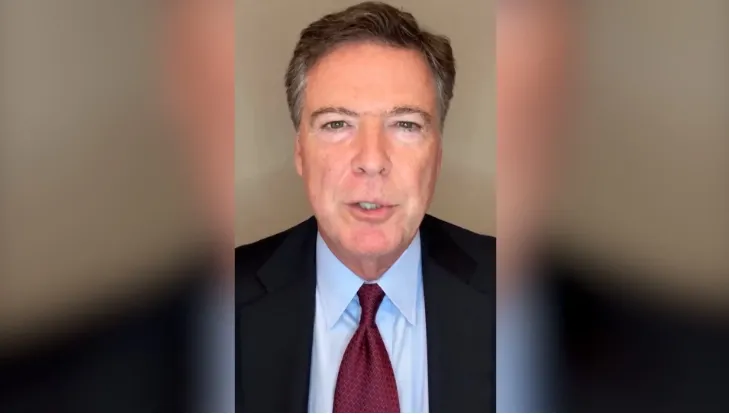 Before donning judicial robes, Nachmanoff spent more than a decade as a federal public defender in northern Virginia, where he represented some of the most challenging and controversial defendants imaginable.
His legal career reveals a consistent theme: an unyielding commitment to ensuring that even the most reviled or marginalized individuals receive the full protections guaranteed by the Constitution.
His appointment to the district court was not without contention. Nominated at the recommendation of Virginia’s Democratic senators, Tim Kaine and Mark Warner, Nachmanoff was confirmed by a razor-thin 52–46 Senate vote.
Only three Republicans—Lindsey Graham, Susan Collins, and Lisa Murkowski—joined Democrats in supporting his confirmation. That narrow margin underscored the polarized climate in which his judicial career began and foreshadowed the scrutiny he would face once assigned to cases carrying immense political weight.
As a magistrate judge in 2019, Nachmanoff presided over the arraignment of Lev Parnas and Igor Fruman, associates of Rudy Giuliani who were charged with campaign finance violations connected to efforts to dig up damaging material on Joe Biden in Ukraine. Nachmanoff granted both men release on $1 million bond, a decision that drew national headlines at the time.
But it was his earlier career as a federal public defender that built his reputation. Nachmanoff’s office represented Zacarias Moussaoui, the al-Qaeda operative once described as the “20th hijacker” in the September 11 attacks.
He also defended Somali pirates captured after attacking a U.S. Navy vessel in 2010. His docket included drug cases, immigration prosecutions, and other high-stakes matters where constitutional rights were often in tension with overwhelming public sentiment.
One of his most notable achievements came before the U.S. Supreme Court. In that case, Nachmanoff successfully argued for broader judicial discretion in sentencing drug offenders who had been subjected to disproportionately harsh penalties under crack cocaine statutes.
In a 7–2 ruling, the justices agreed with his position, with Justice Ruth Bader Ginsburg penning the majority opinion. That victory cemented Nachmanoff’s reputation as an attorney deeply invested in fairness and reform within the criminal justice system.
It is precisely that background that has fueled a sharp divide in how observers interpret Nachmanoff’s assignment to this case.
Critics have been quick to highlight his years representing terrorism suspects, pirates, and convicted drug traffickers. They argue that his formative experiences may lead him to view government prosecutions with undue skepticism and to sympathize excessively with defendants, even those accused of abusing positions of power.
Some political commentators have gone further, claiming that his appointment fits a pattern of Democratic administrations placing “soft on crime” judges on the bench.
Supporters, however, counter that his career demonstrates the very essence of American constitutionalism: that even the most unpopular defendants are entitled to robust legal defense.
They argue that his background is proof of a deep respect for due process and civil liberties, values that should reassure the public that proceedings in the Comey case will be handled fairly and impartially.
Legal scholars have also weighed in, noting that judges with defense backgrounds often bring balance to a judiciary heavily populated by former prosecutors. To them, Nachmanoff’s presence ensures that constitutional protections are not mere abstractions but real guardrails against governmental overreach.
The man standing trial is hardly an ordinary defendant. As FBI director, he became one of the most visible figures in American law enforcement, embroiled in controversies that touched both major political parties.
His decision to publicly announce the reopening of the Hillary Clinton email investigation just days before the 2016 election drew fierce criticism from Democrats, who believed it may have tilted the race in Donald Trump’s favor.
At the same time, his role in initiating and defending aspects of the Russia investigation brought unrelenting attacks from Republicans, particularly Trump and his allies, who accused him of politicizing the FBI and engaging in a “deep state” conspiracy.
Since his firing in 2017, the former director has emerged as one of Trump’s most outspoken critics, authoring books, giving interviews, and defending the integrity of the bureau’s work.
That visibility has made him a lightning rod for partisan passions, ensuring that his criminal trial will unfold under the glare of extraordinary public scrutiny.
The indictment accuses him of lying to Congress in sworn testimony and attempting to obstruct an inquiry into the FBI’s conduct. Such charges, if proven, could carry significant penalties, including prison time, though the exact sentencing guidelines will depend on the details presented at trial.
The prosecution team will be led by U.S. Attorney Lindsey Halligan, recently elevated to that position and now entrusted with one of the most politically sensitive prosecutions of the era.
On the defense side, the former FBI director has turned to Patrick Fitzgerald, a well-known former federal prosecutor. Fitzgerald gained fame for his work on the Valerie Plame CIA leak investigation and for prosecuting former Illinois Governor Rod Blagojevich.
His presence suggests that the defense will mount a vigorous and sophisticated case.
The trial is not just a legal proceeding—it is a political event with profound implications for how Americans perceive the justice system. For Trump supporters, the indictment may serve as long-awaited vindication of their belief that top law enforcement officials acted improperly during his presidency.
For Trump critics, the charges may be seen as an extension of partisan warfare, a way of criminalizing decisions that, while controversial, were within the bounds of official discretion.
The role of Judge Nachmanoff will therefore be scrutinized at every step. His rulings on motions, admissibility of evidence, and jury instructions will carry enormous weight, not only for the outcome of the case but also for the credibility of the justice system in the eyes of a deeply divided public.
To some extent, Nachmanoff embodies the contradictions of modern American justice. He has defended the despised and powerless, yet now he must preside over a case involving one of the most powerful law enforcement officials of the twenty-first century.
His background reflects a devotion to individual rights, but he now must oversee a prosecution in which the balance between accountability and politics will be tested like few others.
Observers expect that his courtroom will become a stage for high drama: fiery arguments between prosecutors and defense counsel, intense media coverage dissecting every ruling, and a defendant who has already declared his unwillingness to retreat quietly.
As the October arraignment approaches, attention will focus not only on the defendant but also on the man behind the bench. Will Judge Nachmanoff’s past as a defender of unpopular clients shape his approach? Will his rulings satisfy both sides of the political divide, or will they become fodder for further controversy?
One thing is certain: the combination of a former FBI director on trial and a relatively new federal judge presiding creates a tableau that will test the resilience of American institutions.
The case will likely set precedents on congressional oversight, executive accountability, and the limits of political partisanship in criminal law.
The judge, the defendant, the lawyers, and the jurors who are eventually selected will all play their parts. Yet it may be Nachmanoff, with his unique blend of experiences and principles, who ultimately defines how this trial is remembered in history.