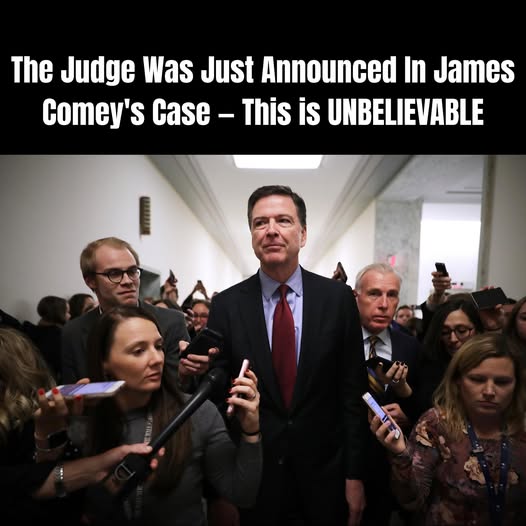
The Judge Was Just Announced in James Comey’s Case
The criminal case against former FBI Director James Comey, one of Donald Trump’s most prominent adversaries, will be handled by the newest judge on the federal bench in Alexandria, Virginia.
Court records show that U.S. District Judge Michael Nachmanoff, a Biden appointee confirmed in 2021, was randomly assigned Thursday to oversee the matter after a grand jury indicted Comey on charges of lying to Congress and obstructing a congressional proceeding.
Comey’s indictment represents the culmination of years of conflict with Trump, who has frequently accused the former FBI director of abusing his office during the 2016 election and early stages of the Russia investigation.
Comey has said publicly since the indictment, “I’m not afraid” and insisted he is innocent.
He is scheduled to be arraigned on Oct. 9 in Alexandria.
Nachmanoff, 57, has a long history in federal courts in northern Virginia. Before his appointment to the U.S. District Court for the Eastern District of Virginia, he spent six years as a magistrate judge and more than a decade as a public defender.
He was recommended for the federal bench by Virginia’s two Democratic senators, Tim Kaine and Mark Warner, and confirmed by a narrow 52-46 Senate vote, with only three Republicans—Lindsey Graham, Susan Collins, and Lisa Murkowski—supporting his nomination.
As a magistrate judge in 2019, Nachmanoff presided over the arraignment of Lev Parnas and Igor Fruman, two associates of Rudy Giuliani who faced campaign finance charges connected to Giuliani’s efforts to dig up damaging information about Joe Biden in Ukraine. He released both men on $1 million bond.
His career before joining the judiciary reflected a commitment to defense work in some of the country’s most high-profile cases.
As a federal public defender, Nachmanoff’s office represented al-Qaeda operative Zacarias Moussaoui and Somali pirates captured after attacking a Navy vessel in 2010. In one notable case argued before the Supreme Court, Nachmanoff successfully pressed for judicial discretion in sentencing drug defendants whose punishments were inflated by crack cocaine laws.
The justices ruled 7-2 in favor of his position, with Justice Ruth Bader Ginsburg writing the majority opinion.
His background as a defense attorney has drawn attention now that he will oversee proceedings against a former FBI director facing felony charges.
Critics note that Nachmanoff’s past career representing controversial defendants could influence his judicial approach, while supporters argue that it shows a long-standing respect for due process and civil liberties.
Comey, who led the FBI from 2013 until his dismissal by Trump in 2017, has defended the bureau’s handling of investigations into Hillary Clinton’s emails during the 2016 campaign, but also authorized surveillance that Republicans later denounced as politically motivated.
After his firing, he became an outspoken Trump critic, drawing condemnation from conservatives who accused him of politicizing federal law enforcement. Trump has openly said he views Comey as part of a “deep state” effort to undermine his presidency.
The indictment charges that Comey misled Congress in sworn testimony and attempted to obstruct an inquiry into the FBI’s conduct.
He will be represented at trial by Patrick Fitzgerald, a former federal prosecutor known for his work in the Valerie Plame leak investigation and the prosecution of Illinois Governor Rod Blagojevich. The Justice Department team pursuing the case is led by U.S. Attorney Lindsey Halligan, recently elevated to the post and now heading one of the most politically sensitive prosecutions of the Trump era.
With Nachmanoff on the bench, the Comey case will unfold before a judge whose career has spanned both defense and prosecution, and whose decisions could shape the legal boundaries of executive power and accountability.
The United States has escalated its fight against international drug trafficking, launching military strikes against Venezuelan cartels operating in the Caribbean.The operation, personally authorized by President Donald Trump, marks a historic shift in U.S. counter-narcotics policy. In a surprising twist, the campaign has drawn support from a prominent Democrat, signaling rare bipartisan unity on one of the nation’s most contentious security issues.On Tuesday evening, President Trump confirmed to reporters in the Oval Office that U.S. forces had engaged and destroyed a drug-laden vessel linked to Venezuelan cartels.“The military literally shot out a boat — a drug-carrying boat,” Trump said bluntly, underscoring the administration’s willingness to use overwhelming force to counter cartels.The White House stated that the vessel was not only loaded with narcotics but also manned by armed traffickers. The strike, carried out in international waters, left no doubt about Washington’s intent to take an uncompromising stance against cartels accused of flooding the United States with deadly drugs.The strike is part of a much broader U.S. military deployment in the Caribbean and off the Venezuelan coast. Over recent months, the Pentagon has dispatched Aegis-equipped destroyers, an amphibious squadron, and even a nuclear submarine to the region.These assets are supported by P-8 surveillance aircraft, helicopters, and Tomahawk-capable platforms. According to defense officials, between 4,000 and 4,500 personnel are currently assigned to the mission. Their presence sends a clear signal that the United States is treating cartel activity not just as a criminal issue, but as a national security threat requiring military force.Secretary of State Marco Rubio, speaking Wednesday, announced that the strikes would continue against drug-trafficking organizations with ties to the Venezuelan regime. The State Department has designated several of these groups, including the infamous Tren de Aragua gang, as foreign terrorist organizations.Rubio said the operation targeted and killed 11 members of Tren de Aragua, which has grown into one of the most violent transnational gangs in the hemisphere. “We’re not going to sit back anymore and watch these people sail up and down the Caribbean like a cruise,” Rubio told reporters.“The president of the United States has determined that narco-terrorist organizations pose a threat to the national security of the United States. I don’t need to explain to you why,” he added.In his remarks, Rubio emphasized the seriousness of the threat. “These are not stockbrokers. These are not real estate agents who, on the side, deal a few drugs,” he said.“These are organized, corporate, structured organizations who specialize in the trafficking of deadly drugs into the United States of America. They pose an immediate threat to the United States. Period.”Rubio also criticized prior U.S. policies that focused on interdiction and seizure of cargo. “Because these drug cartels, what they do is they know they’re going to lose 2% of their cargo — they bake it into their economics,” he explained. “What will stop them is when you blow them up, when you get rid of them.”The military action has also won praise from an unexpected quarter. Senator John Fetterman (D-PA), who has often broken ranks with his party on law-and-order issues, publicly backed the strikes.In a post responding to Rubio’s announcement, Fetterman wrote: “Fully support confronting the scourge of cartel drug trafficking to our nation.”His statement marks a rare moment of bipartisan agreement in Washington, where Democrats and Republicans are otherwise fiercely divided. Fetterman’s endorsement provides political cover for Trump’s aggressive approach, making it more difficult for opponents to dismiss the strikes as mere political theater.U.S. officials have long accused Venezuela’s government of supporting or turning a blind eye to cartel activity. The Maduro regime has been linked to narco-trafficking networks that use Venezuela’s ports and airstrips as gateways for cocaine shipments heading to the United States and Europe.By targeting vessels tied to these networks, the Trump administration is effectively treating cartel operations as extensions of hostile state activity. This shift elevates the stakes, transforming what was once considered primarily a law enforcement issue into a matter of military and diplomatic confrontation.The Tren de Aragua gang, founded in Venezuelan prisons, has expanded rapidly across South America and into the Caribbean. Known for its extreme violence, the group controls drug routes, human trafficking operations, and extortion rackets. Its members have been implicated in murders, kidnappings, and assaults throughout the region.The strike that killed 11 members of Tren de Aragua is being hailed by U.S. officials as a major blow against the organization, though experts caution that its decentralized structure makes it resilient.Still, the message from Washington is unmistakable: the United States is prepared to use lethal force against gangs once considered beyond the reach of conventional military power.Reactions in the United States have been sharply divided. Supporters of Trump’s approach argue that military action is long overdue. Conservative lawmakers and commentators say that decades of interdiction and arrests failed to stop the flow of drugs, and that only decisive strikes will make cartels rethink their operations.Critics, however, warn that escalating military involvement risks unintended consequences. Progressive Democrats argue that the strikes could destabilize the region and lead to retaliation.Civil liberties groups have also questioned the legal basis for treating drug cartels as terrorist organizations, arguing it expands executive power without adequate oversight.Venezuela’s government has yet to formally respond, but experts anticipate Maduro will denounce the strikes as violations of sovereignty. Some regional leaders may echo that stance, though others quietly welcome U.S. action against cartels that have destabilized their own countries.International law experts are also debating whether targeting cartel vessels in international waters constitutes lawful military action. The administration insists that the designations of these organizations as terrorist threats provide full legal authority.The United States has entered a new era in its fight against drug trafficking. With military assets deployed off Venezuela and direct strikes against cartel vessels, the Trump administration has redefined cartel activity as a national security threat requiring decisive force.The bipartisan support from figures like Senator John Fetterman underscores the gravity of the issue, even as critics warn of potential fallout. Whether the strategy will succeed in deterring cartels or provoke new challenges remains to be seen, but the message is clear: Washington will no longer tolerate cartel operations unchecked in the Caribbean.As Secretary Rubio put it, “What will stop them is when you blow them up, when you get rid of them.” The coming months will test whether this bold new approach changes the balance in America’s decades-long war against narcotics.