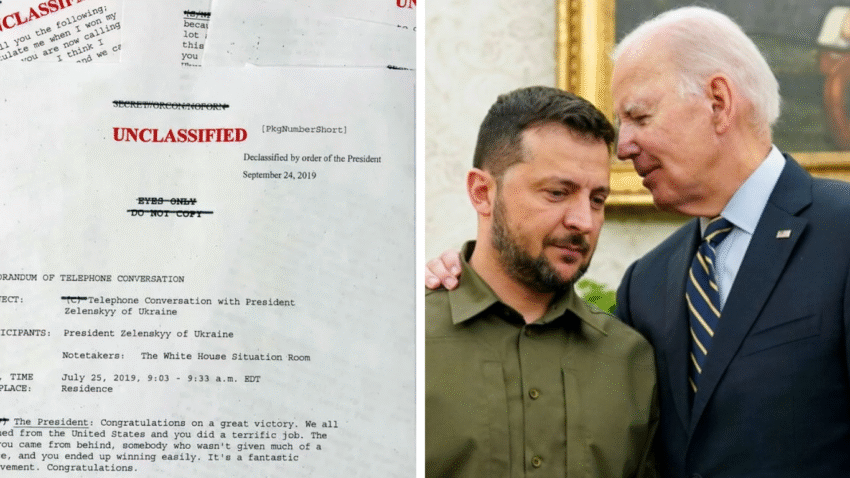
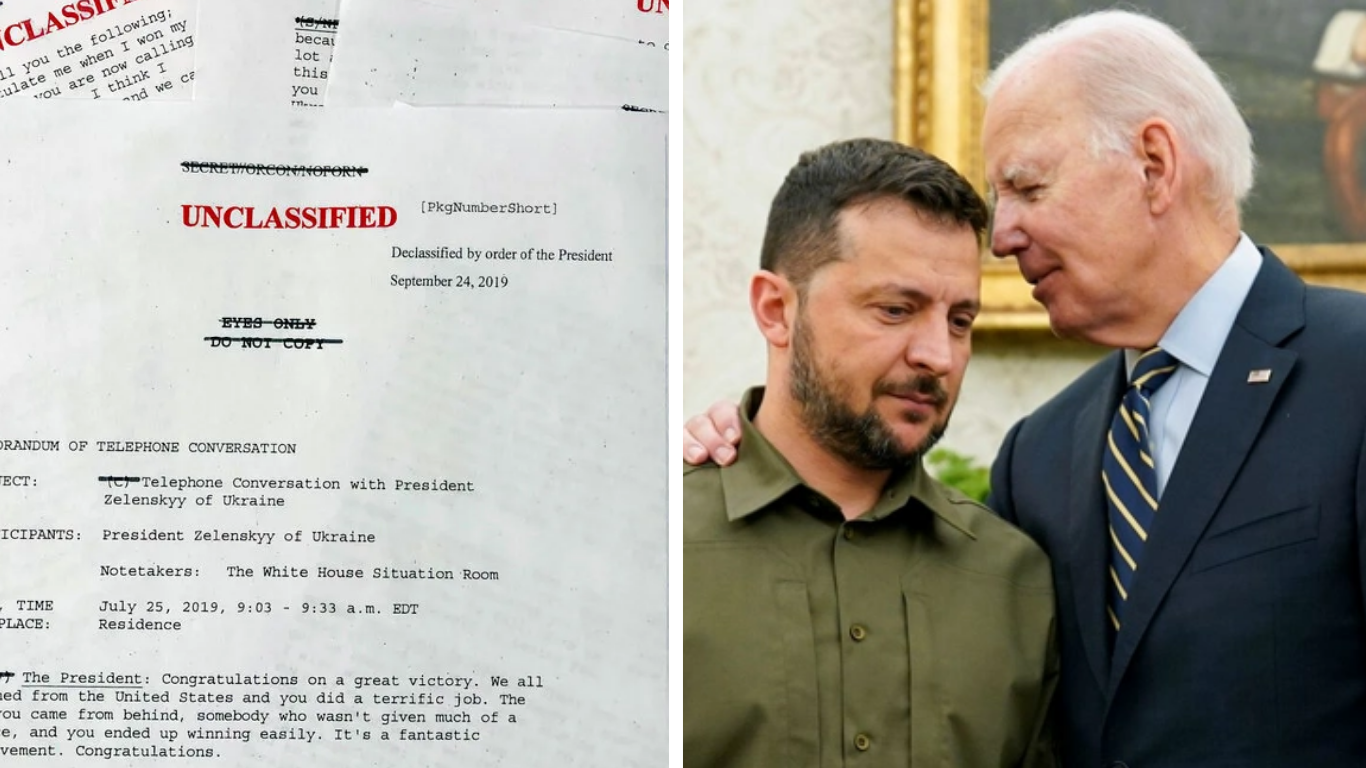
The Central Intelligence Agency (CIA) has declassified a 2015 intelligence report revealing that then-Vice President Joe Biden requested the agency not to disseminate a document detailing Ukrainian officials’ concerns about his family’s alleged corrupt business dealings in Ukraine.
The report, dated December 2015 and created in 2016, captured Ukrainian officials’ frustration over Biden’s visit to Kyiv, where they expected discussions on personnel matters but received only a generic public speech.
Following the visit, some Ukrainian officials privately expressed concerns that the U.S. Vice President’s family had ties to corruption in Ukraine, viewing it as evidence of a double standard within the U.S. government regarding corruption and political power.
CIA Director John Ratcliffe declassified the heavily redacted records, stating that this was an example of “politicization of intelligence.” A senior CIA official confirmed that Biden’s request was granted, and the intelligence report was not disseminated outside the CIA.
The official noted that it was “extremely rare and unusual” for the White House to inquire about the dissemination of a particular report for what appeared to be political reasons.
The declassified documents have reignited scrutiny over Biden’s actions as Vice President and raised questions about the extent to which political considerations influenced intelligence operations during that period.
Republican lawmakers have seized upon the declassified documents, alleging that Biden’s aides suppressed information about his family’s business ties in Ukraine to protect his political interests.
James Comer, a Republican lawmaker, claimed that the newly declassified CIA documents back GOP allegations of suppression of Biden family business ties in Ukraine.
This revelation adds to a growing body of evidence suggesting that intelligence agencies may have been used to shield the Biden family from scrutiny during the Obama administration
The full implications of this declassified document remain to be seen, but it underscores the ongoing scrutiny of the Biden family’s foreign business dealings and the role of intelligence agencies in addressing potential conflicts of interest
The declassification of this report has prompted calls for further investigation into the actions of the Biden administration and its handling of intelligence information.
Critics argue that the suppression of such information undermines public trust in government institutions and raises concerns about accountability and transparency.
The debate over the declassification of this report highlights the broader issue of executive power and the balance between transparency and oversight.
It raises important questions about the role of intelligence agencies in informing public discourse and the extent to which political considerations should influence the dissemination of sensitive information.
As the controversy continues to unfold, lawmakers and the public await further developments and potential investigations into the actions of the Biden administration and its handling of intelligence information related to Ukraine.
The declassification of this report serves as a reminder of the complex and often contentious relationship between politics and intelligence, and the challenges inherent in ensuring that sensitive information is handled appropriately and in the public interest.
In the coming weeks, it is expected that congressional committees will hold hearings to examine the circumstances surrounding the suppression of this intelligence report and to assess the implications for U.S. foreign policy and national security.
The outcome of these investigations could have significant ramifications for the Biden administration and its legacy, as well as for public trust in government institutions and the integrity of the intelligence community.
As the story develops, it will be important to monitor the responses of key stakeholders, including lawmakers and intelligence officials, to gauge the broader impact of this declassification on U.S. politics and governance.
The declassification of this report also underscores the importance of oversight and accountability in the intelligence community, and the need for mechanisms to ensure that sensitive information is handled responsibly and in accordance with the law.
Moving forward, it will be crucial to assess the lessons learned from this episode and to consider reforms that can strengthen the integrity and transparency of intelligence operations.
This declassification brings to light the urgent need for reform in how intelligence is protected from political interference.
Lawmakers are expected to demand greater transparency and safeguards to prevent future suppression of critical intelligence for political purposes.
The revelations further confirm concerns about the politicization of intelligence agencies during the Obama-Biden era.
Republicans and conservative commentators argue that this episode demonstrates a clear abuse of executive authority to shield political allies.
The CIA documents highlight how the suppression of intelligence can undermine national security and the credibility of U.S. foreign policy.
The declassified report has reinvigorated calls for accountability and thorough investigations into the Biden family’s dealings abroad.
President Donald Trump told Just The News on Sunday that he will designate the Muslim Brotherhood as a foreign terrorist organization.
Trump said “final documents are being drawn” and that “it will be done in the strongest and most powerful terms.”
Trump has weighed such a move since his first administration. The Muslim Brotherhood — an Islamist movement founded in Egypt almost a century ago with chapters, political parties, and affiliated groups around the world — has long been accused by critics of fueling extremism and destabilizing the Middle East.
Israeli Prime Minister Benjamin Netanyahu thanked Trump for his plans to designate the Muslim Brotherhood as a terror group, The Jerusalem Post reported.
“I commend President Trump for outlawing the Muslim Brotherhood,” he said. “This is an organization that endangers stability in the Middle East and beyond. That is why the State of Israel has outlawed parts of the organization and will continue to do so.”
Last week, Texas Gov. Greg Abbott designated both the Muslim Brotherhood and the Council on American-Islamic Relations (CAIR) as “foreign terrorist organizations and transnational criminal organizations,” according to Just The News.
Republicans in the House and the Senate, as well as some Democrats, have urged the State Department to designate the Muslim Brotherhood as a foreign terrorist organization.
Secretary of State Marco Rubio signaled in August that the designation was “in the works,” but emphasized that the process is lengthy because the Muslim Brotherhood has numerous branches and affiliates that must be examined individually.
On August 16, 2025, a routine departure at Charlotte Douglas International Airport turned into an unexpected disruption when a Frontier Airlines Airbus A320 experienced engine damage during ground operations. The incident, which involved a ground service hose being sucked into one of the aircraft’s engines, led to significant delays for passengers and attracted attention from aviation enthusiasts and safety professionals alike. While the event caused a nearly nine-hour delay for travelers heading to New York, no injuries were reported, and safety protocols ensured that the situation was managed without escalating further.
The Frontier Airlines flight involved was F93134, scheduled to travel from Charlotte to LaGuardia Airport in New York. The aircraft, an Airbus A320-251N with the registration number N365FR, had already flown into Charlotte earlier in the day from Philadelphia. After passengers disembarked, crews began preparing the plane for its next journey.
As part of standard pre-departure procedures, external ground support equipment, including an air-conditioning hose, was connected to the aircraft. These hoses help regulate cabin temperature while the plane is parked, ensuring passengers board comfortably without relying solely on onboard systems. However, during the course of ground operations, the powerful suction generated by the aircraft’s CFMI LEAP-1A26 engine reportedly pulled the hose into the intake. Within seconds, the hose was shredded, leaving debris and raising immediate concerns about potential engine damage.
Ground staff quickly reacted, halting operations around the plane and preventing any further risk. The aircraft was deemed unfit for departure until inspections could determine the extent of the damage, effectively removing it from service.
The sudden removal of the aircraft left passengers stranded at the airport while airline staff scrambled to find a solution. Originally expecting a routine flight to LaGuardia, travelers had to wait while Frontier arranged a replacement aircraft. The process of coordinating aircraft availability, reassigning crew, and preparing a new plane for boarding took nearly nine hours.
For passengers, the delay was undoubtedly frustrating, but Frontier Airlines emphasized that safety must come first. Boarding an aircraft with even potential engine damage is never an option, no matter the scheduling inconvenience. Eventually, passengers were rebooked on a substitute aircraft and able to continue their journey to New York.
The plane involved in the incident was an Airbus A320-251N, part of the popular A320neo family. Tail number N365FR, this specific aircraft entered service in June 2019 and was just under six years old at the time of the occurrence. The Airbus A320neo family is known for its efficiency, reliability, and reduced environmental footprint, largely thanks to its new-generation engines like the CFMI LEAP-1A26.
These engines, while advanced, produce immense suction forces at low power settings, particularly during ground operations. Even seemingly minor ground equipment, such as a flexible air-conditioning hose, can become hazardous if positioned too close to an active engine. For this reason, airlines and ground handling teams implement strict protocols to ensure that support equipment remains at a safe distance whenever engines are running.
Although some early reports mistakenly identified the aircraft as an A321, clarification later confirmed it was indeed an A320. In aviation, precision matters, as accurate details are essential for maintenance records, safety reporting, and regulatory oversight.
Aircraft engines are among the most sensitive and expensive components of any commercial plane. Even minor foreign object damage (FOD) can require extensive inspections, repairs, or even replacement of key parts. A shredded ground hose, though not as catastrophic as metal debris or tools being ingested, can still cause significant internal wear or blockages. This is why the decision was made to immediately ground the aircraft and prevent further risk.
Beyond the financial cost of maintenance, incidents like this carry broader implications for airline scheduling and passenger experience. A single grounded aircraft can disrupt not just one flight but multiple rotations throughout the day, creating cascading delays across the network. In this case, Frontier’s quick response in sourcing a replacement minimized wider disruptions, though passengers of flight F93134 still endured an extended wait.
For the travelers caught in the delay, the day was challenging. Long waits at airports can be physically and emotionally exhausting, especially when journeys involve onward connections or important appointments. Frontier Airlines staff provided updates and assistance, ensuring that while the wait was long, passengers remained informed about the progress of securing a replacement aircraft.
Some passengers expressed frustration over the extended delay, which stretched close to nine hours. However, many acknowledged that safety ultimately takes priority over punctuality. The alternative—risking flight operations with an engine that may have sustained internal damage—was not an acceptable option for either the airline or the traveling public.
This incident serves as a clear reminder of the complexities and risks inherent in ramp operations at airports. Ground crews work in a fast-paced environment where multiple tasks happen simultaneously: refueling, catering, baggage handling, cleaning, and maintenance checks all occur within a short turnaround window. Each activity must be carefully coordinated to avoid conflicts or hazards.
The ingestion of an air-conditioning hose highlights how even routine ground equipment can become dangerous under the wrong circumstances. Aviation safety relies not only on advanced technology but also on human vigilance and procedural discipline. Every member of the ground team plays a role in ensuring that flights can depart safely and on time.
Frontier Airlines, like all carriers, is bound by strict Federal Aviation Administration (FAA) regulations requiring aircraft to undergo inspections after any suspected damage. By immediately removing the A320 from service, the airline demonstrated its commitment to prioritizing passenger safety over schedule adherence.
The operations team quickly mobilized resources to mitigate the impact on passengers, eventually securing another aircraft to complete the journey to LaGuardia. While the delay was considerable, the airline’s handling of the situation prevented the risk of further complications.
Every aviation incident, even one without injuries or catastrophic consequences, provides valuable lessons for the industry. The event in Charlotte underscores the importance of constant vigilance during ground operations and reinforces why foreign object damage prevention is such a critical focus area for airlines and airports alike.
For passengers, it also serves as a reminder of why delays, while frustrating, are sometimes unavoidable. The rigorous standards that govern aviation exist to ensure that safety is never compromised, even if it means altering travel plans. In this case, the decision to delay the flight until a replacement aircraft was available was not just prudent—it was essential.
The Frontier Airlines incident at Charlotte Douglas International Airport on August 16, 2025, may have caused inconvenience to passengers, but it also showcased the strength of aviation safety systems. A potentially hazardous situation was contained swiftly, no injuries occurred, and the airline ensured that travelers eventually reached their destination.
The Airbus A320 involved will remain under maintenance review until fully cleared for future flights, while Frontier Airlines continues operating with its strong focus on safety. For passengers, the experience highlighted the reality that air travel, while incredibly efficient and safe overall, occasionally encounters unexpected challenges. What matters most is how airlines and crews respond, and in this case, the outcome reaffirmed aviation’s guiding principle: safety always comes first.