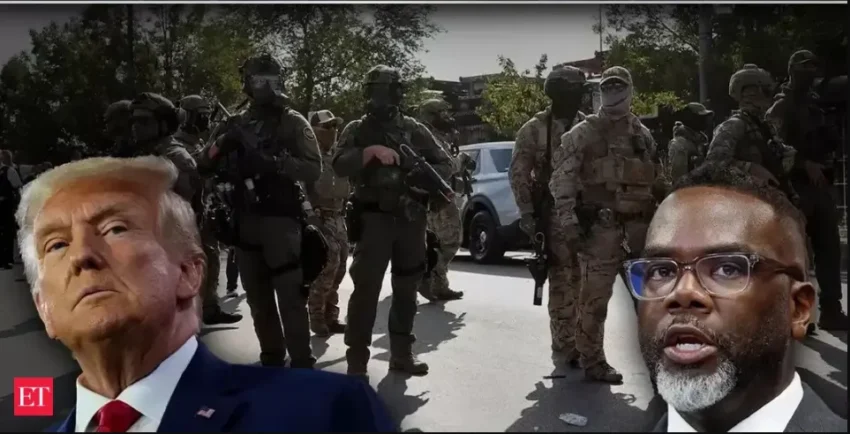
The announcement came with the kind of self-congratulatory pomp only a modern progressive politician could muster. Chicago Mayor Brandon Johnson stood behind a podium emblazoned with the city seal and a backdrop that read “A City of Sanctuary.” Cameras flashed, aides smiled, and Johnson declared proudly that Chicago would now include designated
He might as well have hung a sign on the city limits reading: Federal law not welcome here.
The message was clear — federal immigration agents, especially those affiliated with Immigration and Customs Enforcement, were to keep their distance. Chicago, he said, would remain a safe haven for “migrant families seeking dignity.”
The only problem?
He doesn’t have that authority.
Not legally. Not constitutionally. Not even morally.
Because no city — not even Chicago, no matter how blue its politics — can simply exempt itself from federal immigration law.
But that hasn’t stopped Brandon Johnson or the Democratic Party’s mayors across the country from trying.
To the far-left crowd that props him up, Johnson’s declaration sounded heroic — another act of defiance against the big, bad Trump administration.
But to the people actually living in Chicago, it was another act of insanity.
While Johnson was busy scoring political points by chasing away immigration officers, his city was burning — literally and figuratively. The crime epidemic that began years ago under his predecessors has metastasized. The violence no longer shocks anyone; it’s simply the rhythm of life in Chicago now.
Last weekend alone, at least 30 people were shot across the city — five of them fatally.
Let that sink in: Thirty human beings wounded or killed in one weekend. That’s not an anomaly anymore. That’s the routine.
According to police reports, the victims ranged in age from 16 to 62 years old. Their names won’t make national headlines. Their deaths won’t trend on social media. Their families will grieve in silence while the mayor hosts another press conference about “community healing.”
The grim tally came in early Monday morning. Chicago Police confirmed:
“At least five people were killed and 24 others were wounded in weekend shootings in Chicago as of Sunday.”
The carnage began Friday night. Around 7:45 p.m., officers responded to a shooting in the 900 block of West 85th Street. Inside an apartment, they found a man dead — a gunshot wound to the head. In an alley nearby, another man lay wounded, bleeding from the torso. He was rushed to Christ Hospital but didn’t make it.
By Saturday, the shooting map looked like a checkerboard of red dots. Four additional shootings Friday. Several more Saturday. Multiple on Sunday. And two more before dawn on Monday.
All of this, of course, happened within the boundaries of a city already famous for its “gun-free zones.”
And now, apparently, it’s proud to add “ICE-free zones” to the list.
By Sunday night, the footage had gone viral. Cellphone videos of flashing blue lights, police tape fluttering in the wind, and sobbing families filled social media feeds.
And as always, the internet responded with dark humor — the kind that only weary Americans can muster in the face of such predictable tragedy.
“If this were a foreign army there would be F-15 bombing runs in Chicago,” one user wrote on X.
“Mostly peaceful weekend in Chicago,” another quipped.
It’s gallows humor — but it also says everything. When the public stops being shocked by murder statistics, something fundamental has broken.
Mayor Brandon Johnson’s “ICE-free zones” are not an isolated idea. They are the latest chapter in a long series of anti-law enforcement crusades that have defined his time in office.
Back in September, he made headlines for calling police “a sickness.”
Let that sink in — the man responsible for overseeing one of the most violent cities in America publicly declared that the very institution tasked with protecting citizens was diseased.
He said police “don’t make cities safer.”
He said their presence was “an outdated model.”
And he said it while standing in front of cameras, in a city where children can’t walk to school without crossing gang-controlled streets.
If hypocrisy were an Olympic sport, Johnson would bring home gold for Chicago.
It would almost be comical if it weren’t so tragic.
This same mayor who calls law enforcement a “sickness” can’t stop bragging about police work when it fits his narrative.
During a press conference after nearly 60 people were shot over Labor Day weekend, Johnson took to the podium to demand new federal gun laws.
He claimed that Chicago police officers had seized over 24,000 illegal guns since he took office — and he said it as though it were a personal victory.
“Chicago police officers have taken more than 24,000 illegal guns off the streets of Chicago since I’ve taken office — over 24,000 illegal guns. They have worked hard every single day to make our city safer, and they’ve made historic progress,” Johnson said.
So which is it, Mr. Mayor?
Are the police “a sickness”?
Or are they “heroes” when their statistics help your talking points?
For Johnson, the answer depends on the audience.
When addressing progressives, he blames President Trump for Chicago’s problems — because apparently every act of violence in the city can be traced to Washington.
When that doesn’t stick, he blames Indiana, claiming that its supposedly lax gun laws are flooding Chicago’s streets with weapons.
And when that too fails, he blames “systemic inequities” — a phrase vague enough to mean everything and nothing at the same time.
But data has a funny way of cutting through political fog.
According to recent reports, most guns used in Chicago crimes are not trafficked from red states. They come from within Illinois itself.
That’s right: the problem isn’t “the pipeline from Indiana.” It’s the failure of Chicago’s own leadership — decades of corruption, weak prosecution, and lenient judges who release violent offenders back into the streets.
Johnson’s “ICE-free” proclamation is not just a bad policy. It’s an act of moral negligence.
By declaring that federal immigration enforcement officers are unwelcome in parts of the city, Johnson isn’t protecting families — he’s protecting criminals.
Illegal immigrants with violent records, fugitives from other jurisdictions, and gang-affiliated offenders will now know they can disappear into Chicago’s “sanctuary zones” without fear of deportation.
The irony is cruel.
While law-abiding citizens endure gunfire and carjackings, the mayor is busy shielding those who broke the law to begin with.
Chicago’s sanctuary policy isn’t new. It’s part of a national pattern — one that began as a talking point and has evolved into a full-blown defiance of federal authority.
Under previous mayors like Lori Lightfoot and Rahm Emanuel, the city already limited cooperation with ICE. Johnson’s “ICE-free zones” take it even further — explicitly forbidding federal agents from operating in certain neighborhoods.
But here’s the legal reality:
No city can override federal law. Period.
Immigration enforcement is a federal responsibility. Cities can choose to prioritize their own policing, but they cannot prohibit federal agents from carrying out lawful duties.
What Johnson is doing isn’t leadership — it’s political theater. And like most theater, it’s fake.
For all his speeches about “dignity” and “justice,” Johnson’s policies hurt the very people he claims to champion — low-income minorities living in the city’s most dangerous neighborhoods.
These communities aren’t clamoring for “ICE-free zones.” They’re begging for safety. For order. For peace.
They’re tired of ducking behind furniture when gunfire erupts outside their windows. They’re tired of watching their kids grow up numb to violence.
Every weekend, the same stories unfold: another teenager shot, another mother crying, another mayoral press release about “root causes.”
And nothing changes.
Chicago wasn’t always like this.
Once, it was the beating heart of the American Midwest — a city of ambition, resilience, and grit. Immigrants came here to build lives, not to hide from law enforcement.
Factories roared. Streets thrived. Neighborhoods were proud.
But decades of one-party rule and soft-on-crime policies have corroded the foundation.
Under Brandon Johnson, the city has become a cautionary tale — a place where ideology outweighs reality, where virtue-signaling substitutes for governance, and where lawlessness masquerades as compassion.
Why would any mayor make such a reckless decision?
Because in modern progressive politics, ideology is currency.
Declaring “ICE-free zones” isn’t about policy — it’s about symbolism. It’s about sending a signal to the activist base, the nonprofits, and the donors who equate chaos with compassion.
Every time Johnson defies federal law, his stock rises with the woke elite. Every time Chicago suffers another bloody weekend, he doubles down on his “systemic injustice” rhetoric.
And so the cycle continues — tragedy, denial, deflection, repeat.
Behind the scenes, Trump administration officials are reportedly furious.
According to senior DHS sources, federal immigration enforcement will continue as usual, regardless of the mayor’s proclamations. ICE agents are not bound by local declarations of “sanctuary.” They answer to federal law, not to city hall photo ops.
And while Johnson’s aides pat themselves on the back for “resisting Trump’s overreach,” the White House has made it clear: any city obstructing federal operations could face funding consequences.
That’s not a threat. That’s a promise.
Predictably, the national media treated Johnson’s “ICE-free zones” as a brave stand — another progressive “resistance moment.”
CNN framed it as a “compassionate gesture.” MSNBC called it “a model for inclusive governance.”
But not one outlet asked the most basic question: What happens when an undocumented violent offender hides in an “ICE-free zone” and kills someone?
Who takes responsibility then?
You already know the answer — no one.
Every time progressive leaders like Johnson declare war on law enforcement, ordinary people pay the price.
When police are vilified, criminals feel empowered.
When immigration enforcement is blocked, dangerous fugitives slip through the cracks.
When political ideology replaces public duty, cities fall apart.
Chicago isn’t a case study in social justice. It’s a warning — a glimpse of what happens when moral courage is replaced by moral theater.
When Brandon Johnson took office, he promised to “heal the soul of Chicago.”
Instead, he’s presiding over its unraveling.
He’s turned one of America’s most iconic cities into a playground for criminals and a refuge for illegal aliens.
He’s made police the villains and politicians the victims.
And he’s proven, beyond any doubt, that when leaders lose touch with reality, their citizens pay in blood.
Declaring “ICE-free zones” in a city drowning in violence isn’t progress — it’s abdication of leadership.
It’s a betrayal of every Chicagoan who just wants to walk home safely.
It’s another empty gesture from a man more interested in headlines than results.
And it’s proof that the modern Democratic Party has drifted so far into delusion that enforcing the law is now considered controversial.
What began as a routine flight from Thiruvananthapuram, India, to Dubai turned into a terrifying ordeal for passengers and crew on board Emirates Flight EK521. On what seemed like a normal Wednesday afternoon, the aircraft approached Dubai International Airport under clear skies. Inside the cabin, passengers were calm, unaware that their journey would soon become the focus of international headlines.
Shortly before landing, the pilot issued a precautionary warning about a possible landing gear issue. At first, many passengers thought it was a routine announcement. Yet moments later, their worst fears came true. As the plane touched the runway at 12:45 p.m. local time, disaster struck. The aircraft skidded, flames erupted, and smoke quickly engulfed the cabin.
What followed was a scene of panic and courage. With 282 passengers and 18 crew members on board, evacuation became the top priority. Emergency slides were deployed as smoke filled the cabin. Many passengers described the frantic moments when they scrambled to exit, leaving behind their belongings while clinging to the hope of survival.
Thanks to the swift actions of the flight attendants and ground crew, everyone on board was safely evacuated. Within minutes, the burning plane was consumed by flames on the runway. The fact that all 300 passengers and crew survived this dramatic crash-landing was nothing short of a miracle.
While passengers escaped with their lives, the tragedy was not without loss. During the rescue operation, a brave firefighter lost his life in the line of duty. His sacrifice highlighted the risks that first responders face when rushing toward danger to save others.
Ten passengers were hospitalized with injuries, though reports confirmed that none were life-threatening. For many survivors, the emotional scars of those terrifying minutes will last a lifetime. Still, the gratitude for being alive overshadowed the trauma of the incident.
Early investigations suggest that wind shear—a sudden change in wind speed or direction—may have contributed to the failed landing. Pilots often describe wind shear as one of the most dangerous challenges during descent, as it can disrupt a plane’s stability within seconds.
Passengers also recalled the pilot’s warning about a possible landing gear malfunction, though officials have not confirmed whether it played a role. Aviation experts caution that investigations into such incidents take time, as black box recordings, maintenance records, and weather data must all be analyzed to uncover the truth.
Emirates Airlines released a statement expressing relief that all passengers and crew survived. The airline also extended condolences to the family of the firefighter who gave his life during the rescue. Dubai International Airport temporarily suspended operations, leading to flight delays and cancellations, as emergency services worked tirelessly to bring the situation under control.
Within hours, images and videos of the burning plane circulated across global media, sparking conversations about aviation safety and the importance of emergency preparedness.
For those on board, the experience was nothing short of harrowing. Survivors described the chilling moment when smoke filled the cabin, the heat of the fire outside, and the sound of alarms blaring as crew members shouted evacuation instructions.
One passenger recalled clutching their child while sliding down the emergency chute, praying they would make it out alive. Another described the overwhelming relief of standing on the tarmac, watching the plane burn, and realizing they had survived what could have been a devastating tragedy.
These firsthand accounts serve as reminders of the unpredictability of air travel and the importance of remaining calm in emergencies.
While luck played a part in the survival of all passengers, much of the credit goes to the professionalism of the Emirates crew and the bravery of first responders. Flight attendants acted swiftly to guide passengers out of the aircraft, ensuring that panic did not derail the evacuation process.
Rescue teams on the ground faced extreme conditions, battling intense flames and toxic smoke. Their dedication and teamwork prevented the incident from becoming a far greater tragedy.
Every aviation incident, no matter how rare, provides valuable lessons for the industry. Experts stress that modern aircraft are designed with multiple safety measures to withstand emergencies. This includes reinforced cabins, fire suppression systems, and strict training for pilots and crew.
The Emirates plane fire serves as a reminder that while flying is statistically one of the safest modes of transportation, emergencies can happen. Preparedness, training, and quick decision-making can mean the difference between life and death.
The firefighter who lost his life in the rescue effort will be remembered as a hero who put others before himself. His bravery reflects the selfless nature of first responders worldwide, who face unknown dangers daily to protect lives.
For the families of survivors, his sacrifice will never be forgotten. Many passengers have expressed deep gratitude, acknowledging that their survival came at the cost of his ultimate act of courage.
Though the incident was terrifying, it also highlighted the resilience of the human spirit. Passengers, crew, and rescuers showed extraordinary strength under unimaginable pressure. The safe evacuation of 300 people from a burning aircraft will be remembered as a story of hope amid disaster.
For Emirates Airlines and aviation authorities, the focus now turns to learning from this incident to enhance safety protocols and prevent similar events in the future.
The Emirates plane fire at Dubai International Airport could have been a devastating tragedy, yet it ended with a remarkable survival story. While a firefighter gave his life in service, the safe evacuation of every passenger and crew member is a testament to courage, professionalism, and human resilience.
This dramatic event reminds us that even in moments of crisis, hope, bravery, and quick action can prevail.