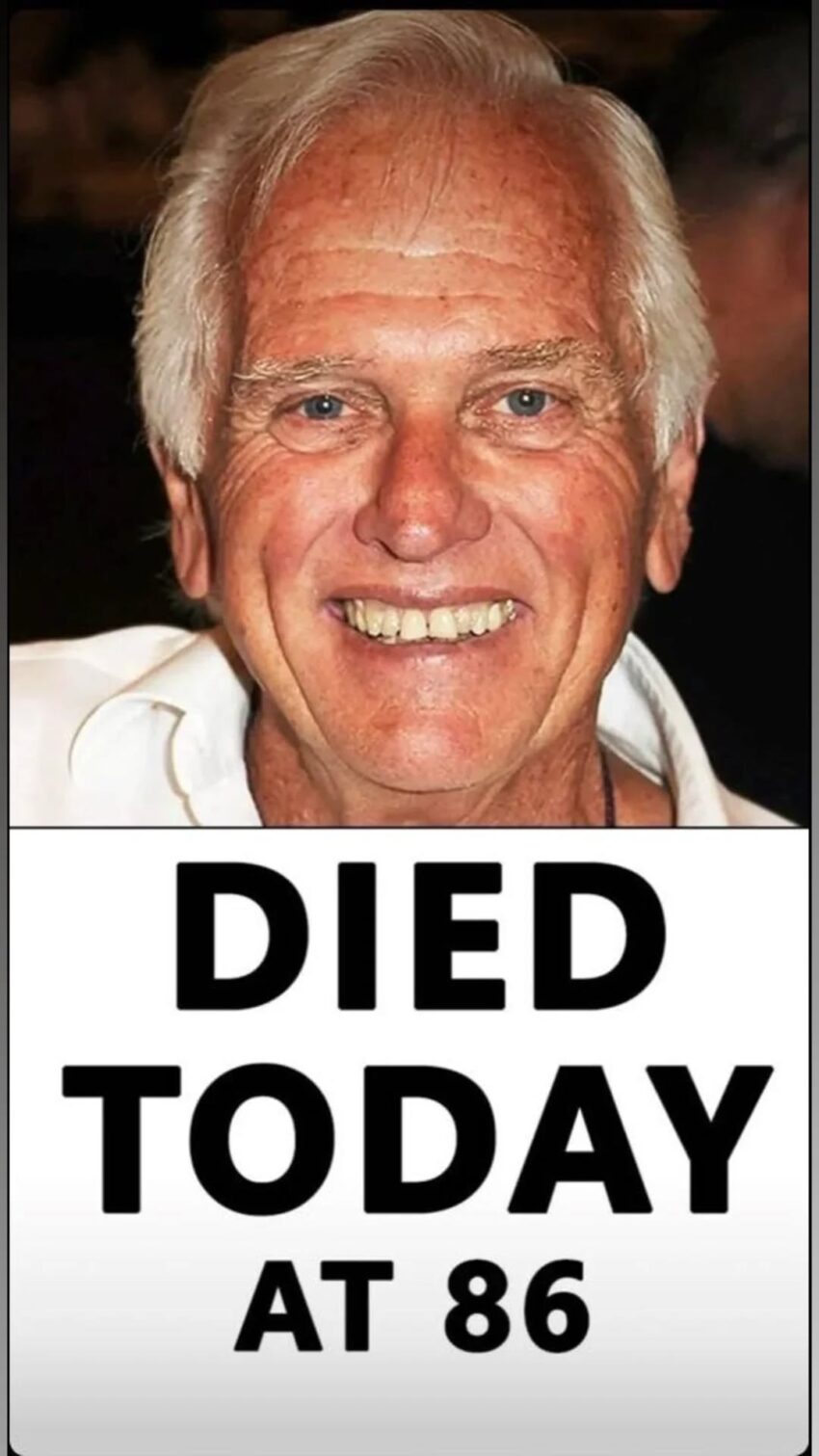
Actor Ron Ely, who is best known for being the star of the 1960s Tarzan TV series, has died at the age of 86.
His final years were shrouded in tragedy, and his death comes five years after his second wife, Valerie Lundeen Ely, was killed in tragic circumstances at the couple’s home in California.
The former flight attendant was fatally stabbed by their son, Cameron Ely, in the family’s home in Santa Barbara, at the age of 62.
Cameron was fatally shot at the scene by authorities with the Santa Barbara County Sheriff’s Office.
Ron, who retired from acting in 2001 (apart from a brief appearance in TV movie Expecting Amish in 2014), and his wife Valerie were married for 35 years before her death.
The couple had three children together, Kirsten, Kaitland, and Cameron.
Ron Ely’s wife was Valerie Lundeen, a devoted mother who once worked as a flight attendant and won Miss Airline International, a beauty pageant for flight attendants, in 1980.
A year later, Valerie was crowned Miss Florida, USA in a beauty pageant in 1981, and she would later compete for the title of Miss USA.
Her future husband, Ron, also had associations with the world of pageants, having hosted the Miss America competition for two years in a row in 1980 and 1981.
Ron and Valerie got married in 1984 and had three children. The couple became grandparents for the first time in 2018 when their daughter Kaitland gave birth to her first child, a little boy.
Valerie was 62 years old when she was killed.
Valerie was killed on October 15, 2019, when she was stabbed to death by her son, Cameron Ely, at the family home in California.
Officers who were called to the scene in Santa Barbara reported that they found Valerie dead after having suffered ‘multiple stab wounds’.
They found Cameron, who was 30 at the time, outside the home. He was deemed a threat after deputies were unable to ‘gain verbal control of the suspect’ and officers fired shots at him, fatally wounding Cameron and killing him at the scene.
A statement on the tragic incident from the Santa Barbara County Sheriff said: ‘The Santa Barbara County Sheriff’s Office responded to a 911 call at the home of actor Ron Ely.
‘Upon arrival, deputies contacted Ron Ely and discovered his wife, Valerie Lundeen Ely, 62, deceased with multiple stab wounds inside the home. While on scene, deputies identified the suspect as the Ely’s son, 30-year-old Cameron Ely.
‘Deputies searched the residence and surrounding area for Cameron Ely. During the search, the suspect was located outside the home. He posed a threat and in response four deputies fired their service weapons at the suspect, fatally wounding him. No deputies were injured during the confrontation with the suspect.’
‘The Santa Barbara County Sheriff’s Office is conducting criminal, coroner’s, and administrative investigations of this incident. Autopsies of both the victim and the suspect are pending. The names of the involved deputies will be released at a later date.’
In October 2020, Ron Ely filed a federal wrongful death lawsuit against the Santa Barbara County Sheriff’s Office.
In court documents obtained by People, the lawsuit claimed that Cameron was surrendering before police shot him more than 20 times.
PORTLAND, OR — Federal officials have unveiled a sweeping new security policy aimed at curbing the chaos that has plagued Portland’s streets for years. The Department of Homeland Security (DHS) announced this week that it is immediately enforcing a new “visibility and identification rule” outside federal buildings — a measure that effectively bans protest participants from wearing masks, full-face coverings, or elaborate disguises during demonstrations.
The rule, which had been slated to take effect in January 2026, was fast-tracked after a series of increasingly theatrical protests outside the city’s Immigration and Customs Enforcement (ICE) facility. According to federal officials, these nightly gatherings had shifted from standard demonstrations into organized, costume-heavy spectacles that blurred the line between political expression and obstruction.
“What we’ve seen recently is not protest — it’s coordinated disruption,” said Acting DHS Spokesperson Marisol Tanner. “Our officers have been confronted by individuals wearing masks, helmets, and costumes designed to prevent identification while engaging in illegal activity. That’s not peaceful assembly; that’s concealment with intent.”
A City With a Long Memory of Unrest
Portland has long been a flashpoint for clashes between law enforcement and protest groups, particularly those associated with Antifa and other anti-establishment movements. Since the 2020 protests that followed George Floyd’s death, the city has seen sporadic waves of demonstrations, often centered around federal facilities.
While the early movements drew broad public sympathy, recent iterations have become smaller but more confrontational. Protesters now frequently appear in costumes — from comic book villains to medieval knights — a strategy they describe as “creative resistance” but which law enforcement sees as deliberate confusion tactics.
“They call it art; we call it camouflage,” said ICE regional director Jason Cordova, who has overseen federal operations in Portland since 2023. “When people are lighting flares and blocking entrances in masks that hide their identity, that’s not performance art. That’s obstruction and evasion.”
The New DHS Directive: Visibility is Non-Negotiable
Under the new directive, anyone participating in or near a protest outside federal property in Portland must keep their face visible to law enforcement at all times. The rule prohibits:
The measure grants federal security officers the authority to detain or remove individuals who violate the rule and imposes fines of up to $2,500 for repeat offenders.
According to internal DHS documents reviewed by The Northwest Chronicle, the agency fast-tracked the enforcement date after a Halloween-week protest where more than 200 participants — many dressed as clowns, skeletons, and fantasy characters — surrounded the ICE facility, using strobe lights and noise machines to disrupt operations.
Antifa-Aligned Groups Cry Foul
Almost immediately after the announcement, local activist groups denounced the move as an attempt to suppress free speech.
The Portland Anti-Fascist Network (PAFN) called the DHS order “a pretext for criminalizing dissent” and accused federal agents of targeting left-wing demonstrators while ignoring similar tactics used by right-wing activists in other parts of the country.
“People wear masks at protests to protect themselves from retaliation — from employers, police, and extremists,” said Kara Jennings, a PAFN organizer. “Now the government is saying you have to unmask to speak. That’s not democracy; that’s intimidation.”
Civil liberties organizations also raised concerns. The American Civil Liberties Union of Oregon issued a statement saying it was “reviewing the legality of the DHS directive,” warning that restrictions on anonymity at protests could have a “chilling effect on First Amendment rights.”
“The government cannot equate concealment with criminality,” said ACLU attorney Jacob Heller. “There are legitimate reasons individuals choose to remain anonymous, especially in politically charged environments.”
Federal Officials Push Back
DHS officials insist the new rule is not about ideology but about maintaining order and accountability.
“We don’t care who’s protesting — left, right, or center,” Tanner said. “What matters is that law enforcement can identify individuals when crimes occur. The anonymity of masks has been exploited for too long to enable vandalism, assaults, and the destruction of public property.”
Federal agents say the change could dramatically improve safety in Portland, where nightly protests often strain police resources and lead to standoffs lasting into the early morning.
“When you can’t see who’s in the crowd, every movement becomes a potential threat,” said Federal Protective Service Officer Raymond Cho, who has been stationed in Portland since 2020. “It’s about transparency. Visibility keeps everyone safer — protesters and officers alike.”
Mixed Reaction From Portland Officials
City leaders, meanwhile, have offered mixed responses. Mayor Ted Wheeler, who has struggled for years to balance civil liberties with public order, said the federal government “acted within its jurisdiction” but urged DHS to ensure “clear communication and restraint in enforcement.”
Several members of the Portland City Council criticized the move, saying it could reignite tensions between residents and federal agents.
“Federal intervention has never gone over well here,” said Councilmember Alicia Ruiz. “Every time they step in heavy-handed, it leads to more conflict, not less. I’m worried this new rule could escalate rather than de-escalate things.”
Public Opinion: Fatigue and Frustration
Many Portland residents, weary of years of unrest, appear to support the new measure.
“I’m all for the right to protest,” said local business owner Mark Wallace, whose downtown café has been vandalized multiple times during demonstrations. “But if you’re showing up in a mask at 2 a.m. with fireworks and spray paint, you’re not a protester — you’re a problem.”
A recent poll by Oregon Watch, a regional media firm, found that 62% of Portland residents support stricter enforcement around federal buildings, while 28% oppose such measures on civil liberties grounds.
A ‘Game-Changer’ or Another Flashpoint?
DHS officials describe the anti-mask directive as a “game-changing” step toward restoring accountability in protest zones. But activists vow to resist, calling the rule another chapter in the ongoing clash between law enforcement and demonstrators who see themselves as defenders of free expression.
Social media posts from local groups have already called for a “visible resistance rally” this weekend — a protest that organizers say will feature “creative, unmasked solidarity.” Federal officials, however, warn that any attempt to defy the new rule will be met with “firm but lawful action.”
As Portland braces for yet another round of confrontation, one thing seems certain: the battle over masks — and what they represent — has become symbolic of a deeper national divide between order and expression, visibility and anonymity.
“For years, masks have been both protection and provocation,” said political analyst Lena Moritz. “Now the government has decided to pull them off. Whether that restores peace or sparks new defiance, we’ll soon find out.”
Dozens of Democratic candidates running for U.S. House seats nationwide told Axios they either would not support House Minority Leader Hakeem Jeffries (D-N.Y.) for party leader or were not prepared to commit to voting for him.
The responses suggest growing unease within some parts of the Democratic Party about its current leadership as the 2026 election cycle approaches, the outlet reported this week.
Since assuming the role of Democratic leader in 2022, Hakeem Jeffries has maintained unanimous support within his caucus. That unity, however, may be tested in the next Congress amid rising frustration from grassroots activists, particularly on the party’s left flank.
While Senate Minority Leader Chuck Schumer (D-N.Y.) has drawn much of the criticism from progressive circles this year, Jeffries is increasingly becoming a focal point of dissatisfaction as well, Axios noted.
Axios contacted nearly every Democrat running for a U.S. House seat considered potentially winnable for the party in 2026, receiving responses from 113 candidates through phone interviews or written statements.
Of those surveyed, 20 said they would not vote for Hakeem Jeffries as speaker or minority leader, while another five indicated they were likely to oppose him. Fifty-seven candidates declined to commit to supporting Jeffries, describing it as too early to decide or citing concerns over ideology, strategy, messaging, or leadership style.
Only 24 respondents said they would definitely back Jeffries, and seven more said they were likely to do so, the outlet said.
However, his office pushed back on the narrative that he’s lost support.
“Leader Jeffries is focused on battling Donald Trump, ending the Republican shutdown of the federal government and addressing the crushing GOP health care crisis,” Jeffries spokesperson Justin Chermol told Axios.
Many of the Democrats expressing skepticism toward Hakeem Jeffries are political outsiders or long-shot candidates, while several front-runners in key battleground races declined to respond to Axios’ inquiries. Still, a number of Jeffries’ critics and noncommittal candidates have credible paths to winning seats in Congress.
Among them are Daniel Biss and Kat Abughazaleh, two leading contenders in the Democratic primary to replace retiring Rep. Jan Schakowsky (D-Ill.), both of whom stopped short of pledging to support Jeffries.
Other prominent challengers — including Luke Bronin, Donavan McKinney, Mai Vang, Saikat Chakrabarti, and Patrick Roath — have also withheld their support. Each is running well-funded campaigns aimed at unseating long-serving Democratic incumbents.
Heath Howard, a New Hampshire state representative running for an open U.S. House seat, told Axios regarding the Democratic leader: “I think we need to have a new type of leadership that’s … going to fight back significantly harder against the Trump administration.”
Abughazaleh, meanwhile, told Axios she will support a leader who is “taking actual action against this administration” and that the left should use “our leverage to demand progressive change.”
“We’ve got to see improvement, without question,” Amanda Edwards, who was a member of the Houston city council and is now running in a Texas special election, told the outlet.
Harry Jarin, a firefighter mounting a primary challenge to former House Majority Leader Steny Hoyer (D-Md.), told Axios: “The anger of the base right now is not being matched by Democratic leadership … and that is going to have to change one way or another.”
A recurring theme among candidates who declined to back Jeffries was his refusal to endorse socialist New York City mayoral candidate Zohran Mamdani — a decision that has also become a source of frustration among left-wing members of Congress.
“His refusal to endorse Zohran makes me nervous that, if I were to become the nominee in my race, he and the party would not support me,” noted Jacob Lawrence, who is set to challenged Rep. Chuck Edwards (R-N.C.).
Chakrabarti, when asked whether he would support for Jeffries, quipped: “What is it that Hakeem said about endorsing Zohran? ‘I’ll have conversations with him and see where it goes.’”