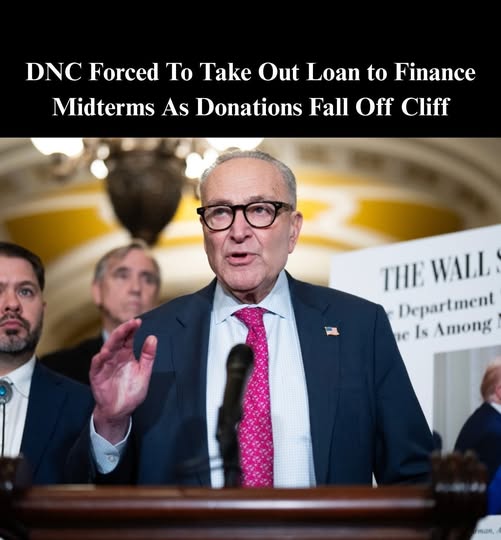
The Democratic National Committee (DNC) has secured a substantial loan in preparation for next year’s midterm elections, as the party struggles with leadership and has little to demonstrate for its government shutdown efforts. On Thursday, Politico reported on a filing the party mady with the Federal Election Commission concerning the $15 million loan.
“The national party committee framed the line of credit as an early investment to boost its candidates in New Jersey and Virginia earlier this month, and help build up state parties ahead of next year’s midterms. But the need for a loan still puts the DNC in sharp contrast with its GOP counterpart, the Republican National Committee, which was sitting on $86 million at the end of September,” the outlet said.
Politico noted the organization had taken out loans in the past, “although usually not this early in the cycle or of this magnitude all at once.”
The DNC reportedly spent over $15 million in 2025 to cover former Vice President Kamala Harris’s presidential campaign expenses. Harris and her running mate, Governor Tim Walz (D-MN), lost to President Donald Trump in the 2024 election. The additional expenditure came after Harris’ campaign blew through about $1.5 billion in donations.
By comparison, President Trump over the summer touted how well the Republican Party was doing in terms of finances and donations.
“The Republican Party is doing really well. Millions of people have joined us in our quest to MAKE AMERICA GREAT AGAIN. We won every aspect of the Presidential Election and, based on the great success we are having, are poised to WIN BIG IN THE MIDTERMS,” he wrote on Truth Social.
“We have raised far more money than the Democrats, and are having a great time fixing all of the Country-Destroying mistakes made by the Biden Administration, and watching the USA heal and prosper,” the president added.
The fundraising shortfalls are also hitting individual Democrats.
Senate Minority Leader Chuck Schumer’s fundraising, for instance, has slowed to a near standstill, sparking fresh speculation that he could face a serious primary challenge from Rep. Alexandria Ocasio-Cortez in 2026, Conservative Brief reported last month.
Federal Election Commission filings show the five-term New York Democrat raised just $133,000 during the last quarter — a sharp drop from his typical multi-million-dollar hauls and less than half of what he raised during the same period in his last election cycle, The New York Post reported.
The slowdown comes as Ocasio-Cortez, 36, raked in $4.5 million for her House reelection campaign during the same three-month period. The Bronx and Queens congresswoman has refused to rule out a Senate run — or even a future presidential bid — raising concerns inside Democratic circles that she may soon target Schumer directly.
Schumer’s campaign spent more than it raised from July through September, shelling out $322,000 while pulling in less than half that amount
The 74-year-old lawmaker’s latest report shows just $133,000 in new receipts compared to the $337,000 he raised in the same period ahead of his 2022 race. By contrast, during the final quarter before that election, Schumer brought in nearly $6 million for his campaign and helped direct a record-breaking $119 million into the Senate Majority PAC.
While he still has $8.6 million cash on hand, that total trails Ocasio-Cortez’s reported $11.8 million — an unusual reversal for the longtime Senate leader known for his prolific fundraising operation.
“There’s a big political and financial upside to being bold and capturing energy, and in this moment that accrues to AOC, not Chuck Schumer,” said Adam Green, co-founder of the Progressive Change Campaign Committee. “He cannot avoid noticing that AOC is the kind of person inspiring people and therefore getting fundraising benefit.”
Schumer’s decline in donations has raised eyebrows among Democratic strategists and donors who have long viewed him as one of the party’s most effective fundraisers. His past success has relied heavily on support from Wall Street, lawyers, and real estate interests — three industries that have historically powered his leadership PAC.
A new front in the national debate over crime, punishment, and judicial accountability has opened with Congressman Randy Fine of Florida announcing legislation that would target judges who repeatedly release violent criminals who go on to commit additional crimes.The proposal comes in direct response to the shocking murder of Iryna Zarutska in Charlotte, a killing allegedly carried out by repeat offender Decarlos Brown Jr., whose lengthy record of arrests and releases has sparked outrage across the country.Fine, a Republican lawmaker known for his hardline stances on law and order, did not mince words when unveiling his proposal.
“Those 12+ judges that released Decarlos Brown Jr. should have their day in court too,” Fine declared in a statement. He painted a picture of judges shielded by armed court officers while ordinary citizens bear the consequences of their leniency.“It’s easy to release criminals when you’re protected by an armed bailiff at all times. The rest of us aren’t so lucky.”
The legislation, still being drafted, would establish procedures for investigating and prosecuting judges who release violent offenders who later commit crimes.Supporters argue it is an overdue measure to restore accountability in a system that they believe too often favors criminals over victims.Critics are likely to respond with concerns about undermining judicial independence and politicizing the bench, but for now, Fine’s proposal has already struck a nerve.
At the heart of Fine’s legislation is the case of Decarlos Brown Jr., a repeat offender whose name has become synonymous with systemic failure.According to reports, Brown had appeared before more than a dozen judges over the years, each of whom opted to release him despite a history of violent behavior.Those decisions, critics say, paved the way for tragedy when Brown allegedly murdered Zarutska, a woman described by family and friends as kind, vibrant, and full of promise.
Her killing has become a rallying cry for those who argue that the justice system is tilting too far toward leniency, allowing dangerous individuals to slip through the cracks.For Fine, it was the breaking point. He framed his legislation as both a tribute to Zarutska and a wake-up call to the judiciary. “When judges make reckless decisions that cost innocent people their lives, there must be consequences,” he insisted.The bill proposes creating a framework for oversight that goes beyond traditional judicial review. While details remain under development, Fine explained that judges who release violent offenders later implicated in new crimes would face investigation and possible sanction.Sanctions could range from removal from the bench to criminal prosecution, depending on the severity of negligence found.The goal, Fine emphasized, is not to punish judges for every bad outcome but to ensure they weigh public safety more heavily when considering bail, parole, or sentencing decisions.
“We are not talking about mistakes made in good faith,” he said. “We are talking about judges who repeatedly turn loose violent criminals despite clear warning signs. That is not justice. That is negligence.”Supporters of the bill argue that it would restore public trust in the judicial system by holding judges accountable in the same way that police officers, prosecutors, and lawmakers are accountable for their actions.
Critics warn that the bill could have a chilling effect, discouraging judges from exercising independent judgment for fear of political backlash.Fine expressed optimism that his bill would pass “with ease” in a Republican-controlled environment. He suggested that public concern over rising violent crime would make opposition politically risky.“The people want accountability,” Fine said. “This legislation should pass with ease. Yet, we already know how Democrats are likely to vote.”His remarks reflect a broader partisan divide over criminal justice. Republicans have generally pressed for tougher laws and stricter sentencing, emphasizing victims’ rights and public safety.
Democrats, while not monolithic, have often championed reforms aimed at reducing incarceration rates, addressing systemic bias, and providing second chances for offenders.Fine’s bill, therefore, not only proposes a specific policy change but also sets up a symbolic battle over competing visions of justice. Republicans are expected to frame the debate as one of protecting citizens from violent criminals, while Democrats may raise alarms about eroding the separation of powers and undermining due process.
One of the central criticisms of Fine’s proposal will inevitably revolve around judicial independence. For centuries, the American system has prized the ability of judges to rule without fear of personal reprisal.The prospect of prosecuting judges for their decisions represents a seismic shift, critics say, one that could fundamentally alter the balance between law and politics.Legal scholars have already begun weighing in, warning of the potential for abuse. If judges face prosecution for releasing defendants who later reoffend, they argue, the safest course of action will always be to deny release—regardless of the facts or the law.
Such an environment could lead to overcrowded prisons, clogged dockets, and erosion of civil liberties.Fine counters that judicial independence is not absolute and must be balanced against accountability. “No one is above the law,” he argued. “Not criminals, not politicians, and not judges. Independence cannot be a shield for incompetence or negligence that costs innocent lives.”The debate over Fine’s bill comes at a time when violent crime continues to dominate public concern. High-profile cases of repeat offenders committing heinous acts after being released on bail or parole have stoked anger across the political spectrum.From major cities to small towns, voters are demanding tougher measures to ensure dangerous criminals remain off the streets.The Zarutska case has become emblematic of this frustration. Media coverage has focused not only on Brown’s alleged crime but also on the system that repeatedly gave him another chance.
For many, Fine’s bill represents a necessary corrective—a way to ensure that future judges think twice before releasing someone with a record of violence.The road to passing Fine’s bill will be contentious. Hearings are expected to draw heated testimony from victims’ families, legal experts, and advocacy groups. Law-and-order organizations are likely to rally behind the proposal, while civil liberties groups prepare to mount strong opposition.In Congress, the measure could become a lightning rod for broader debates about the role of the judiciary, the rise of violent crime, and the future of criminal justice reform.Fine has already signaled that he will not shy away from making the issue partisan, casting Democrats as soft on crime if they oppose the bill.
“This is about saving lives,” he declared. “If Democrats want to stand with violent offenders instead of innocent victims, let them explain that to the American people.”As the legislation moves forward, it will test not only the political will of Congress but also the boundaries of the American justice system. The idea of prosecuting judges for their rulings is unprecedented and, to some, alarming.Yet the anger generated by Zarutska’s murder has created a political climate where bold measures can gain traction.For Fine, the issue is clear-cut: accountability for everyone, including those in black robes. For his opponents, the proposal risks undermining the very foundation of judicial independence. Between these two poles lies a debate that could reshape how America balances justice, safety, and liberty in the years to come.
The murder of Iryna Zarutska has become more than a personal tragedy. It is now a symbol of systemic failure and a catalyst for sweeping legislative change.Congressman Randy Fine’s bill represents one of the most aggressive attempts yet to hold judges directly accountable for the decisions they make.Whether it becomes law or not, the proposal has already succeeded in thrusting the judiciary into the center of America’s ongoing debate over crime and punishment.As the battle lines form, one question looms over the debate: should judges be untouchable in their independence, or should they, like everyone else, face consequences when their actions have deadly results?The answer will determine not only the fate of Fine’s bill but also the future of the American justice system itself.