White House Press Secretary Carolyn Leavitt’s frantic media tour across Fox News and Newsmax was a textbook exercise in political projection and relentless message control,
aimed squarely at countering two political disasters for the Trump administration: the economy and the drug boat strikes. In a display of what critics call shameless spin, Leavitt repeatedly attempted to gaslight the loyalist bases by insisting the economy is fixed,
the opposition is composed of “con artists,” and the administration’s actions are motivated by pure, selfless dedication to the American people—even as the facts openly contradicted her claims.
Leavitt’s primary goal was to reverse the disastrous polling following President Trump’s self-proclaimed “A++++” economic grade. Her core message was both condescending and absolute: the economy is fixed, and the only remaining challenge is getting the American people to believe it.
The Inheritance Myth: Leavitt opened both segments by claiming President Trump “inherited the worst inflation crisis in modern American history from the Biden administration” and that he and his team “have been working to fix it,
” successfully. This is a direct projection of the Republican playbook: Democrats fix Republican-created messes, only to have Republicans return to power and claim they fixed the mess left by the
Democrats. Critics point out that 10 out of the last 11 U.S. recessions began under Republican administrations, turning Leavitt’s claim into a study of historical irony.
Tariffs as a Solution:
When pressed on high prices, especially for groceries, Leavitt touted the administration’s $12 billion aid package for farmers, claiming it was funded by successful tariffs that have “brought in billions of dollars back into our country.
” This is a breathtaking political spin. As critics quickly noted, the tariffs themselves—which led to a trade war with China—were the original cause of financial pain for American farmers,
forcing the need for a bailout in the first place, just as they did in Trump’s first term. Leavitt is essentially demanding credit for applying a small bandage to a gaping wound the administration itself inflicted.
The Soybeans Lie: Leavitt further claimed that President Trump had convinced President Xi of China to “continue purchasing or begin purchasing again American soybeans,” asserting that China had stopped out of disrespect for the Biden administration.
This is a flat-out objective lie. Data shows that soybean sales to China declined dramatically after Trump won election and introduced his tariffs, recovering somewhat under President Biden, only to drop again under the current administration.
Leavitt was also forced to defend the administration’s highly controversial foreign policy actions: ordering lethal strikes on suspected drug boats in the Caribbean,
juxtaposed with the pardon of former Honduran President Juan Orlando Hernández, who was convicted of trafficking hundreds of tons of cocaine into the U.S.
Projection on the Military: Leavitt attempted to paint the opposition as morally bankrupt,
claiming it “speaks to the depravity of the Democrat party” that they are “attacking our military leadership” and “brave men and women” who conducted the strikes. This shifts the focus from the legality and morality of the
order to the perceived attack on the soldiers.
The Drug War Paradox: Leavitt justified the strikes by referencing the GOP platform to “demolish foreign drug cartels” and the grief of American families who have lost loved ones to overdoses.
Yet, this dedication to stopping drug flow rings hollow against the backdrop of the Hernández pardon—a move that freed a man who was convicted of running his country as a narco-state.
Critics assert the administration has no credibility on suppressing drugs, as their actions suggest a motive driven by political expediency or “owning the libs,” not a consistent war on drug trafficking. Furthermore, national security experts under both Republican and Democratic administrations have questioned the legality of the strikes, which critics argue constitute a war crime due to the lack of due process and the failure to attempt rescue of capsized, helpless individuals.
Leavitt’s media appearances demonstrated an administration desperately trying to rally its base around a narrative that is increasingly detached from the facts and the public’s lived experience. From gaslighting the American people about their own pocketbooks to the cynical juxtaposition of pardoning a drug kingpin while ordering lethal strikes on suspected drug traffickers, the press secretary’s tour was a high-stakes effort to manage a political disaster. The core problem, however, is that an aggressive defense of demonstrable falsehoods only reinforces the perception of hypocrisy and shamelessness among those not already in the cult of personality.
Washington, D.C.—October 2025
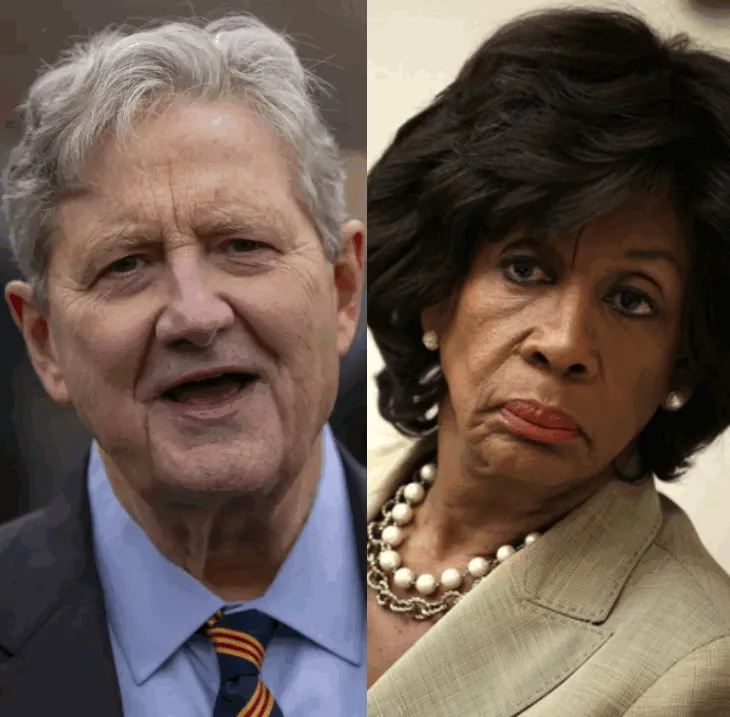
In what may become one of the most consequential hearings in recent congressional history, Senator John Kennedy of Louisiana delivered a devastating exposé on Congresswoman Maxine Waters, unraveling decades of alleged corruption, self-enrichment, and divisive rhetoric. The Senate Banking Committee hearing, originally scheduled to address the housing crisis and congressional ethics, quickly transformed into a public reckoning for Waters, whose 34-year career representing South Los Angeles communities came under intense scrutiny.
.
.
.
The committee room was packed, an unusual sight for a late October morning. The official agenda—housing policy and ethics—seemed routine, but the buzz in Washington signaled something more. When Senator Kennedy, a master of folksy interrogation, and Congresswoman Waters, famous for her fiery rhetoric and the catchphrase “reclaiming my time,” were set to clash, the political world paid attention.
Senator Kennedy, 74, sat at the center of the dais, looking every bit the rumpled country lawyer with wire-rimmed glasses and a Southern drawl that softened even the sharpest rebuke. His reputation for dismantling witnesses with deceptively simple questions preceded him.
Opposite him, Congresswoman Waters, 85, wore a bright purple suit and an expression of righteous indignation. She had come prepared to defend herself and attack her Republican adversaries, particularly Kennedy, whom she accused of enabling “Trump’s racist agenda.”
Waters wasted no time. Before the committee could address housing, she launched into a blistering statement:
“Republicans on this committee, particularly Senator Kennedy, don’t care about poor people. They serve corporate interests and enable Donald Trump’s racist agenda. You, Senator Kennedy, mock the suffering of black communities with your country lawyer act. You represent everything that’s wrong with America.”
The progressive staffers in the gallery murmured approval. It was classic Waters—aggressive, accusatory, and unapologetically combative.
Kennedy waited quietly, then responded with characteristic calm. He cleaned his glasses—a move that signaled something big was coming.
“Well, Congresswoman Waters, that was quite a speech. Very passionate, very angry. Now, I’m just a simple country lawyer, so maybe I’m confused about something. We’re here to talk about housing and ethics, and you spent your time calling me racist, which is fine, I reckon. I’ve been called worse. But I’ve been doing some homework on you, ma’am. And I’m curious about some things, like how you’ve gotten so rich while the district you represent stays so poor. That seems interesting.”
Waters bristled, calling the line of questioning racist. Kennedy, undeterred, replied, “I’m attacking corruption. Don’t much care about your race. I care about your record. Care about how you’ve spent 34 years in Congress enriching yourself and your family while the people you claim to serve suffer.”
He opened a folder and began listing the payments made from Waters’ campaign to her daughter’s company, Slate Mailer Management Services, totaling millions over the decades.
The silence in the room was palpable as Kennedy continued. Suddenly, an elderly black woman in the gallery stood up. Tears in her eyes, she introduced herself as Dorothy Jenkins, a lifelong resident of Watts.
“I gave $50 to Congresswoman Waters every year for 20 years. Sometimes I’d skip meals to have enough to donate. I thought my money was going to help the community, to help kids get better schools, to fight poverty, to make things better in Watts. But you gave it to your daughter to make your family rich while we stay poor.”
Her words echoed through the room. Kennedy quietly affirmed, “Ms. Jenkins isn’t alone, ma’am. Thousands of small donors in your district—working people, poor people—gave because they believed in you. But you fought for your family bank account instead.”
A young man from Compton stood next, his voice trembling with anger. “I’ve never seen her in our neighborhood, not once, except on TV during election years. My school didn’t have enough textbooks, streets full of potholes, crime everywhere, but she lives in a mansion worth millions. Her daughter is a millionaire from campaign donations. Her grandson got paid from the campaign, too. The whole family getting rich.”
Kennedy wasn’t finished. He shifted to the 2008 financial crisis and Waters’ involvement with One United Bank, a small institution that received bailout money under questionable circumstances. Kennedy revealed that Waters’ husband owned substantial stock in the bank and that she had personally intervened to secure TARP funds, protecting her family’s investment while thousands of families like Robert Chen’s lost their homes.
“My family suffered, lost our home, but her family got protected. That’s not public service. That’s theft. That’s corruption,” Chen testified, his voice breaking.
Kennedy pressed further. “You were supposed to oversee banks, protect consumers, protect taxpayers. Instead, you used your position to help a bank your family had money in. The House Ethics Committee investigated, found you violated ethics rules, brought discredit upon the House. But what happened? Nothing real. Letter of reproval. No real punishment. Americans lost homes, lost savings, lost jobs during that crisis. But they watched politicians protect their own investments.”
Kennedy then turned to Waters’ public statements, especially her calls to “confront” Trump officials in public places. Sarah Miller, a DC restaurant owner, recounted how her business was targeted by protesters following Waters’ remarks, resulting in financial loss and fear among her staff.
A young Republican staffer described being harassed, followed, and threatened after Waters’ rhetoric, ultimately forcing her to quit her job. Kennedy’s tone was somber. “Your inflammatory rhetoric has consequences. Real consequences for real people.”
He continued, “If a Republican told supporters to form mobs around Democratic officials, it would be condemned as incitement. But you say it—nothing. No real consequences. Your rhetoric deepens division in America. Makes confrontation seem acceptable. Makes harassment normal.”
Kennedy summarized the charges: millions funneled to family members, using office for personal gain, divisive rhetoric with real-world harm. Waters attempted her signature defense, calling the hearing racist, but Kennedy shut it down:
“I’m attacking corruption, ma’am. Don’t care about your race. I care that you got rich while your district stayed poor. I care that you used your office for personal financial gain. I care that your words hurt innocent people. That’s not racism. That’s accountability.”
The committee chairman announced a full investigation into campaign finance violations and family enrichment schemes, with a recommendation for Department of Justice review of the One United Bank matter.
Waters left the hearing, her staff trailing behind, her usual bravado replaced by defeat.
The impact was immediate. The House Ethics Committee opened a formal investigation. The FEC and IRS began reviewing campaign finances and auditing family businesses. In California, younger Democrats announced primary challenges, and community organizers demanded Waters resign.
Dorothy Jenkins’ story went viral, symbolizing the betrayal of working-class donors. Waters issued a statement blaming racism and political motivation, but the public wasn’t buying it. Kennedy hadn’t attacked her race; he’d exposed her corruption.
On December 1st, facing insurmountable odds and multiple investigations, Waters announced she would not seek reelection in 2026. Her district celebrated, and a new generation of leaders stepped forward, promising genuine representation.
The Waters case became shorthand for congressional corruption—using office to enrich family, living in luxury while constituents suffered, avoiding accountability for decades. Term limits movements gained traction. “No family enrichment” became a campaign slogan.
Dorothy Jenkins stopped donating to campaigns. “I learned my lesson. Politicians say they care about us, but they’re just using us. I’ll keep my $50 now. Use it for food instead.”
Sarah’s restaurant recovered, but she remained wary of political figures. The young staffer found a new job, advocating against inflammatory political rhetoric. Robert Chen never fully recovered from losing his home, but seeing Waters held accountable gave him closure.
In Watts and Compton, communities began to hope for real representation. Because eventually, even the most protected corruption gets exposed. Eventually, even the most skilled deflector faces accountability. Eventually, a country lawyer asks questions that can’t be answered with accusations or slogans.
And so, 34 years of enrichment, exploitation, and divisive rhetoric came to an end—not with righteous fury, but with quiet defeat. A career built on corruption, crumbling under the weight of simple questions and undeniable facts.