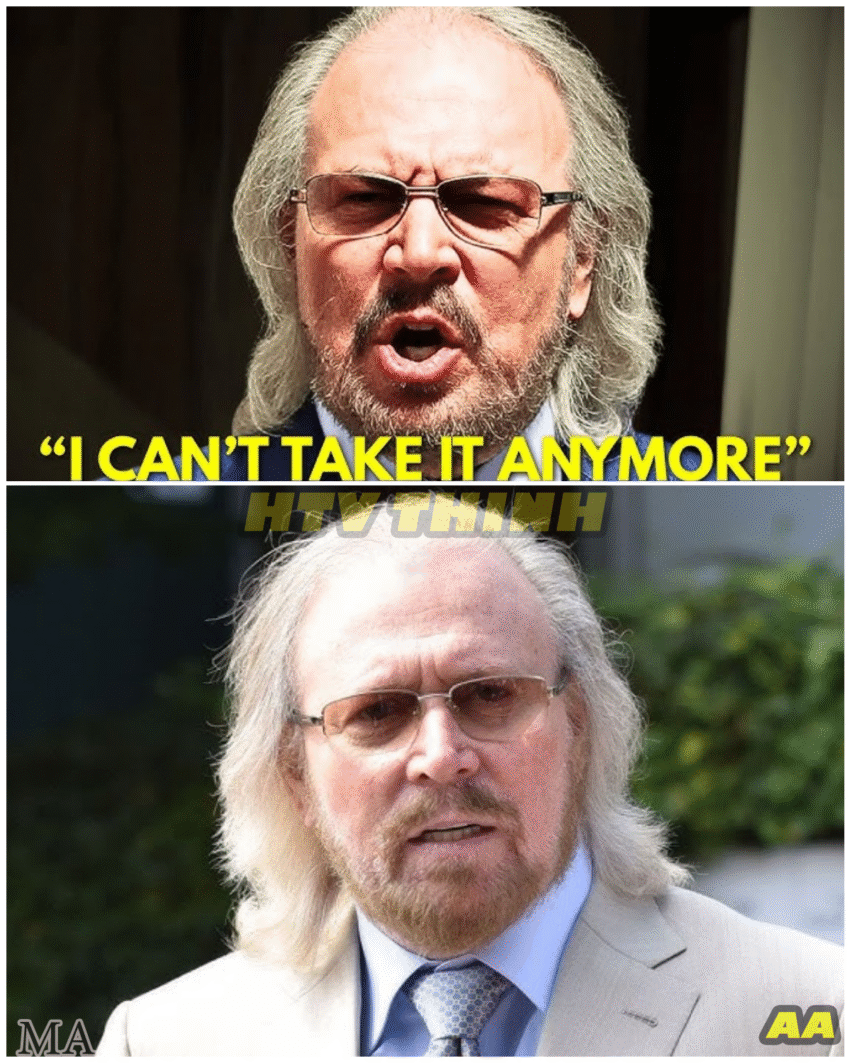
They say lightning never strikes twice — but in 1978, Barry Gibb didn’t just get struck by lightning.
He was the lightning.
The golden-haired demigod of disco didn’t simply write hits; he invented the entire emotional vocabulary of polyester.
While the rest of us were trying to dance without tearing our bell-bottoms, Barry was casually doing the impossible — writing four of the top five Billboard hits at the same time.
That’s right.
While most musicians were struggling to rhyme “love” with “dove,” Barry was out here crafting anthems that made John Travolta strut and every nightclub in America explode in feverish, chest-hair-slicked euphoria.
1978 wasn’t just a good year for Barry Gibb — it was the year music waved the white flag.
The Bee Gee in chief wasn’t satisfied with mere success; he wanted total domination.
And he got it.
While radio DJs frantically swapped out vinyls to keep up with the demand for Gibb’s songs, Barry was somewhere in Miami, probably in a silk shirt, writing another hit before breakfast.
He was unstoppable, like a disco Terminator fueled by falsetto and heartbreak.
Music historians still whisper about that fateful moment when Barry achieved what no other songwriter has done before or since.
Picture it: four of the top five songs on the Billboard Hot 100 were written or co-written by one man — the same man whose hair had its own gravitational pull.
We’re talking “Stayin’ Alive,” “Night Fever,” “If I Can’t Have You,” and “Shadow Dancing. ”
Four songs.
One Gibb.
Millions of hips shaking uncontrollably.
It wasn’t just domination; it was a glitter-covered musical coup.
Fake “musicologist” Dr. Randy Vinylson, who allegedly teaches “The Sociology of Funk” at an unaccredited online university, claims this moment in pop history “transcended genre, culture, and basic human decency. ”
According to Vinylson, “Barry Gibb didn’t just write songs — he reprogrammed the human brain to crave falsetto harmonies and tight white pants.
It’s science. ”
But how did he do it? Was Barry a mere mortal with a knack for melody, or did he tap into some secret disco dimension? Legends abound.
Some say he made a deal with the glitter gods.
Others whisper about a cursed mirror ball that granted him eternal chart power in exchange for an unending supply of chest oil.
Whatever the truth, one thing is certain: no songwriter since has managed to duplicate that kind of domination.
Not even Taylor Swift with her army of heartbroken fanatics or Ed Sheeran with his calculator-level math pop could touch the sheer audacity of Barry’s 1978.
Barry himself has remained humble about it.
In interviews, he tends to shrug off the accomplishment, as if writing four simultaneous megahits is something you do between sips of tea.
“It was just the right time,” he once said.
Sure, Barry.
And Michelangelo “just felt like doodling” the Sistine Chapel.
Even his brothers — Robin and Maurice — knew they were witnessing something freakish.
Robin reportedly said that watching Barry work was like “watching a man possessed by rhythm and divine hair. ”
Maurice once joked that Barry could “write a number one hit faster than I can make toast. ”
It wasn’t jealousy; it was awe.
Meanwhile, music producers of the era were begging for a piece of the Gibb magic.
If you were an artist in the late ’70s and your career didn’t involve Barry Gibb, you were basically invisible.
The man was everywhere — writing for Andy Gibb, Yvonne Elliman, Frankie Valli, and even Barbra Streisand.
Yes, the same Barbra Streisand who has never publicly sweated a day in her life.
When she teamed up with Barry, the result was Guilty — an album so smooth it should come with a caution label for slipperiness.
The music press of 1978 went into collective meltdown.
Rolling Stone didn’t know whether to canonize Barry or burn his effigy in protest of disco’s tyranny.
Critics were torn between admiration and exhaustion.
One writer famously quipped, “If Barry Gibb sneezes, it’ll go platinum. ”
And then came the backlash — because of course it did.
The infamous “Disco Demolition Night” in 1979 saw disco records literally blown up in a baseball stadium by angry rock fans who couldn’t handle the Bee Gees’ dominance.
But here’s the delicious irony: even as disco “died,” Barry’s songs lived on, creeping into film soundtracks, karaoke bars, and the playlists of people who swear they hate disco but still hum “How Deep Is Your Love” in the shower.
Fake music historian Trudy Glitz of PopConspiracy Weekly insists, “Barry Gibb didn’t kill disco.
He transcended it.
He evolved into pure musical energy — like Obi-Wan Kenobi, but with tighter pants. ”
Indeed, while others faded into nostalgia specials, Barry never stopped.
He adapted, collaborated, and somehow stayed relevant across six decades — a feat nearly as supernatural as his falsetto.
He went from Studio 54 to Nashville, swapping the mirror ball for a cowboy hat but keeping that signature melodic DNA intact.
And let’s be honest: nobody writes about love like Barry Gibb.
His lyrics aren’t just about romance; they’re about full-body melodrama — passion so intense it could melt vinyl.
He didn’t just sing about heartbreak; he built heartbreak into architecture, layering harmony upon harmony until even the happiest listener felt a pang of beautiful despair.
The 1978 “miracle year” remains his crowning jewel, and no one has come close.
“He was like Mozart in an open shirt,” says alleged industry insider “DJ DiscoBob,” who claims to have met Barry once “in a dream but maybe also in real life. ”
“When Barry sang, angels didn’t just weep — they put on roller skates. ”
You could argue that 1978 was a cultural fever dream, a polyester hallucination where everyone looked like an extra from Saturday Night Fever and nobody knew how to stop dancing.
But when the glitter settled, Barry’s music endured.
His fingerprints are all over modern pop — from Bruno Mars’ funk to The Weeknd’s retro soul.
Even Beyoncé’s recent disco revival owes a little nod to the man who made dance floors sacred temples of heartbreak and groove.
So what makes Barry Gibb’s 1978 reign truly legendary? It wasn’t just the number of hits — it was the sheer, ridiculous scale of it all.
He wasn’t merely successful; he was omnipresent.
You couldn’t buy groceries, ride an elevator, or go on a date without hearing that falsetto.
It was like living in a world scored entirely by Barry Gibb’s emotions.
And the craziest part? Nobody complained.
To this day, no songwriter — not Max Martin, not Diane Warren, not even the algorithmic brain of Spotify — has managed to replicate that level of chart control.
Some have tried, of course.
There have been tribute albums, Bee Gees musicals, and countless documentaries trying to dissect “the Gibb genius. ”
But the truth is simple: you can’t replicate magic.
You can only dance to it.
And now, decades later, Barry at 79 looks back on that year with the bemused calm of a man who knows he peaked higher than any mortal should.
“It was a blur,” he once told an interviewer.
“But a beautiful blur. ”
That’s classic Barry — eternally cool, even when describing what may well have been a divine intervention set to a disco beat.
The internet, of course, has rediscovered his legend, with TikTok teens ironically grooving to “More Than a Woman” and realizing, too late, that they’ve fallen under the Gibb spell.
The disco phoenix has risen again — this time with hashtags.
In an era of auto-tune and algorithmic pop, Barry’s story feels almost mythical.
No ghostwriters, no AI — just pure human groove.
And maybe that’s the real reason no one’s matched him since.
Because while everyone else was trying to sound perfect, Barry Gibb was busy sounding alive.
So here’s the verdict, straight from the Temple of Glitter: Barry Gibb didn’t just dominate 1978 — he owns it forever.
The charts have changed, the world has changed, but nobody, nobody, has pulled off what he did in that one feverish, falsetto-fueled year.
And as long as there’s a dance floor somewhere on this planet, his songs will keep echoing — proof that sometimes, the impossible doesn’t just happen once.
It stays alive.
“It Wasn’t Just Love… It Was BETRAYAL. ” – The DARK, HIDDEN TRUTH Behind Agnetha and Björn’s Sudden Split That…
“Deep Below Lake Superior: Drone Footage of the SS Edmund Fitzgerald Reveals Something No One Can Explain — and It’s…
“The SHOCKING Discovery Beneath the Waves: Titanic’s Lost Vault Reveals First-Class Treasures — and a Secret That Could Rewrite History…
“‘It Wasn’t Supposed to See That…’ Bryce Johnson’s Drone Captures a TERRIFYING Truth Hidden Deep in the Wilderness — And…
“The 12-Foot Forest MONSTER: Hunters Set Out to Track a Grizzly But Caught Something Far More Terrifying — And Experts…
“Bigfoot CAUGHT on Camera? The Bone-Chilling Videos That Have Experts Shaking — Terrifying Sightings, Hidden Footage, and Secrets in the…
End of content
No more pages to load
Next page