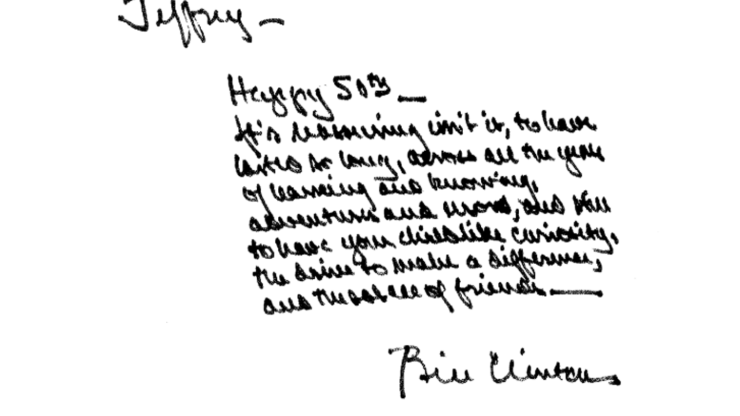
The release of Jeffrey Epstein’s infamous 50th birthday book has sent shockwaves through America.
A disturbing handwritten note from former President Bill Clinton has been uncovered, and it is raising new questions about how close Clinton really was to the disgraced financier.
The book, titled The First Fifty Years, was compiled in 2003 by Ghislaine Maxwell.
It contained messages and tributes from powerful figures across politics, business, and entertainment. The book was presented to Epstein during a lavish birthday celebration.
Clinton’s entry, now confirmed to be authentic, is one of the most striking pieces in the collection.
His words to Epstein were not casual remarks but a glowing personal tribute.
Clinton wrote, “I particularly value your childlike curiosity and drive to make a difference in the world. And I cherish the comfort of our friendship.”
The choice of words has stunned the public. The reference to Epstein’s “childlike curiosity” is being widely condemned, especially in light of Epstein’s predatory crimes against minors.
Conservatives argue this is not simply a poor turn of phrase. Instead, they say it reveals the disturbing way powerful elites overlooked or even excused Epstein’s behavior.
The book, spanning 238 pages, includes many contributors. But none are as politically explosive as Clinton’s entry.
His note reflects admiration and closeness that can no longer be denied.
The release of this scrapbook came through the House Oversight Committee, which has been investigating Epstein’s ties to the world’s elite.
The public now has access to a document that shows in Clinton’s own handwriting just how close he was to Epstein.
Clinton has long downplayed his association with Epstein. He has repeatedly claimed he barely knew the man. Yet this letter directly contradicts that narrative.
Flight logs already confirmed that Clinton flew on Epstein’s private jet multiple times. Photos placed him at Epstein’s properties.
Now his own words show he valued Epstein’s friendship.
For years, Democrats and their allies in the media tried to minimize Clinton’s connection to Epstein.
They portrayed him as just another name in a crowded social circle. This letter proves otherwise.
The irony is unavoidable. Clinton, once celebrated as a global statesman, is now exposed as praising a man who abused young girls and built his empire on exploitation.
House Oversight members say this discovery underscores why full transparency is necessary. Americans deserve to know who in positions of power enabled Epstein and protected him for decades.
Former federal prosecutor Francey Hakes reacted to the revelation by saying the words were “astonishing in hindsight.” She noted they show “a disturbing pattern of minimizing who Epstein really was.”
This reaction has fueled calls for further investigation. Many Americans now want to know what else has been hidden about Clinton’s ties to Epstein.
The silence from Clinton’s camp is also telling. No official denial or clarification has been issued since the note was made public. That silence is being read as an admission that there is no defense for what he wrote.
Republican lawmakers have seized on the issue, pointing out that Epstein’s victims have been denied justice for too long while powerful figures were shielded. Clinton’s entry is now evidence of that protection.
Epstein was first convicted in 2008, receiving a light sentence that outraged the public. Many believe he was protected by his network of influential friends. Clinton’s praise only confirms how entrenched those friendships were.
Long before the gavel fell, whispers of an extraordinary punishment rippled through the courtroom. Few imagined the scale of what was coming. When the judge finally spoke, the verdict stunned everyone: 985 years behind bars for a teenager barely old enough to drive. The
Inside the courtroom, disbelief hung thick in the air. The teen, whose identity is shielded due to age, stood silently as the judge read the sentence. Witnesses described the moment as surreal: murmurs of shock and outrage rippled across the room, punctuated by audible gasps. Video footage captures his face shifting from confusion to horror—his future effectively erased in an instant.
Prosecutors painted a harrowing portrait: a series of assaults, robberies, and reckless acts that left the community reeling. Court documents indicate the sheer number and severity of the charges made this one of the most complex cases local courts had ever seen. While some specifics remain sealed due to the defendant’s age, officials maintain that the magnitude of his crimes warranted the unprecedented ruling.
Once clips of the sentencing circulated online, the case exploded across social media. Millions of viewers debated fiercely: some denounced the ruling as cruel and irredeemable, arguing that no teenager should be written off completely. Others defended the court, insisting that justice demands accountability, no matter the offender’s age. The polarized reactions reflect a deeper societal tension over how the law should handle youthful offenders.
Conclusion
The 985-year sentence has become more than a local courtroom story—it’s a global flashpoint in debates about justice, punishment, and redemption. Can a young life be condemned without hope for reform? Should the legal system emphasize rehabilitation, or is there a point where accountability demands permanence? This case challenges society to reckon with its own definitions of fairness and consequence, reminding us that justice is never as simple as it seems.
Please SHARE this article with your family and friends on Facebook.