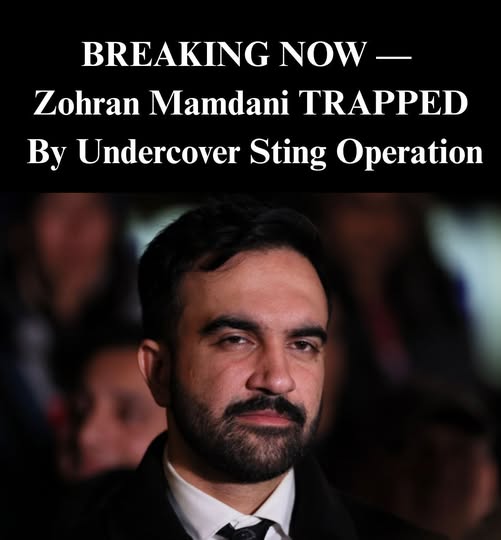
A nonprofit organization in New York City has been caught on camera advising a supposed noncitizen to illegally vote in the mayoral election for Zohran Mamdani.
According to footage released by O’Keefe Media Group (OMG), an undercover journalist posing as an unregistered immigrant approached the nonprofit’s director, asking how to cast a ballot — and who to vote for.
The director allegedly explained how the journalist could navigate the system to vote despite not being a citizen and hinted at which candidate to choose, saying he should vote for the one whose name starts with “M.”
James O’Keefe, founder of the undercover investigative journalism organization, posted the video to X, with the caption: “La Jornada Executive Director Pedro Rodriguez Tells Undercover OMG Journalist Posing as an Unregistered Migrant to ‘Vote for the Guy That Starts with ‘M’ – Despite 501(c)(3) Regulation Prohibiting Political Activity by Tax-Exempt Organizations. Rodriguez Acknowledges Knowing the Individual Is ‘Not Registered’ Before Advising him How to Vote – a Potential Violation of Federal & State Election Laws.”
It’s illegal to vote in New York City elections as a non-citizen, but the voter ID mechanisms are not particularly strong, either.
The video shows the director of the nonprofit “La Jornada” – which boasts a focus on “assisting migrants with their paperwork and legal needs” – talking to the journalist posing as the immigrant.
Mike Casey, the correspondent, told Rodriguez, “Yes, I’m an immigrant. They sent me here to vote. I was recommended to come here to find information to vote. I was given two, dos locations. Forgive me, I am, no Espanol.”
Rodriguez responded, “No, this is perfect for me,” before asking the undercover journalist when he registered to vote.
“I did not, I didn’t sign anything. They just told me to come here to vote,” Casey said.
“You’re not registered? Okay,” the director says. OMG reported that even though the journalist posing as the unregistered immigrant was not in a legal voting status, he was nonetheless instructed to go vote at a local community college.
“It’s three guys. The guy that starts with ‘M,’” Rodriguez instructed.
The only candidate in the race was Zohran Mamdani, who wound up blowing out his opponents to become mayor-elect on Tuesday.
When O’Keefe and his team later confronted Rodriguez, the nonprofit’s director, he denied ever instructing the undercover journalist to vote for Mamdani — despite the fact that the reporter had clearly posed as an illegal immigrant in the recorded exchange.
Mamdani, a self-described “democratic socialist,” is now set to run New York City, the financial capital of America and, arguably, of the free world.
Just the News has reportedly obtained internal documents from the Democratic Socialists of America (DSA) outlining how the group’s New York City chapter, to which Mayor-elect Zohran Mamdani belongs, plans to pressure him into implementing sweeping anti-Israel policies throughout city governance and public life.
Mamdani, who defeated former Gov. Andrew Cuomo and Republican Curtis Sliwa on Tuesday, has long been a fixture in the DSA, where he’s listed as one of nine “New York State Socialists in Office.” The organization, which is decidedly anti-Israel, played a key role in his campaign, backing him in both the Democratic primary and the general election.
During the mayoral race, Mamdani attempted to downplay his ties to the group’s more radical and revolutionary platform — and, according to Politico, the NYC DSA branch actively helped him do so by providing public cover to make his campaign appear more moderate than it truly was.
According to the “Socialists in Office” website, the group is composed of “DSA-endorsed elected officials who work together in the New York State Legislature to advance a socialist vision for working-class people across our state” — and among those featured is Mamdani.
The latest political storm in Washington is centered on Representative Ilhan Omar, whose personal history has again come under scrutiny following intensified federal efforts to denaturalize her over alleged immigration fraud.What began as whispers has now grown into a full-scale push, raising questions not only about Omar’s future but also about the broader political climate in which naturalized citizens may find their very status under threat.This development has stunned observers, fueled partisan divisions, and thrust the issue of denaturalization into mainstream conversation. For critics, it is evidence of long-standing doubts about Omar’s past.
The shocking murder of conservative activist Charlie Kirk has taken another disturbing turn as new details from court filings and statements by family members paint a portrait of a suspect whose political leanings shifted dramatically in recent years.Tyler Robinson, the man charged with Kirk’s murder, is at the center of an explosive case that has not only rattled the political world but also exposed deep ideological divisions within his own family.According to newly released information, Robinson’s mother has told investigators that she personally observed her son becoming “more political” and increasingly outspoken about transgender rights and related issues.She described how Robinson’s beliefs had drifted into a more left-leaning stance, with a particularly strong focus on supporting gay and transgender individuals.Her testimony to authorities detailed how her son developed a deep bond with his transgender roommate and lover, Lance Twiggs, which she believed played a role in shaping his worldview. “He cared deeply about their struggles and became very protective,” she reportedly told investigators.This ideological transformation created serious tension in the Robinson household, particularly between Tyler and his father, a registered Republican who held traditional views on gender and biological sex.Heated arguments erupted, with Robinson insisting that biological men should be free to transition to women if they chose, while his father firmly opposed the idea. One argument became especially memorable. His mother recalled her son angrily referring to Charlie Kirk’s speech at Utah Valley University as “stupid” and claiming that Kirk “spreads too much hate.” For her, that moment underscored the growing gap between her son’s beliefs and those of his father.
After Kirk was gunned down, investigators quickly circulated surveillance images of a suspect wearing a hat and sunglasses. When Robinson’s mother saw the photo, she showed it to her husband. His reaction was instant and chilling: he thought it looked like their son.Court documents reveal that Robinson’s father confronted Tyler directly, asking him about the resemblance. In that tense moment, Tyler admitted he was the shooter.Rather than fleeing, Robinson turned himself in to the authorities on the night of September 11, the very same evening that Kirk’s murder shocked the nation.“As they discussed the situation, Robinson implied that he was the shooter and stated that he couldn’t go to jail and just wanted to end it,” prosecutors wrote in their filings. “When asked why he did it, Robinson explained there is too much evil and the guy spreads too much hate.”This confession devastated his parents. His mother has since cooperated fully with investigators, while his father has struggled with the burden of being the one who ultimately turned in his own son.Prosecutors have moved quickly and decisively. Robinson has been charged with aggravated murder for the killing of Charlie Kirk, but that is only the beginning.Additional charges include obstruction of justice for hiding the rifle used in the shooting and discarding clothing in an attempt to avoid detection.He also faces two counts of witness tampering after allegedly urging his roommate to delete incriminating text messages and refuse to answer investigators’ questions.
Furthermore, he was charged with committing violence in the presence of children, an enhancement that underscores the devastating impact of his actions on bystanders.Prosecutors announced Tuesday that they intend to pursue the death penalty, citing the political motivation behind the attack, the deliberate planning, and the scale of the crime.What investigators have uncovered so far suggests that Robinson’s actions may not have been entirely spontaneous. Court filings point to text message exchanges and Discord chat logs that hint Robinson’s roommate, Twiggs, may have known about the plan beforehand.Authorities are carefully combing through communications with transgender activists to determine whether Robinson was encouraged, influenced, or possibly assisted in targeting Kirk.“It appears from the data we’ve accumulated that this ideology had infected him and had taken over,” FBI Deputy Director Dan Bongino said in a televised interview. “He was intent on making Charlie his target and people may have known in advance.”Charlie Kirk, founder of Turning Point USA, was one of the most prominent conservative voices on college campuses. Known for his fiery speeches, confrontational debates, and unapologetic defense of conservative values, Kirk was a polarizing figure. He thrived on challenging opponents and encouraging students to openly debate cultural and political issues.For supporters, he was a courageous truth-teller willing to confront liberal orthodoxy. For critics like Robinson, however, Kirk symbolized what they believed to be intolerance and hate. That sharp divide in perception underscores the larger political polarization in America today.Robinson’s mother’s account adds fuel to the narrative that he targeted Kirk precisely because of his political expression. Prosecutors have explicitly argued that the murder was an ideological attack, not merely a personal dispute.The Robinson family’s experience illustrates how national political debates can tear through even the closest bonds. A father aligned with the Republican Party, a son aligned with progressive activism, and a mother caught in the middle watching the conflict escalate—this domestic backdrop gave investigators critical insight into how Robinson’s radicalization unfolded.The disagreements over transgender rights and gender identity were not abstract debates in this household; they were personal. Tyler’s romantic involvement with his transgender roommate and his passionate defense of trans rights put him in direct conflict with his father’s conservative values.The tension only deepened as Tyler became more vocal, more entrenched, and ultimately, more radical.The most harrowing moment for Robinson’s parents came the night they confronted their son. When his father asked him about the shooting, Tyler’s response was chilling not only for its admission but also for its justification.He framed the murder as an act against evil, suggesting that Kirk’s message itself was harmful enough to warrant violent retaliation.To his parents, this was both shocking and heartbreaking. They had watched their son change, but they never imagined it would lead to this. His mother later told investigators that she wished she could have intervened sooner, but by then, his beliefs and his anger seemed unshakable.The case now heads toward what is expected to be a lengthy and high-profile trial. With prosecutors seeking the death penalty, Robinson faces the gravest of consequences.His defense attorneys are expected to argue that his political beliefs, mental state, and personal struggles played a role in shaping his actions, though prosecutors insist the murder was deliberate, premeditated, and motivated by ideology.
The evidence of concealed weapons, discarded clothing, and witness tampering strengthens the prosecution’s argument that Robinson knew exactly what he was doing and took steps to cover it up.The possibility that his roommate had foreknowledge adds another layer of potential criminal liability for others in his circle.Beyond the courtroom, this case has already reverberated through the political landscape. It highlights the dangers of political extremism and the way divisive rhetoric can radicalize individuals.Whether from the left or right, the willingness to justify violence against political opponents threatens the foundations of open debate and civil society.The case also underscores the challenges faced by families caught in ideological crossfires. Parents watching their children embrace radically different beliefs often feel powerless, and in this case, the stakes escalated to the ultimate tragedy.As the trial looms, the entire nation will be watching. Supporters of Kirk are mourning the loss of a conservative icon, while others grapple with the implications of ideological violence.Robinson’s mother remains a key witness, her testimony offering a rare window into the personal journey of a man accused of assassinating one of America’s most vocal conservative leaders.Her willingness to cooperate with investigators has already shed light on Robinson’s transformation and may play a decisive role in how the case unfolds. For prosecutors, her account bolsters the argument that the murder was not random but was a politically motivated act of hatred.The murder of Charlie Kirk by an alleged political opponent has become one of the most consequential criminal cases in recent memory. At its heart lies the story of a young man whose ideological shift set him on a deadly collision course with a national figure.The portrait that emerges is not only of a suspect consumed by ideology but also of a family torn apart by political differences, forced to make impossible choices in the face of unimaginable tragedy.For Tyler Robinson, the path forward is bleak, with the death penalty hanging over him. For his parents, the grief is compounded by the fact that their son’s victim was not only a public figure but also a man he viewed as the embodiment of hate.For America, the case is a chilling reminder of where unchecked political radicalization can lead.