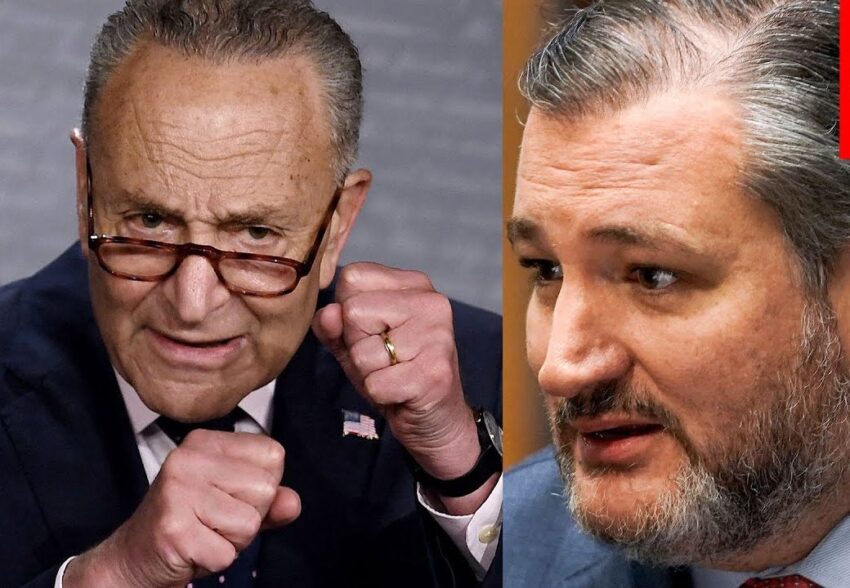
Senator Ted Cruz launched a blistering attack against Democratic leadership, blaming them squarely for a government shutdown that has lingered into its 29th day.
According to Cruz, the shutdown is not about genuine policy negotiation but about protecting Chuck Schumer and appeasing the radical left‑wing of his party.
Cruz argued that Democrats, under Schumer’s guidance, intentionally allowed the funding for the federal government to lapse.
He said their demands—among them taxpayer‑funded healthcare for undocumented immigrants and the reversal of work requirements for able‑bodied adults—are so extreme they have effectively triggered this standoff.
In Cruz’s view, this is not a simple budget dispute but a political maneuver. “This is all about political saving Chuck Schumer’s rear end,” Cruz declared, accusing Schumer of throwing American taxpayers under the bus in order to placate his party’s base.
He said: “We’re on day 29 of the stupidest shutdown. This is the SCHUMER Shutdown.”
Cruz’s words reflect deep frustration over the failure of the Senate to approve even a clean funding measure, even though the House passed one.
He painted the situation starkly: “The reason the government is shut down is that Chuck Schumer has a political problem. And he has a political problem from right where you’re sitting right now, from New York.” Cruz went on to assert that progressives in the Democratic Party almost removed Schumer from his leadership post after an earlier decision to allow funding to continue—yet now Schumer is playing to that same base by refusing to open the government.
Cruz accused Democrats of hypocrisy, pointing out that when shutdowns happened under Democratic leadership in the past, they condemned the tactic. Now, he says, they are using it as a weapon for pure politics rather than public service.
He warned that at some point “seven or eight Democrats are going to have some sense come into them.” According to Cruz, it’s likely that these will be retiring Democrats—those no longer worried about a primary challenge—who are free to break ranks because they don’t face the same pressure from the radical left‑wing base. In his telling, those in danger of primaries must pander to extreme positions, thus forcing the shutdown.
Cruz emphasized that while the shutdown continues, essential services are still functioning, but many federal workers are going without pay. The underlying damage, he said, goes beyond the immediate. He argued the shutdown erodes public trust in government, hurts working families and veterans, and punishes taxpayers who did nothing to create the mess.
He urged Americans to see the shutdown for what it is: not a noble policy stand, but a power move. “We’re NOT watching public policy, or elected officials who give a D‑MN about the people they represent!” Cruz exclaimed, shifting into a more emotional tone to emphasize his point that ordinary citizens are suffering while political games play out.
Cruz pointed specifically to the issue of illegal immigration and healthcare. He argued that Democrats’ refusal to reopen the government without addressing their demands for undocumented immigrants is proof that this is about something other than funding normal government operations.
“Their demands include taxpayer‑funded healthcare for illegal aliens and a reversal of the Republican reforms blocking handouts to able‑bodied adults who refuse to work.”
He also suggested the Democrats are exploiting the shutdown to demonstrate to their base that they are willing to “stand up” against Donald Trump and Republicans—even if that means harming the country in the process.
“They almost threw [Schumer] out of the job as minority leader… This shutdown exists for one purpose, and it’s for him to tell the crazy left‑wing base… I hate Donald Trump as much as you do,” he said.
Cruz urged Republicans and the American public to hold their ground: not to allow the Democrats to continue using the shutdown as leverage.
He called for clean funding measures—free from what he described as extraneous partisan policy riders—to be approved immediately.
According to him, the first priority should be reopening the government, then negotiating policy reforms rather than forcing them through the appropriation process.
He stressed that constituents should issue pressure: “If your senator tells you this is just about principles and policy, ask them whose principles and whose policy.”
Cruz asserted that the agenda being pushed is not aligned with the values of most Americans or taxpayers, but rather with a specific faction within the left‑wing of the Democratic Party.
Cruz also addressed the optics: he said the public looks at this and sees dysfunction. He warned that the longer the shutdown drags on, the greater the risk of long‑term damage—not only to federal operations but to faith in governance itself.
“You do not build trust in government by shutting it down. You build it by opening it, doing work, and delivering for the people,” he said.
Washington, D.C. — In a dramatic turn of events during a high-stakes House Judiciary Committee hearing, former Trump official and current conservative figure Kash Patel erupted in anger as Democrats played a controversial video linked to the Jeffrey Epstein investigation. The incident, which quickly went viral online, underscored growing political tensions over transparency, justice, and the alleged protection of powerful individuals connected to the late financier’s case.
The hearing, focused on the FBI’s handling of Epstein-related documents, quickly escalated when Democratic lawmakers introduced a video they claimed showed suppressed or ignored evidence regarding high-profile connections. The footage, described as a segment from a larger “Epstein file,” was played in the chamber without prior notice to Patel or Republican members — a move that ignited immediate outrage.
As the video played, Patel visibly tensed before interrupting proceedings with a fiery outburst. “I don’t give a damn what they say about me,” he shouted, slamming the video as misleading and politically motivated. His response drew sharp rebukes from Democrats, who accused him of obstructing justice and protecting allies of former President Donald Trump.
Leading Democratic voices, including Rep. Jamie Raskin and Rep. Pramila Jayapal, pressed Patel on whether any Epstein-related documents had been withheld or redacted to shield prominent figures. Raskin demanded the full, unredacted release of all case files, arguing that the American public — and Epstein’s victims — deserve full transparency. Jayapal went further, accusing Patel of betraying survivors by delaying justice and hiding the names of alleged co-conspirators.
Patel, however, firmly denied the allegations. He argued that any documents withheld remain protected by legal rulings, sealed court orders, or ongoing investigations. He insisted that the FBI has complied with all legal obligations and that no credible evidence has been suppressed to protect political figures. “The suggestion that we’re hiding something — especially to protect Donald Trump — is not only false, it’s defamatory,” Patel said.
The video itself — parts of which have circulated online — remains controversial. Some argue it includes nothing new, merely repackaged claims that have already been debunked or legally sealed. Others insist it points to a deliberate effort by federal agencies to downplay elite connections to Epstein’s trafficking network.
The hearing highlighted a deep partisan divide. Democrats painted the issue as one of accountability and justice, while Republicans, led by Patel’s supporters, accused their rivals of weaponizing the Epstein case to attack Trump and his allies ahead of the 2024 election. Patel, who has long been a vocal defender of the former president, dismissed the hearing as “a political circus masquerading as oversight.”
By the session’s end, no new evidence was officially entered into the record, but the confrontation left a lasting impression. The explosive moment served as a reminder of how the Epstein case — despite his death in 2019 — continues to cast a long, dark shadow over American politics, with both parties using it to fuel their broader narratives of corruption, abuse, and conspiracy.