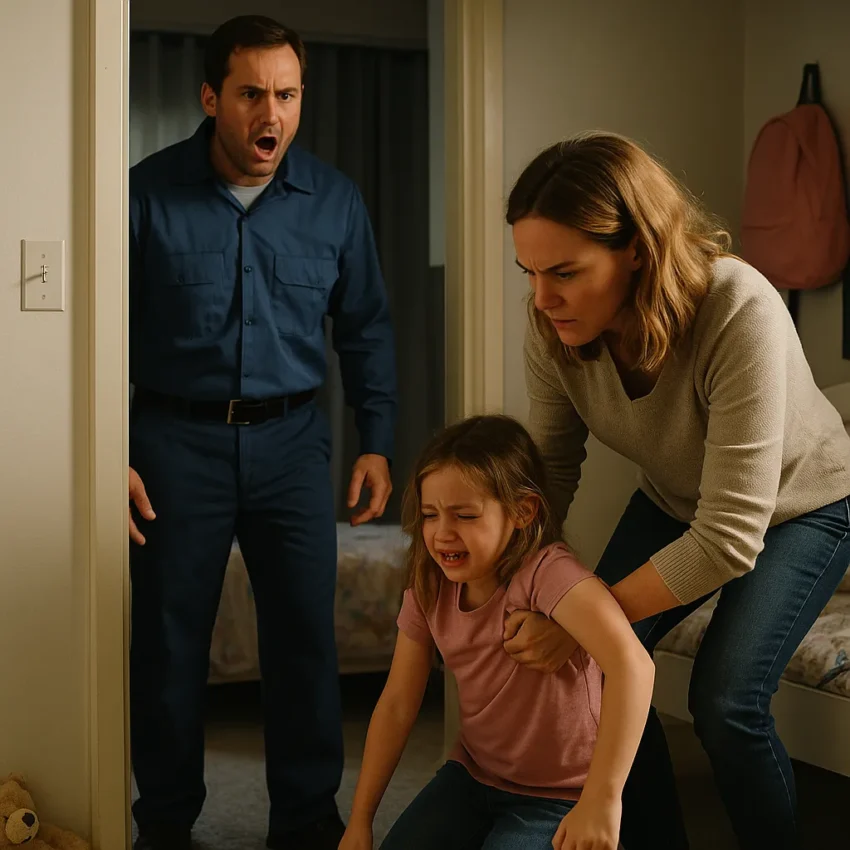
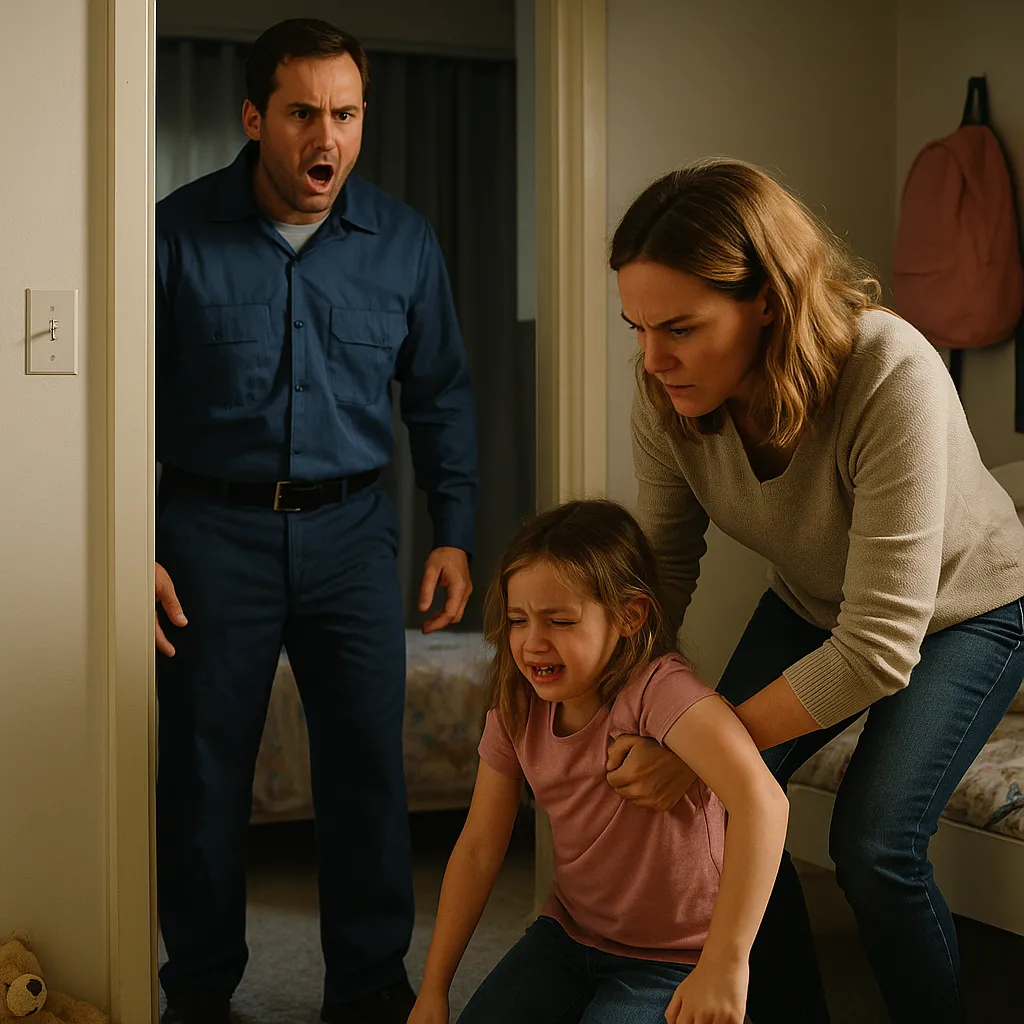
David didn’t sleep that night. The image of Emily’s bruised arm haunted him in flashes — the way she clung to his shirt, the silent tremor of fear that no seven-year-old should know. Lauren had locked herself in the guest room after he told her to get out of Emily’s sight. The house was quiet except for the clock ticking above the fireplace. Every second sounded like judgment.
He sat on the couch, holding Emily as she finally drifted off against his chest. Her tiny breaths, uneven and shaky, made him want to cry. But he didn’t. He couldn’t. Not in front of her. Not yet.
When dawn broke, the kitchen smelled faintly of coffee. David hadn’t even realized he’d brewed it. He just needed something to do — anything that felt normal. But nothing was normal anymore. He heard the soft creak of the guest-room door. Lauren stepped out, her hair a mess, her eyes red.
“David… please, I didn’t mean—”
He cut her off. “Don’t. Don’t you dare say it wasn’t what I saw.”
“She lied to me,” Lauren whispered. “She took my bracelet. I just— I snapped.”
Lauren’s lips trembled, and for a moment she looked like the woman he’d once fallen for — gentle, fragile, lost. But the memory of her hand raised against his daughter crushed any trace of pity.
He didn’t shout again. He didn’t threaten. He just looked at her and said quietly, “Pack your things.”
Lauren’s shoulders collapsed. “David, please—”
“Pack. Your. Things.”
Emily woke up an hour later, rubbing her swollen cheek. “Daddy, where’s Mommy?”
Days passed in a haze of silence. David called his boss, said he needed time off. He fixed pancakes every morning even when Emily only ate a few bites. She stopped singing to her dolls. She slept with the lights on. The house felt colder, emptier — but also calmer, like it was finally breathing again.
At night, David went through the motions of fatherhood and guilt. He blamed himself for not seeing sooner, for believing love could replace the mother Emily had lost. His first wife, Claire, had been his heart. Her death — a sudden car crash — had nearly destroyed him. And when Lauren came along with her soft voice and patient smile, he thought maybe, just maybe, the world was giving him a second chance.
He was wrong.
One evening, as he tucked Emily into bed, she asked, “Daddy, do people stop loving you when you’re bad?”
David froze. “Who told you that?”
“Mommy used to say that when I made her angry.”
Two weeks later, the doorbell rang. Lauren stood there, a suitcase in one hand, a look of exhaustion on her face. “I need to see her,” she said quietly.
Tears streamed down Lauren’s face, but David didn’t move. He watched as she turned, walked down the porch steps, and disappeared into the fading light. The door clicked shut like the end of a chapter no one wanted to write.
Winter came early that year. Emily started therapy. Her counselor, a kind woman named Dr. Harris, said healing would take time. Some nights were harder than others. Once, Emily woke up screaming that she’d seen her mother standing at the window, crying. David rushed to comfort her, whispering that it was just a dream. But when he checked the window later, a faint outline of a handprint was there, smudged in the cold glass. He wiped it away without thinking.
Slowly, life began to rebuild itself in quiet fragments. They adopted a golden retriever puppy named Max. Emily smiled more, though she still avoided her reflection in mirrors for reasons she couldn’t explain. David started cooking again, humming softly while flipping pancakes like he used to before everything broke.
But some nights — the lonely, echoing ones — he still replayed that moment. Lauren’s hand, Emily’s cry, the sound of innocence being crushed beneath an adult’s anger. It never left him.
One spring afternoon, David received a letter. The handwriting was familiar — shaky but unmistakable.
He opened it slowly.
“David,
I know I have no right to ask for anything, but I need you to know — I got help. I’m in counseling. They say I had postpartum depression, unresolved grief. I don’t know if it explains what I did, but it’s the truth. I loved Emily. I still do. I just didn’t know how to love the right way.
David folded the letter and stared out the window. Max was chasing Emily across the backyard, her laughter ringing out like sunlight. For the first time in months, he let himself smile.
He never told Emily about the letter. Not yet. Maybe when she was older, when forgiveness didn’t feel like reopening a wound.
Years passed. Emily grew into a bright, thoughtful teenager. She loved to paint, to capture light the way her mother — her real mother, Claire — used to in photographs. She rarely mentioned Lauren. But one evening, while cleaning the attic, she found the old unicorn toy, now faded and mended with tape. She brought it downstairs.
“Dad,” she said softly, “I think I want to forgive her.”
David looked up from his work, surprised. “You do?”
Emily nodded. “I don’t remember much, but I remember she cried after. Maybe she was sorry.”
They sat together, watching the sun set through the window. The light stretched across the room like a blessing — warm, quiet, whole again.
David realized that love, in its truest form, wasn’t about holding on. It was about letting go — of anger, of guilt, of ghosts that lived in the corners of old houses.
And in that gentle silence, where pain and peace finally met, the truth that had once almost slipped away came home at last.
The truth that even after the storm, there can still be light — if you choose to open the door.
On December 3rd, the world will once again hold its breath — because Princess Kate
will step back into the royal spotlight.
Alongside Prince William, she will personally welcome the royal couple from Qatar, attending the official ceremony hosted by King Charles III, before returning in the royal carriage to
For most royals, this would be just another diplomatic engagement.
But for Kate — still recovering from illness after months of treatment — it is an act of devotion that redefines duty, grace, and strength.
Sources close to the palace say that Princess Kate insisted on joining the welcome, despite her doctors’ cautious advice. After her major abdominal surgery earlier this year and subsequent cancer diagnosis, her public appearances have been few and far between.
Yet those who know her say she couldn’t bear to miss this one.
“She feels it’s her duty,” one insider shared softly. “She doesn’t want her illness to overshadow the King’s diplomacy. That’s who she is — steadfast, selfless, and impossibly graceful.”
Even now, her calendar remains carefully measured. She won’t attend the state banquet later that evening — a necessary concession to her health — but her brief presence at the ceremony itself will carry immense symbolic power.
Because when Kate steps out of that carriage, the cameras won’t just see a princess — they’ll see courage wrapped in elegance.
This isn’t the first time Kate has enchanted the world with her effortless diplomacy.
At last year’s South Korea state visit, she appeared in a striking scarlet gown, her presence commanding yet gentle, her smile warm but poised.
The image went viral almost instantly. Royal watchers across the globe described her as “the embodiment of modern royalty.”
What struck people most wasn’t the jewels or the gown — it was her confidence. She carried herself with the kind of unspoken assurance that only true queens possess.
Her makeup was minimal, her hair swept back simply, and yet she glowed — that unmistakable radiance of someone who knows her purpose.
Even without words, her message was clear: power doesn’t need to shout when it shines.
This upcoming visit from the Qatari Amir and his wife marks a significant diplomatic occasion for the United Kingdom. It will be the first major state event since Kate began her gradual return to public duties — and her participation, even in a limited capacity, signals something more profound than protocol.
It’s a moment of rebirth — a quiet declaration that she’s finding her strength again.
Observers expect her to appear in a muted but elegant gown, likely favoring soft tones that highlight her natural complexion. Royal stylists suggest she may wear her hair down, with minimal jewelry — allowing her timeless poise to speak for itself.
Even without the tiaras and grandeur of a banquet, Kate will undoubtedly steal the moment, just as she always has.
There’s something magnetic about Kate’s beauty — not the superficial kind, but the serenity that comes from within.
Her eyes carry calmness; her gestures radiate empathy. That’s why the public sees her not merely as a princess but as their queen in waiting.
Last year’s image in red remains etched in memory — Queen Kate in her prime, glowing beneath the chandeliers, representing Britain with dignity and quiet fire.
Now, as she returns this December, that same image feels like a promise renewed — the light after a long night.
She may be fragile, yes. But she is unbroken.
Royal fans have long called her “The Eternal Pearl.” It’s not just because of her beauty — it’s because of her purity of spirit.
Like a pearl, she was formed through pressure — adversity, illness, scrutiny — and yet she emerged stronger, smoother, shining with resilience.
Even when absent, her presence lingers — in photographs, in gestures, in the way the nation waits for her with affection rather than curiosity.
To many, Kate represents the best of the British monarchy: elegance without arrogance, compassion without performance.
When Kate greets the guests from Qatar on December 3rd, the scene will be brief — perhaps just a few moments of smiles and handshakes. But for millions watching, it will mean everything.
It will remind the world why Kate Middleton has become more than a royal — she’s a living symbol of grace under trial, beauty without vanity, and strength in silence.
And as the carriage returns to Buckingham Palace, sunlight glinting off its gold trim, all of Britain will be united in one quiet wish — that their Eternal Pearl keeps shining, no matter the storm.