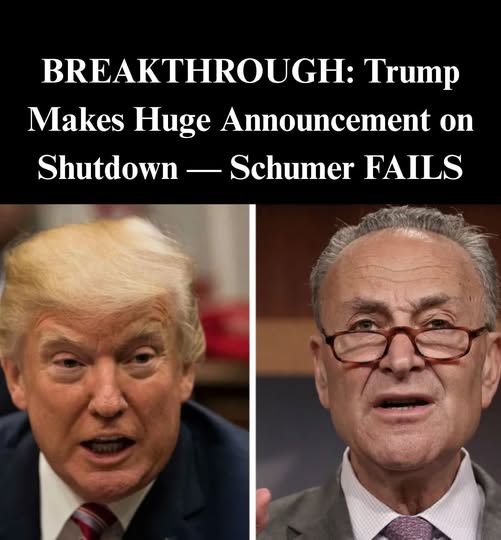
President Nick Daniels of the National Air Traffic Controllers Association warned Senate Minority Leader Chuck Schumer and the Democratic Party that the ongoing government shutdown is posing serious safety risks in U.S. airspace.
The NATCA, which represents more than 10,800 certified air traffic controllers nationwide, has repeatedly called on Congress to pass a clean continuing resolution (CR) to end the shutdown — now on track to become the longest in American history.
The House approved a clean CR a month ago, but Democrats have blocked it more than a dozen times, insisting on tying the measure to their partisan legislative demands.
Daniels emphasized that air traffic controllers are unfairly shouldering the weight of the shutdown, with thousands now working exhausting six-day, 10-hour shifts amid an existing shortage of 3,800 personnel.
As essential workers, controllers are required to remain on the job, yet many are facing severe financial strain. They received partial paychecks for pre-shutdown work on October 14, followed by $0 paychecks on October 28 and in the pay periods since — leaving many with more than 120 hours of unpaid labor.
The shutdown has also furloughed 2,350 support staff — including engineers and technicians — while freezing new controller hiring and training and pausing critical maintenance and modernization projects, leaving the air traffic system increasingly vulnerable.
In an interview with Fox News, Daniels said hundreds of controllers have been forced to take second jobs just to make ends meet amid the prolonged shutdown.
“These American patriots, they are the unsung heroes that Secretary Duffy speaks about so often. They are the ones that have been thrust into the spotlight, into center focus of a shutdown. And air traffic controllers, we don’t start shutdowns, we’re not responsible for ending shutdowns. Who does? Congress,” he said.
“And that’s why we’re saying, end the shutdown immediately. It’s not like we’re sitting here talking about an aviation issue. We’re talking, I understand the fears, the frustrations of the American people. We want to do an amazing job on their behalf, and we are. We’re showing up to work every day, the best way that we can to get through this crisis. But this isn’t something that we asked for. We didn’t want to put ourselves in the middle of it,” he added.
“Yet here we are, the rope in the tug of war game that we didn’t ask for at all. And we should not be used as political pawns in any way, shape or form for these shutdowns,” Daniels noted further.
WATCH:
Air traffic controllers have become a focal point in the government shutdown standoff, as flight delays and cancellations ripple across more than 20 U.S. airports.
Over the October 31–November 2 weekend — the worst stretch since the shutdown began — the FAA logged 98 “staffing triggers,” forcing ground stops, reduced arrival rates, and flight reroutes. Half of the nation’s 30 busiest airports reported staffing shortages, with absences in the New York area soaring to 80 percent.
NATCA and aviation experts have issued grave warnings, saying the shutdown is “eroding critical layers of safety” and rendering the National Airspace System “less safe with each passing day.”
Schumer has openly admitted that Senate Democrats are dragging out the government shutdown for political gain. In an October 9 interview with Punchbowl News,
He went even further, effectively insulting the intelligence of his own voters by insisting the shutdown is the GOP’s fault because Republicans “control everything.” In reality, that’s flatly untrue — Senate Republicans can’t pass a clean continuing resolution without 60 votes.
A new political storm is brewing on Capitol Hill as a resolution has been formally filed in the House of Representatives seeking to strip Rep. Ilhan Omar, Democrat from Minnesota, of all her committee assignments.The measure, introduced by Republican lawmakers, signals a renewed push to confront one of the most polarizing figures in Congress and underscores the ongoing partisan warfare that has come to define the legislative body.
The resolution represents not only an attack on Omar personally but also a broader test of political strength between the two parties.Republicans argue that Omar’s past remarks and actions disqualify her from serving on influential committees, while Democrats warn that the effort is part of a dangerous trend of politicizing committee assignments for partisan gain.According to House Republicans, the resolution was filed in response to a series of controversial statements Omar has made over the years on foreign policy, religion, and domestic politics.Critics within the GOP have long accused her of spreading antisemitic tropes, undermining U.S. allies, and engaging in rhetoric they consider divisive.
The resolution calls for Omar to be removed from all committee posts immediately, a punishment that would significantly weaken her influence in the chamber. “Ilhan Omar has demonstrated time and again that she is unfit to serve in roles that require trust, judgment, and a commitment to American values,” one Republican lawmaker stated after introducing the measure.
Republicans are framing the resolution as a matter of accountability rather than politics. They argue that Omar’s positions and past comments are not isolated incidents but part of a pattern that reflects poorly on the House as an institution.Several Republicans pointed to Omar’s remarks about U.S. foreign policy in the Middle East, particularly regarding Israel, as evidence of her unfitness for committee roles. Others noted her criticisms of American military actions abroad, portraying them as disrespectful to service members.“She has not only failed to uphold the standards expected of members of Congress, but she has actively undermined them,” one supporter of the resolution claimed. “We cannot allow someone who traffics in dangerous rhetoric to hold influential committee seats.”
Democrats quickly denounced the move as a partisan attack designed to silence a progressive voice in Congress. They defended Omar as a duly elected representative whose constituents have the right to have her serve fully in the House.“This is about political payback, plain and simple,” one Democratic leader said. “Republicans are targeting Rep. Omar because they disagree with her views, not because she has violated any rules or laws.”Omar’s allies argue that her criticisms of U.S. foreign policy are rooted in legitimate debate and that attempts to brand her as unfit are part of a broader pattern of targeting women of color in Congress. “This is not about accountability—it’s about silencing dissent,” another Democrat insisted.
Rep. Omar herself responded defiantly to news of the resolution. In a statement, she said that attempts to remove her from committees will not silence her or the millions of Americans who share her concerns about foreign policy, human rights, and social justice.“My critics have always tried to paint me as something I’m not,” Omar said. “But my focus has always been on fighting for the people I represent, for peace abroad, and for justice here at home. No resolution can change that.”
She accused Republicans of hypocrisy, pointing out that some GOP lawmakers with their own history of incendiary remarks continue to serve on committees without consequence. “This is not about standards—it is about politics,” she concluded.The push to remove Omar is not occurring in a vacuum. In recent years, committee assignments have become a battleground for partisan skirmishes.Republicans have targeted Democratic members for controversial remarks, while Democrats previously moved to censure or remove Republican members over inflammatory statements and social media activity.This tit-for-tat dynamic has raised alarms among political observers who worry that committee assignments—once considered largely apolitical—are becoming weapons in the partisan arsenal.The effort to unseat Omar fits squarely into this trend, further eroding norms that once guided congressional governance.
If successful, the resolution would strip Omar of her current committee roles, significantly reducing her influence in shaping policy and legislation. It would also serve as a symbolic rebuke of her positions, effectively marginalizing her within the chamber.However, the move could also backfire politically. Omar’s removal would likely galvanize progressives, who would see it as proof of Republican hostility toward outspoken minority voices.It could also deepen the rift between moderates and progressives within the Democratic Party, as leaders weigh how aggressively to defend Omar while managing broader electoral concerns.
Among Republicans, support for the resolution appears strong, though some moderates have expressed caution. They worry that escalating the practice of removing members from committees could set a precedent that harms both parties in the long run.Democrats, meanwhile, are largely united in opposing the measure, though some have privately expressed frustration with Omar’s handling of past controversies.Publicly, however, the party has closed ranks around her, portraying the resolution as an attack not just on Omar but on progressive representation itself
Today, however, the grounds for removal have expanded to include controversial speech and political positions, reflecting the heightened polarization of the era.Omar’s case is emblematic of this shift. While she has not been accused of breaking laws or violating ethics rules, her political stances have made her a lightning rod for criticism.Republicans argue that her rhetoric rises to the level of disqualification, while Democrats insist it falls within the bounds of legitimate debate.Outside Washington, the resolution has ignited intense debate among voters. Supporters of the measure applaud Republicans for taking action, saying that Omar’s comments have long crossed the line.
Detractors accuse Republicans of scapegoating her and warn that silencing controversial voices undermines democracy.On social media, the announcement sparked a flood of reactions, with hashtags both defending and condemning Omar trending simultaneously.Advocacy groups on both sides quickly mobilized, framing the resolution as either a necessary defense of American values or a dangerous attack on free speech.The resolution will move through House procedures, potentially leading to a floor vote. Its chances of success will depend on whether Republicans can maintain unity and whether any Democrats break ranks. With the chamber closely divided, every vote will matter.Even if the resolution fails, the debate itself is significant. It highlights the growing willingness of lawmakers to use procedural tools to target opponents and the increasingly fragile nature of congressional norms.For Omar, it ensures that her political career will remain in the spotlight, for better or worse.The filing of a House resolution to remove Rep. Ilhan Omar from her committee assignments marks the latest escalation in the partisan battles consuming Congress.To Republicans, it is a necessary step to hold a controversial lawmaker accountable. To Democrats, it is a cynical attempt to silence a progressive voice.
The outcome remains uncertain, but the debate itself underscores how deeply divided the nation’s lawmakers are—not just over policy but over the basic rules and norms of governance.For Omar, the resolution is both a personal challenge and an opportunity to rally her supporters. For Congress, it is yet another reminder that the institution once known for compromise is now defined by conflict.
The political establishment in Washington was rocked this week after Senator John Fetterman of Pennsylvania broke with his party to defend President Donald Trump’s military strike on a suspected Venezuelan drug-smuggling vessel.The move not only deepened fault lines within the Democratic Party but also delivered a symbolic blow to Senate Minority Leader Chuck Schumer, who has been among the most vocal critics of Trump’s foreign and domestic policy decisions.
The controversy began when U.S. forces operating under Trump’s orders carried out what the Pentagon described as a “kinetic strike” against a boat linked to the Tren de Aragua gang.The group, a Venezuelan-based organization that has been formally designated a foreign terrorist entity by the U.S. government, has been accused of drug trafficking, human smuggling, and violent crimes across Latin America.Eleven members of the gang were reportedly killed in the operation, which the administration framed as a counterterrorism strike. While the White House hailed the move as a decisive step in the fight against narcoterrorism, critics raised questions about its legality and precedent.The New York Times reported that the strike lacked clear legal precedent, arguing it blurred the line between military action and law enforcement operations.Legal scholars pointed out that drug smuggling, even when tied to terrorism, has historically been treated as a criminal justice matter rather than a target for lethal force.
Legal scholars pointed out that drug smuggling, even when tied to terrorism, has historically been treated as a criminal justice matter rather than a target for lethal force. Despite the controversy, Fetterman voiced unequivocal support for Trump’s decision. Writing on X, he said:“Overdosing takes 100,000+ American lives every year. Cartels wage this war against our nation everyday. Maybe it’s time for our nation to push back and hold the cartels fully accountable.”
His remarks stood in sharp contrast to many in his party, who have long opposed Trump’s tough-on-crime and hardline immigration policies. By siding with Trump, Fetterman not only elevated the political debate but also forced Democrats to reckon with growing divisions over how to respond to the drug crisis.Schumer and other Democratic leaders sharply criticized the strike, arguing it represented an overreach of executive power and a dangerous precedent for future presidents. They maintained that while drug cartels pose serious challenges, military action should not substitute for coordinated international law enforcement.Schumer warned that Trump’s approach risked escalating tensions with Venezuela, particularly after reports that two Venezuelan fighter planes shadowed a U.S. Navy destroyer operating in international waters.
The Pentagon described the flights as “highly provocative,” while Trump himself issued a stark warning that Venezuelan aircraft could be shot down if they put U.S. forces in a “dangerous position.”The administration’s defenders countered that decisive action was necessary to deter criminal organizations and foreign regimes that shelter them. For Trump’s base, the message was clear: the president is taking concrete action to defend American lives.The episode highlighted a broader debate that has been simmering in Washington for years. Conservatives, including Trump allies, argue that cartels should be treated as terrorist organizations and confronted militarily.Liberals tend to favor law enforcement solutions, multilateral cooperation, and investments in prevention.
Liberals tend to favor law enforcement solutions, multilateral cooperation, and investments in prevention.By siding with Trump, Fetterman signaled a willingness to break from traditional Democratic orthodoxy. His stance reflects a political calculation that drug overdoses and fentanyl smuggling are pressing enough issues to justify extraordinary measures.
It also positioned him as a voice for working-class communities ravaged by addiction — a constituency Trump has often targeted with his own rhetoric.The strike on the Venezuelan-linked vessel was not an isolated event. In recent months, the Trump administration has ramped up its military presence in the southern Caribbean, deploying Navy destroyers, surveillance aircraft, and Marines to support counter-narcotics operations.The Pentagon confirmed that the recent strike was part of a broader campaign against the Tren de Aragua gang and other narcoterrorist organizations. Trump himself celebrated the operation on Truth Social, writing:
“Earlier this morning, on my Orders, U.S. Military Forces conducted a kinetic strike against positively identified Tren de Aragua Narcoterrorists in the SOUTHCOM area of responsibility.”His language left little doubt that he views the cartels as enemies of the United States, comparable to terrorist groups in the Middle East.Still, the strike raises unresolved legal questions. Critics argue that Trump acted without explicit congressional authorization, bypassing traditional oversight of military operations.
Some legal experts warn that conflating drug trafficking with terrorism could create a slippery slope, enabling presidents to use military force against criminal actors without checks and balances.Others argue that Congress has been too slow to adapt existing laws to the reality of transnational cartels. Supporters of Trump’s move believe the legal framework must evolve to confront groups that operate like militarized organizations rather than traditional crime syndicates.
The political fallout is already evident. Democrats are scrambling to present a unified response, but divisions are growing. Some lawmakers, particularly from states hardest hit by fentanyl overdoses, privately admit that Trump’s strategy resonates with their constituents. Fetterman’s public support may embolden others to break ranks.With midterm elections looming in 2026, the issue of how to combat cartels is likely to become a defining campaign theme. Trump and his allies will argue that Democrats are weak on crime and unwilling to take bold action. Democrats, in turn, will accuse Trump of reckless militarization and disregard for international law.
Fetterman’s decision to support the president complicates that narrative. It demonstrates that even within the Democratic Party, there is no consensus on how to address the crisis. For Trump, the endorsement by a prominent Democrat provides a powerful talking point that his policies transcend partisan politics.The dismissal of San Francisco immigration judges, the expansion of military operations in the Caribbean, and the unprecedented strike on a Venezuelan-linked drug-smuggling vessel are all part of a broader strategy by the Trump administration to redefine America’s approach to immigration and narcotics.Fetterman’s support for Trump’s strike highlights how deeply the fentanyl crisis has reshaped political alliances. At the same time, Schumer’s opposition underscores the ideological battles that continue to divide Washington.As the administration moves forward with its campaign against narcoterrorism, the stakes are rising not just for America’s legal system but for its political future. The coming months will reveal whether Trump’s strategy galvanizes bipartisan support or sparks a constitutional showdown over the limits of presidential power.