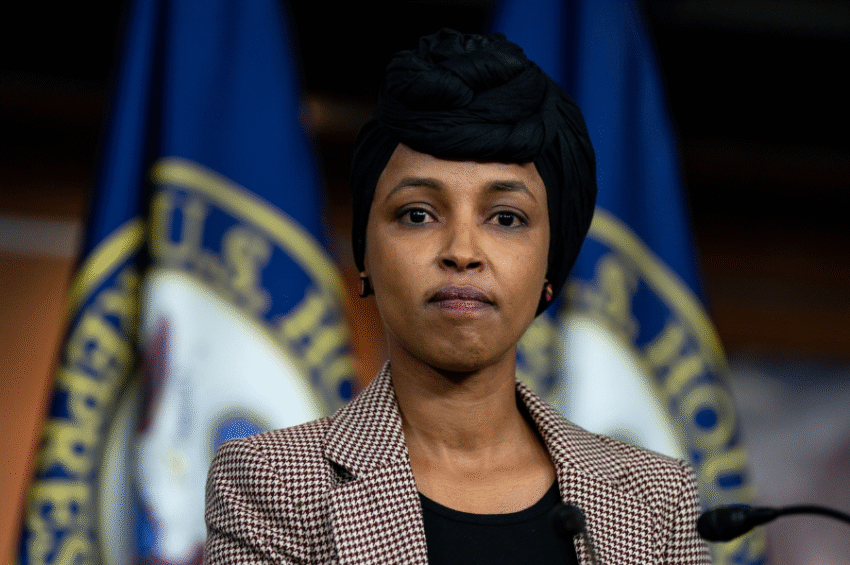
Democratic Rep. Ilhan Omar of Minnesota is facing new scrutiny over her personal finances after a watchdog group accused her of defaulting on federal student loans while advocating for debt forgiveness in Congress.
The American Accountability Foundation (AAF) sent a letter to House Speaker Mike Johnson on Friday alleging that Omar, who earns $174,000 a year, is in collection proceedings over federally guaranteed student loans.
“We are writing today to share serious concerns about abuse of office and abuse of government loans by a member of the House of Representatives, Representative Ilhan Omar,” AAF President Thomas Jones wrote.
According to the group, Omar’s financial disclosure forms show she owes between $15,001 and $50,000 in outstanding student loan debt — loans backed by the federal government.
“As you know, these loans are guaranteed by the United States Government and Representative Omar’s default would shift the cost of her student loans onto the U.S. taxpayer,” Jones said. “The fact that someone making $174,000 as a Member of Congress cannot pay their student loans is unconscionable and embarrassing.”
The group went further, accusing Omar of using her position to pressure federal agencies not to enforce collection on her loans.
“Adding insult to injury, there are credible claims that she is using her influence as a Member of Congress to bully the Department of Education into not collecting the past-due payments,” Jones wrote.
Jones said his organization filed a Freedom of Information Act (FOIA) request to obtain any correspondence between Omar and the Department of Education related to her loans.
The letter urged Speaker Johnson to take an unprecedented step to ensure taxpayers are not left on the hook.
“We are calling upon you to instruct the Chief Administrative Officer of the House of Representatives to impound Representative Omar’s Congressional salary and pay it out to Nelnet, the servicer of her federal student loan, until such time as her payments are current,” the letter said.
Omar’s office did not immediately respond to requests for comment on the allegations.
The AAF has frequently targeted Democratic lawmakers with ethics complaints and financial investigations, arguing that elected officials should be held to a higher standard when it comes to managing public and personal funds.
Critics say the revelations highlight a potential conflict of interest for Omar, who has been one of the most vocal advocates of widespread student debt cancellation. She has repeatedly called for full forgiveness of federal student loans, framing the issue as one of economic justice.
But the watchdog group says her personal situation undermines that message.
“If you’re in default on taxpayer-backed loans and using your office to influence policy that could personally benefit you, that’s an ethical red flag,” Jones said.
Omar’s finances have drawn attention before. In 2023, the financial analytics firm Quiver Quantitative noted a sharp change in her disclosures over the years.
“When she first filed in 2019, she didn’t disclose any assets,” the firm wrote at the time. “Her recent filing shows assets worth up to $288,000. However, she now has up to $100,000 in credit card debt, along with up to $50,000 of existing student loan debt.”
The latest claims add to the list of controversies surrounding the congresswoman, who has faced ethics complaints and campaign finance questions in the past.
Whether the House takes action remains to be seen, but AAF says it will continue pressing for transparency — and repayment.
The U.S. Congress is getting older. Nearly 120 members are 70 or older, prompting questions about whether cognitive tests should be required for lawmakers. Rep. Marie Gluesenkamp Perez introduced the idea earlier this year, proposing a neutral process to determine if any member suffers from serious cognitive issues. Although the amendment did not pass, many Americans remain uneasy about entrusting major decisions to officials who might face cognitive decline.
Cognitive decline often accompanies old age, but the proposed tests aimed to assess process, not age. Supporters argue that such exams could rebuild trust in Congress. Critics worry they could be politically manipulated or clash with constitutional rights.
Many insist voters, not medical exams, should decide who governs. Lawmakers counter that mandatory testing could infringe on privacy. Legally, implementing such a requirement is complicated. The Constitution sets the qualifications for Congress, and new laws cannot override them. A constitutional amendment would be needed—a challenging feat.
Currently, Congress can discipline or expel members for misconduct. However, expulsion requires a two-thirds vote, and incapacity alone rarely triggers action.
Globally, cognitive requirements for officials are uncommon. In Singapore, officeholders must be of “sound mind,” though no routine tests exist. Medical panels may intervene if a mental issue arises.
Communist Party leaders undergo internal cognitive and health evaluations, though details are limited. Similarly, Vatican City expects leaders to be of sound mind, and incapacity can disqualify a candidate.
Even if Congress required tests, selecting the right tool is tricky. Clinical tools like the MMSE and MoCA were not designed to evaluate a person’s fitness for office. Results can be affected by education, language, and culture.
Set the bar too low, and serious issues may be overlooked. Set it too high, and officials could be wrongly disqualified. Alternatives include greater transparency from candidates about health or testing only when credible concerns arise.
Democracy relies on voters to choose leaders. Mandatory cognitive tests remain politically and legally difficult. Still, options exist to boost trust: transparency about officials’ health and fair processes to address serious concerns.
A constitutional amendment would be required for mandatory testing—a rare and difficult path. Meanwhile, hiding cognitive or physical decline becomes harder as symptoms become visible. Public debates, like those involving President Biden and former President Trump, have highlighted these challenges. Sudden changes in an official’s condition can leave voters shaken and disillusioned