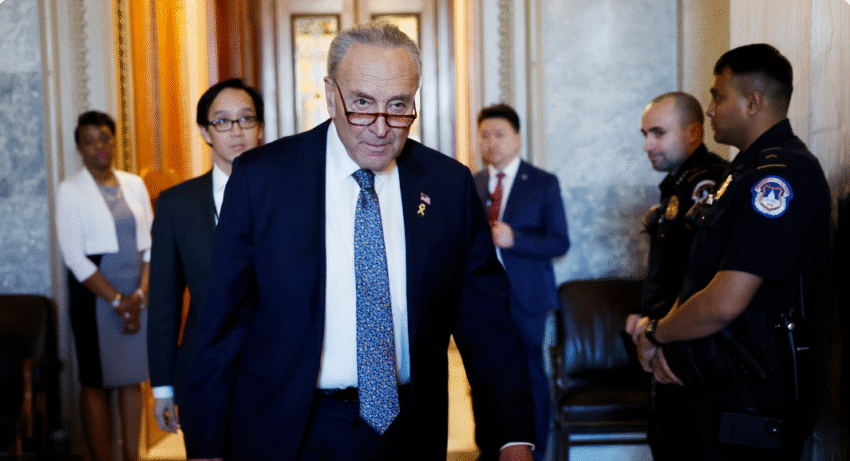
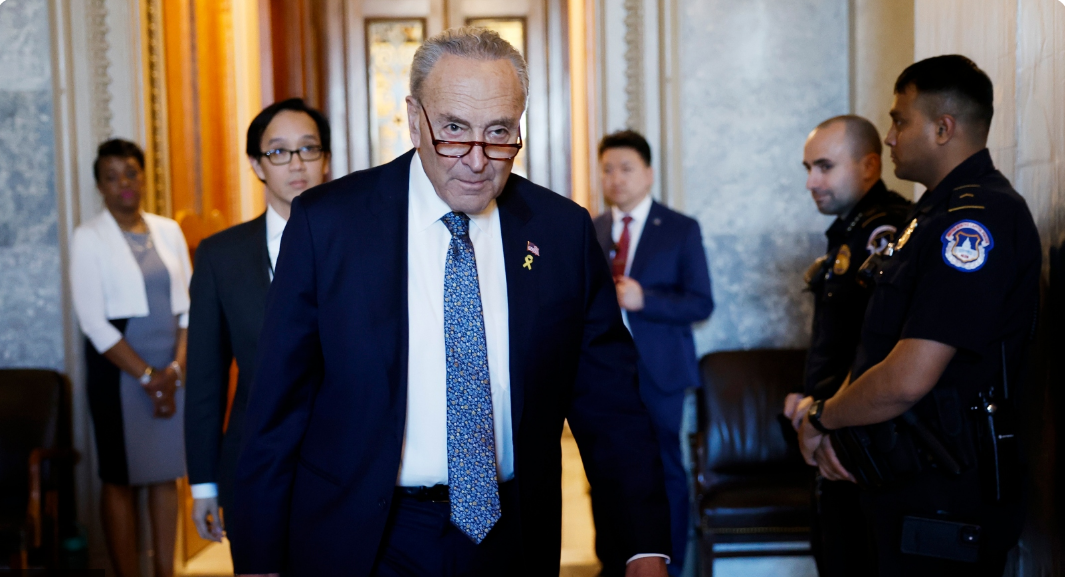
Senate Minority Leader Chuck Schumer walked away from a Republican colleague on the floor of the chamber on Saturday after he was cornered over a so-called “fix” he offered for Obamacare subsidies as the government shutdown he is leading entered its 39th day.
Schumer was engaging with Sen. Bernie Moreno (R-Ohio) after the Democratic leader offered a proposal to reopen the government: A one-year funding extension of taxpayer-funded subsidies for Americans who buy health insurance under the Affordable Care Act.
During the exchange, Schumer admitted to Moreno that he did not yet have a written proposal.
“We can’t give you a counter in writing, but it’s very simple,” Schumer said. “Because we have two sentences we would add to any proposal which would extend the ACA benefits for one year.”
Moreno the revealed that the Schumer proposal did not seem to contain income caps, meaning people who make millions of dollars a year can obtain taxpayer-subsidized health care.
“It does still have no income caps, so people who make $1, $2, $3 million a year,” Moreno said before Schumer interrupted him.
“Once we pass the one-year fixed so people right now aren’t in difficulty, we would sit and negotiate that,” Schumer said. “[Senate Majority Leader John Thune (R-S.D.)]has said that he won’t negotiate before. We’re willing to negotiate once the credits are extended, plain and simple.”
The Ohio Republican then responded, “So for one year, people making millions of dollars would still receive these COVID-era subsidies?”
At that, Schumer accused Moreno of caring more about billionaires before disengaging and leaving the chamber, according to reports.
“I was going to ask him before he stormed out of the room because evidently he doesn‘t want to hear any opposing views or actually engage in meaningful negotiation … Would he continue 0 dollar premiums, which we know for a FACT, have enormous levels of fraud,” Moreno said.
“If he had stayed, I would have asked him a third question: Does he want these monies to go directly to insurance companies?”
President Donald Trump appeared to gain some leverage in the ongoing government funding standoff Thursday after Senate Democrats sought to link a funding deal to an extension of Affordable Care Act subsidies.
What began as an effort by Democrats to pressure Republicans during the shutdown negotiations has shifted in Trump’s favor, following a new proposal he unveiled on Truth Social.
In his post, the president announced a plan to redirect hundreds of billions of dollars in Obamacare subsidy payments from insurance companies to direct payments for American citizens.
“I am recommending to Senate Republicans that the Hundreds of Billions of Dollars currently being sent to money sucking Insurance Companies in order to save the bad Healthcare provided by ObamaCare, BE SENT DIRECTLY TO THE PEOPLE SO THAT THEY CAN PURCHASE THEIR OWN, MUCH BETTER, HEALTHCARE, and have money left over,” Trump wrote.
“In other words, take from the BIG, BAD Insurance Companies, give it to the people, and terminate, per Dollar spent, the worst Healthcare anywhere in the World, ObamaCare. Unrelated, we must still terminate the Filibuster!” he added.
Conservative commentators lauded the proposal as “genius,” noting that the former president has effectively recast himself as an advocate for direct-to-consumer healthcare freedom. They said the plan reframes the debate as “healthcare for the people” versus the Democrats’ defense of “big insurance.”
Shortly after Trump’s post, Senator Rick Scott (R-FL) announced that he was working on legislation to turn the proposal into reality.
“Totally agree, @POTUS! I’m writing the bill right now,” Scott said. “We must stop taxpayer money from going to insurance companies and instead give it directly to Americans in HSA-style accounts and let them buy the health care they want. This will increase competition & drive down costs.”
In a pivotal moment of accountability, the U.S. House of Representatives voted to remove
The highly charged vote followed a series of impassioned speeches, most notably from
Representative Lee Zeldin’s floor speech was widely lauded by conservative commentators for its directness and refusal to accept what he called “political theater” (5:38). Zeldin argued that the entire debate was necessary
He systematically laid out the pattern of Omar’s controversial statements that, he argued, disqualified her from the committee:
Hypnosis/Influence: Zeldin reminded the chamber that Omar had to apologize for talking about a “hypnosis of Israel that they have over the entire world” (2:26–2:29).
Bought Off/Dual Loyalty: She also apologized for suggesting that support for Israel was because representatives were “bought off by Jews” (2:30–2:36).
Pledging Allegiance: The final tipping point, according to Zeldin, was Omar’s statement that supporters of the U.S.-Israel relationship “must have pledged allegiance to a foreign government” (2:42–2:48).
Zeldin’s main point was the issue of double standards (3:39). He argued unequivocally that if a Republican member had made just one of these comments, “That member’s name would be in this resolution and this resolution would be all about condemning anti-Semitism and it would be done so forcefully” (2:13–2:22). He pointed to the example of a Republican member who was named and removed from his committees following condemnations of white supremacy, a standard he demanded be applied to anti-Semitism as well (3:42–4:03).
A key part of the debate centered on whether Omar’s comments were made out of ignorance or deliberate malice. While some may have suggested naiveté, Zeldin dismissed this notion, stating firmly that he gave Omar “more credit” than that: “I don’t believe she is naive. I believe that she knows exactly what she’s doing” (3:05–3:13).
This view reflects a consensus among critics that Omar’s use of classic anti-Semitic tropes—such as those suggesting excessive Jewish financial influence or dual loyalty—was calculated, making the comments fundamentally “pointed, bigoted, unreasonable, illegitimate, anti-Semitic” (4:07–4:11).
Beyond the specific anti-Semitic comments, critics cited a broader pattern of rhetoric they viewed as dismissive of American values and tragedy. The host specifically highlighted Omar’s infamous comment regarding the 9/11 terror attacks, where she referred to the event by saying “some people did something” (5:54–5:56).
The host condemned this phrase as “deeply disrespectful” and a reduction of a national tragedy where “Thousands of innocent Americans were murdered” (6:01–6:06). This comment, critics argue, demonstrated a “shocking disconnect from the American experience” (6:20–6:22) and was cited as further evidence of her unsuitability for a key foreign policy role.
The core argument for removing Omar from the Foreign Affairs Committee was not about punishing her free speech, but about protecting the integrity of U.S. governance and foreign relations (1:28–1:31).
The House Foreign Affairs Committee holds immense responsibility: its members handle classified information, shape the nation’s foreign policy, and directly influence global alliances (7:17–7:26).
The consensus among Republicans and like-minded commentators was that membership on such a sensitive committee requires “100% for America” loyalty (7:29–7:31). Zeldin stressed that while “reasonable legitimate criticism of a government” is an American value, “hurling anti-Semitic rhetoric” is not (3:15–3:27).
The host summarized the action as a necessary principle-based move: “Removing her from that committee wasn’t about revenge. It was about protecting America’s interests and making it clear that this kind of rhetoric has no place in Congress” (7:50–7:57).
The final vote, which passed despite vocal opposition from Democratic members who defended Omar and accused the action of being motivated by racism, was a significant political victory for the Republican majority and a powerful symbolic assertion of their zero-tolerance stance on rhetoric deemed harmful to international relationships and American values.