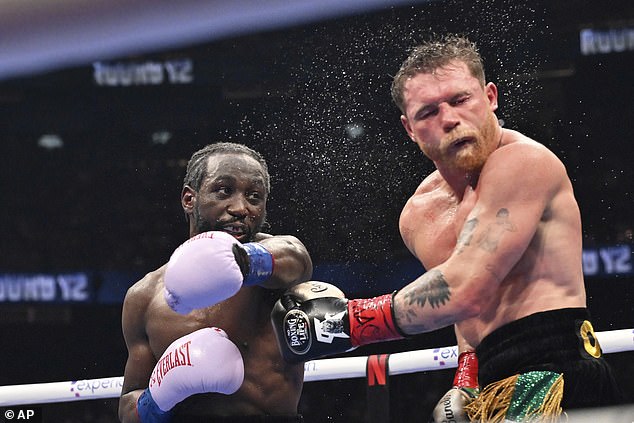
It was a blink-and-you-miss-it moment — a single second that captured everything that makes Terence “Bud” Crawford one of the most complete fighters of his generation.
Canelo Alvarez stepped forward behind his trademark high guard, looking to shift the fight’s rhythm with a looping left hook. It was a move that has broken countless opponents — but not this time.
Before Canelo’s glove could even complete its arc, Crawford read it, reacted, and responded — with perfection.
Slow the footage down, and you’ll see the genius unfold.
Crawford pivots slightly left, shifts his weight just enough to draw the hook short, and releases a razor-sharp counter right hand straight down the middle.
It’s surgical — not wild, not lucky, but timed with such microscopic precision that Canelo’s own momentum amplifies the impact.
The shot lands flush on the chin. Canelo’s head snaps back, his balance shifts, and for a split second, the unshakable Mexican icon looks… human.
That single exchange — maybe two seconds total — tells an entire story about levels, instinct, and mastery.
Crawford isn’t just fast. He’s cerebral.
Every move he makes in the ring serves two purposes: to create openings and to punish mistakes. Against a fighter like Canelo — who thrives on calculated aggression — Crawford’s trap-setting becomes art.
He waits for the rhythm, feels the range, and when Canelo’s glove lifts to throw, Crawford’s shot is already halfway home.
It’s not reaction — it’s anticipation.
This is what separates Crawford from almost every fighter alive. His ability to remain calm under fire, analyze in real time, and execute with machine-like accuracy is almost unnatural.
Analyst Tim Bradley put it best after reviewing the clip:
“That counter wasn’t just fast — it was premeditated. Crawford knew it was coming, and he punished it like only a true master could.”
This wasn’t just about who landed the better punch. It was a moment that sent a shockwave through the boxing community.
Canelo, long considered the sport’s most polished and powerful technician, had just been caught — clean — by a fighter moving up from welterweight.
For fans and pundits, it was a visual confirmation of what Crawford’s supporters have been saying for years: his timing beats everything.
Even power. Even pedigree. Even Canelo.
The slow-motion replay plays like poetry in motion — the fluidity, the control, the execution.
It’s what makes Terence “Bud” Crawford not just a champion, but an artist in 8-ounce gloves.
One moment of brilliance, one counterpunch — and the boxing world was reminded:
In a sport built on power, it’s timing that rules the throne. ⏱️
When the leader tried to grab her, his arm suddenly twisted with a dry crack. The man screamed, his wrist bent at an unnatural angle. In a heartbeat, the laughter vanished from the clearing. The other bandits froze, watching as the woman’s eyes turned cold — not furious, not panicked — but disciplined, sharp, and trained to kill.
Before anyone could react, she pushed the wounded man aside and moved with the precision of a soldier who had faced death before. One swung his knife; she ducked and drove her elbow into his ribs, shattering the breath from his lungs. He fell like a felled tree. Another lunged with a roar — she caught his wrist, twisted, and sent his own blade deep into his thigh. He howled, collapsing on the damp ground.
Only seconds had passed. The forest, which moments ago echoed with their laughter, was now filled with cries of agony.
The last one, tall and broad-shouldered, took a step back. “You… who are you?” he stammered.
She turned toward him, brushing a strand of hair from her face. “Captain Alina Voronova, 17th Infantry Division,” she said calmly. “And you’ve just attacked the wrong person.”
The man’s courage melted. He turned to flee, but her hand was faster. In one motion, she drew the small pistol from her belt — silent, black, deadly. The click of the safety breaking was the only sound before the shot echoed through the trees. The man dropped to his knees, a clean wound in his shoulder.
“Run,” she said, lowering her weapon. “And remember this night. Remember who you tried to hurt.”
He stumbled into the darkness, leaving his companions groaning on the ground.
Alina knelt beside the old man once more. His breathing was shallow, his pulse weak. She tore a piece of her sleeve and gently wiped the blood from his face. The old man opened his eyes slowly, confusion flickering in them.
“You… you saved me,” he whispered.
She shook her head softly. “No, I just did what any soldier should.”
The man’s trembling hand reached for hers. “They’ve been robbing the villages… for weeks,” he muttered. “No one dared to stop them.”
Alina’s jaw tightened. “They won’t be back. Not after tonight.”
She helped him to a fallen log, unfastened her canteen, and offered him water. The forest was quiet again — that kind of silence that follows violence, heavy but alive.
“Where are you headed, Captain?” the old man asked after a moment.
She looked beyond the trees, where the fog thinned toward the east. “To the border,” she said. “My unit’s gone. I’m the last one left.”
The man’s eyes widened. “You mean… you’re alone?”
Alina nodded. “I was captured. Escaped two nights ago.”
There was a long pause. The man studied her face — pale, resolute, yet weary. “You’ve seen things no person should see,” he murmured.
She gave a faint smile. “War doesn’t ask what we can bear. It just teaches us how to keep moving.”
He lowered his gaze. “You remind me of my daughter,” he said softly. “She was in the army too… never came home.”
Something flickered in Alina’s eyes — a brief tremor behind the steel. She touched his shoulder gently. “Then maybe tonight, she’s watching over us both.”
The man’s lips trembled. He tried to speak but couldn’t. His tears fell silently onto the soil.
Hours passed. Alina built a small fire, using her knife to cut dry branches. The flames cast warm light across their faces. She cleaned his wounds carefully — movements slow, practiced, tender. She found herself thinking of her own father, the last time she saw him at the train station, saluting her with trembling pride.
She swallowed hard. Duty had taken everything — friends, peace, even her name. She had become nothing but rank and uniform. Yet in this quiet clearing, nursing an old man’s bruises, she felt something unfamiliar — a fragile thread of humanity returning.
When dawn began to break, birds stirred above them. The fog lifted, revealing the full horror of the night. The ground was scattered with the unconscious bandits, their weapons lying in the mud. Alina looked at them silently — not with hatred, but with the cold mercy of a soldier who knows revenge has no end.
She rose and pulled her coat tighter. “You should go back to your village,” she told the old man. “Take the southern path. The river will lead you to safety.”
“And you?” he asked, gripping her sleeve.
“I still have a war to finish.”
He shook his head weakly. “You’ve done enough.”
Alina’s gaze drifted toward the horizon, where a thin plume of smoke rose. “Not yet. Not while they still burn homes and bury children.”
The man hesitated. Then, with trembling fingers, he reached into his pocket and drew out a small medallion — a silver icon, tarnished but intact. “Take this,” he said. “My wife’s. She believed it would protect whoever carried it.”
Alina hesitated. “I can’t—”
“You can,” he interrupted gently. “You deserve it more.”
She took the medallion and closed her fist around it. The metal was cold, but somehow it steadied her.
When the first rays of sun pierced the treetops, she helped the man to his feet. He took a few steps, then turned. “Captain,” he said, his voice cracking. “You didn’t just save my life. You gave me back my faith.”
Alina smiled faintly. “Then don’t lose it again.”
He nodded and disappeared into the forest, leaving her alone with the wind and the faint smell of smoke.
For a long moment, she stood still — listening to the whispers of leaves, the fading echoes of violence, the slow return of peace. Then she fastened the medallion around her neck, lifted her rifle, and began walking east.
Every step hurt. Every breath carried the memory of what she’d lost. But there was no room for weakness anymore. Somewhere beyond those hills, soldiers still fought — and she would find them.
She paused once, looking back at the trail of light through the trees. The forest was alive again — birds calling, leaves rustling, the world pretending it hadn’t seen what happened.
A faint smile touched her lips. “The forest keeps its secrets,” she murmured. “And so will I.”
She turned and vanished into the mist, her silhouette swallowed by the dawn — a lone soldier walking toward the sound of distant thunder, carrying both her wounds and her promise.
And far behind her, the old man reached his village, whispering to everyone who would listen:
“She came out of the fog — an angel in uniform. And when the devils fell, she didn’t curse them. She forgave them.”
From that day on, villagers spoke of her not as a soldier, but as a legend. The woman who fought gravity itself — not of the earth, not of vengeance — but of mercy.
And somewhere, deep in another forest, another group of bandits looked nervously into the mist, hearing stories of a ghostly captain who appears when injustice stirs — a woman who carries a silver medallion that glows faintly in the dark, whispering of all those she swore to protect.
She was gone, but her oath lived on.
And in the hush of dawn, the forest remembered her steps — light, precise, and full of fire.