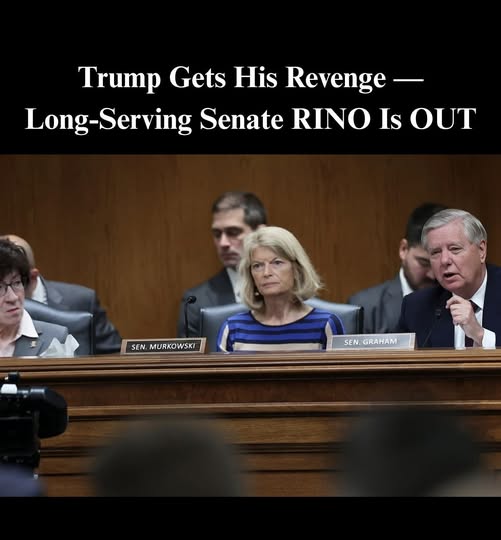
Alaska Gov. Mike Dunleavy is preparing to announce a 2028 run for the U.S. Senate against Sen. Lisa Murkowski, according to several sources close to the governor who spoke exclusively to Fox News this week.
The move would place him against Murkowski, who has repeatedly clashed with President Donald Trump and is often viewed as one of the most moderate Republicans in Congress. Dunleavy, by contrast, has been a strong Trump ally since 2016, Fox reported.
“He’s not going to quit his term,” a top source close to Dunleavy, who previously worked with him in Juneau, told Fox News Digital. The source stressed that Dunleavy intends to complete his time as governor before seeking higher office.
The last governor to leave office early to pursue national ambitions was Sarah Palin, who resigned in 2009. “She never recovered,” the source said.
Dunleavy has earned a reputation for avoiding Washington’s spotlight but producing results in Alaska. “He’s not about an ego and pushing himself in front of the cameras. He gets stuff done,” the source said. “He doesn’t like the cocktail parties and photo ops.”
Even so, those close to him say he understands that “being in Washington is the only way to get things done.” While he has joked that he prefers Alaska’s Arctic landscapes to “all this concrete” in Washington, he recognizes the need to represent the state at the national level.
Dunleavy was the second governor to endorse Trump in 2016 and has been one of the most frequent governors to visit the White House despite the 3,500-mile distance. “Trump has talked to him before about running and wants him to run,” the source said.
Dunleavy also attended Trump’s Aug. 15 meeting with Russian President Vladimir Putin at Joint Base Elmendorf-Richardson in Anchorage, further underscoring his role as one of the president’s key allies in Alaska.
Winning as a Republican in Alaska has historically been difficult. Former Gov. Jay Hammond was the last to win re-election in 1978. Sean Parnell, who became governor after Palin’s resignation, did not win re-election outright.
Still, Dunleavy is seen as a formidable candidate. “A lot of people have mentioned this (race) to him and … I think it is a very viable option for him,” another source told Fox News Digital.
“Obviously there are a lot of frustrations with Sen. Murkowski,” the source added, noting her tense relationship with Trump. “Gov. Dunleavy has been not only a successful governor, but a strong ally for him. So it’s only natural that he’d be hearing that from Alaskans — but also from folks in the broader MAGA movement.”
Dunleavy, like Murkowski, has succeeded under Alaska’s ranked-choice voting system, which critics say has benefited Democrats. But unlike her past challengers, sources say he has broad support outside conservative circles.
He is also respected among Native communities across the North Slope and rural Alaska, where he has focused on energy development, infrastructure, and rural education. Those ties could prove critical in a statewide race where the Native vote has often played a decisive role.
“Murkowski has never faced a challenger like him,” another source said. “He’s built support that goes beyond just conservatives.”
A top Alaska political analyst agreed. “Conservatives would welcome an opportunity to unseat Murkowski,” the analyst said Thursday. “The fact that Trump and Murkowski have had such a strained relationship and Dunleavy and the president (have) a good relationship is really what has led us to this point.”
Murkowski, the daughter of former Alaska Gov. Frank Murkowski, has shown her resilience in the past. She famously won a write-in campaign in 2010 after losing the GOP primary to Tea Party candidate Joe Miller. But analysts say Dunleavy would represent her most serious threat yet.
The 2028 matchup would pit two of Alaska’s most prominent figures against each other: Murkowski, the entrenched moderate with a family legacy in Alaska politics, and Dunleavy, the Trump-aligned governor who has drawn support across communities.
A U.S. appeals court has handed down a significant victory for election integrity, upholding Texas’s voter ID requirements for mail-in ballots and dealing a harsh blow to Democrats like Congresswoman Jasmine Crockett, who admitted the law has already hurt her party’s vote totals.The 5th Circuit Court of Appeals’ decision affirms what President Donald Trump and Republicans have argued for years: requiring voter identification is common-sense, constitutional, and essential to ensuring that only legal votes are counted.The ruling is not only a defeat for Democrats who have railed against Texas’s Senate Bill 1 (SB1) since its passage in 2021, but also a validation of Trump’s broader push for laws like the SAVE Act, which would require proof of citizenship for voter registration nationwide.The law at issue, SB1, requires voters to provide identifying information when requesting and submitting mail-in ballots. Specifically, Texans must include their driver’s license number or the last four digits of their Social Security number on ballot applications.
This simple safeguard was designed to confirm that every mail-in voter is who they claim to be, closing loopholes that made the system vulnerable to fraud.A three-judge panel of the 5th Circuit rejected claims that these requirements were unconstitutional. Writing for the panel, Judge James Ho, a Trump appointee, made clear that the law was both reasonable and necessary.“The number-matching requirements are obviously designed to confirm that every mail-in voter is who he claims he is,” Ho explained. “And that is plainly material to determining whether an individual is qualified to vote.”Judge Ho emphasized that the requirements restate information already publicly available, noting that anyone can request voter registration data. Without safeguards, bad actors could use this information to fraudulently obtain mail-in ballots. By demanding ID, Texas simply ensures that ballots reflect legitimate voters.
Judge Ho’s opinion was joined by Judge Don Willett, another Trump appointee, and Judge Patrick Higginbotham, appointed by President Reagan. Together, the panel unanimously concluded that SB1 does not violate federal law.Representative Jasmine Crockett, one of Texas’s most vocal Democrats, reacted with fury on MSNBC after the decision. She admitted the law has cost Democrats votes and damaged their electoral chances.“Unfortunately, we’ve seen our numbers fall now that they’ve had these voter restrictions in place,” Crockett said. She described SB1 as a partisan measure passed “in the dark” by Republicans and claimed it disenfranchised voters.
But Crockett’s own words reveal the true reason for Democrats’ outrage: not that eligible voters are being silenced, but that Democrats’ margins are shrinking.In essence, she admitted the law works—it prevents ballots of questionable validity from entering the system, thereby narrowing Democrats’ traditional advantage in exploiting mail-in loopholes.The court’s ruling is a direct vindication of President Trump’s years-long push for stronger election integrity measures. From the moment he entered politics,Trump warned that lax voting laws, especially around mail-in ballots, created opportunities for fraud. His critics dismissed these warnings as paranoia. Yet rulings like this prove his concerns were justified.Requiring voter ID is not voter suppression. It is common sense. Just as Americans show ID to board airplanes, purchase alcohol, or even attend government events, they should be expected to provide identification to exercise one of the most sacred responsibilities of citizenship—voting.
By upholding Texas’s law, the courts affirmed Trump’s core message: every legal vote must count, and every illegal vote must be rejected.The timing of this ruling could not be more significant. In Congress, House Republicans have passed the SAVE Act, which would require proof of citizenship for voter registration nationwide.Although the bill now sits in the Senate facing opposition from Democrats and hesitation from a handful of moderates, the Texas ruling underscores the importance of pushing forward.If the courts recognize that voter ID for mail-in ballots is “plainly material” to ensuring qualified voters, then proof of citizenship at registration is an equally logical and necessary safeguard.President Trump and his allies have consistently argued that without citizenship verification, foreign nationals could exploit America’s lax registration systems, diluting the votes of lawful citizens.House Speaker Mike Johnson (R-La.) has framed the SAVE Act as critical to restoring faith in elections, and the Texas decision adds fresh momentum. By confirming that voter ID laws are constitutional, the court has effectively dismantled Democrats’ main argument against similar federal protections.
Democrats like Crockett claim voter ID laws disenfranchise minorities, the elderly, and rural voters. But study after study shows that overwhelming majorities of Americans, including minority voters, support ID requirements. A Gallup poll found nearly 80 percent of Americans back voter ID laws.So why do Democrats oppose them? The answer is political advantage. By opposing safeguards, Democrats create conditions where ballots of questionable validity—ballots without proper verification, ballots harvested in bulk, or ballots cast without identity checks—can inflate turnout in their favor. Voter ID laws close these loopholes, forcing elections to reflect only legitimate ballots.
That is why Crockett lamented that “our numbers fell.” Democrats’ frustration is not about democracy—it’s about losing a rigged advantage.Texas’s decision to pass SB1 in 2021 was an act of leadership. Governor Greg Abbott and the Republican legislature faced intense backlash from Democrats, media outlets, and activist groups, all of whom predicted chaos and mass disenfranchisement.Yet, elections in Texas have proceeded smoothly under SB1. Voter turnout remains robust, and confidence in mail-in ballot integrity has grown.The courts have now affirmed that Texas acted well within its rights to secure its elections. This ruling sends a powerful signal to other states: do not be intimidated by Democratic lawsuits. Voter ID laws are constitutional, effective, and essential to election integrity.The decision has clear implications for the upcoming 2026 midterm elections. With Democrats openly acknowledging that voter ID laws reduce their margins, Republicans see an opportunity to expand similar measures across the country. The courts have provided the legal backing. The political moment is ripe.For Trump, the ruling validates his consistent emphasis on election security as a pillar of his platform. For Democrats, it is a harsh reminder that their strategy of opposing ID laws is crumbling under legal scrutiny.Crockett’s public admission that the law cost Democrats votes may haunt her party in 2026 as Republicans highlight her words to show that Democrats oppose election integrity not out of principle but out of self-interest.At its core, this decision is about protecting the rights of American citizens. Voter ID laws do not suppress votes—they safeguard them. They ensure that every citizen’s ballot is counted and that illegal or fraudulent ballots are excluded.