

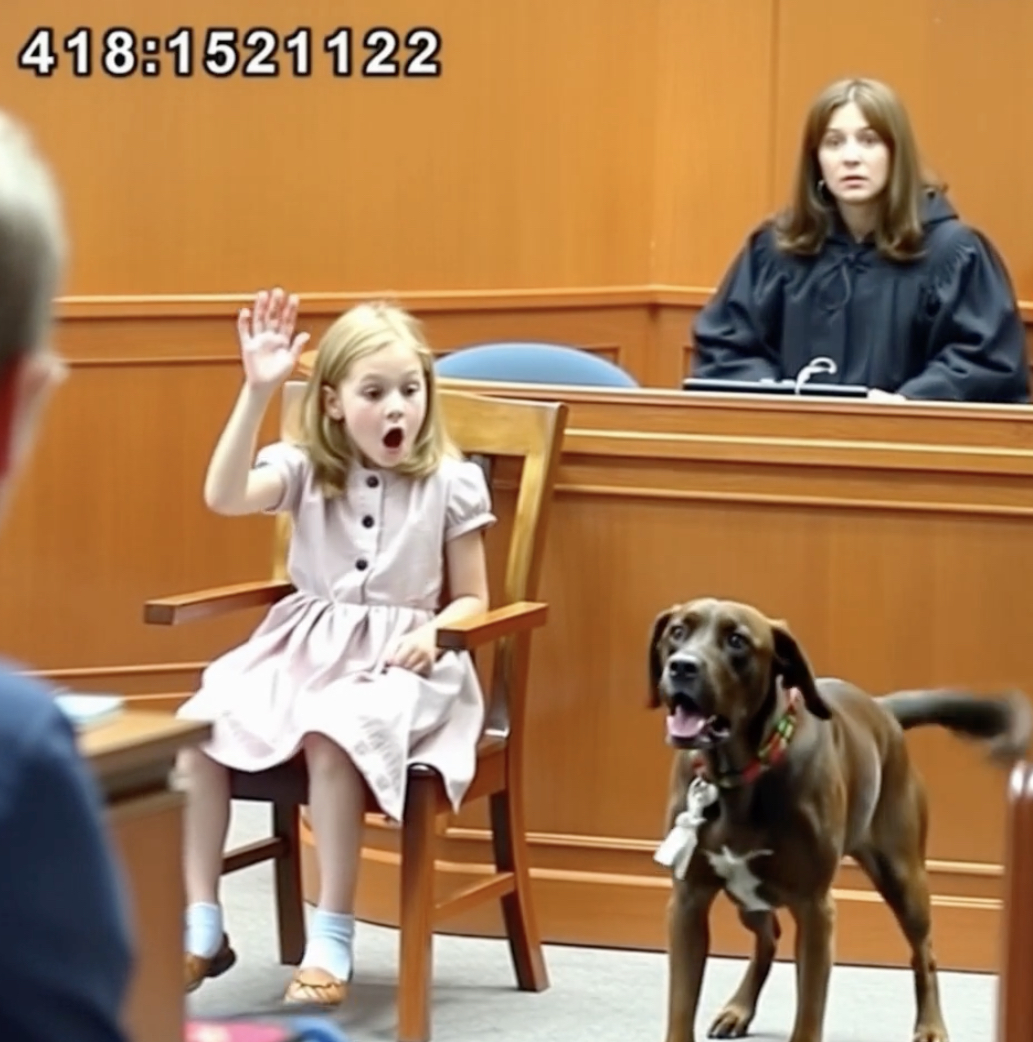
 “I remember the basement.”
The courtroom fell silent, the weight of her words hanging heavily in the air. Judge Dawson leaned forward, her expression softening, yet her eyes were sharp with understanding. “Thank you, Isla,” she said gently. “Can you tell us more about the basement?”
Isla hesitated, glancing at Moose. The big dog nudged her leg reassuringly, his presence giving her strength. She took a deep breath. “It was dark,” she began, her voice small but gaining confidence. “There was a little window, but it was always locked. I was scared all the time. He said I was bad, that no one wanted me. But Moose… he stayed with me. He never left.”
A murmur rippled through the courtroom. Leonard shifted uncomfortably in his seat, his previous composure unraveling. His lawyer leaned over, whispering furiously in his ear, but Leonard seemed frozen, his focus fixed on the dog that had just exposed him.
“Isla,” Judge Dawson’s voice was calming, drawing the child’s attention back. “Did this happen often?”
Isla nodded, her fingers tangling in Moose’s fur. “Yes, but then one day, the door was left open. Moose helped me find the way out. We ran and ran until we found the bus station.”
Leonard’s lawyer rose again, desperation tainting his voice. “Your Honor, this is hearsay from a child and a dog! There is no evidence to support—”
“Enough,” Judge Dawson interjected, her tone brokering no argument. “The court will take a recess to consider the testimony given.” She looked at Isla, her gaze steady. “You’ve been very brave today, Isla. Thank you.”
With that, the gavel struck again, signaling the temporary pause of the proceedings. Isla exhaled, a shuddering release of the breath she’d been holding. Moose stood, pressing against her leg, his warm, solid form a reminder of safety.
Her foster parents, Jim and Megan, approached, wrapping her in a gentle embrace. Their eyes were misted with pride and sorrow, understanding the gravity of what Isla had just faced and overcome. “You did so well,” Megan whispered, brushing Isla’s hair back tenderly.
Outside the courtroom, the storm had subsided, leaving the air crisp and fresh. Light filtered through the high windows, casting hopeful shadows on the marble floors. Isla looked up, seeing the sky clearing, and felt a burgeoning sense of freedom.
As the adults talked in hushed tones around her, she focused on Moose. He wagged his tail softly, sensing the shift in the atmosphere. Isla leaned down, her forehead resting against his. “Thank you, Moose,” she murmured, gratitude filling her small voice.
The next time they sat in courtroom 3B, it was to hear Judge Dawson’s ruling. Isla walked in, her hand lightly gripping Moose’s harness. She felt different—lighter, as if sharing her truth had unshackled something inside her.
Judge Dawson smiled warmly as she entered. “In consideration of the testimony and evidence presented,” she began, “it is the ruling of this court that Leonard Griffin’s petition for custody is denied. Isla Merrin shall remain in the care of her foster parents, Jim and Megan, with continued support from her service dog, Moose.”
Relief was palpable in the room, a collective exhale of tension. Isla’s foster parents squeezed her shoulders, their happiness clear. Isla, too, couldn’t help but smile. Moose barked once, a sound of joyous affirmation.
At that moment, Isla knew she had found her voice—and with it, a new beginning.
Bruce Willis – the action hero who once defined blockbuster cinema – now faces his most poignant role: living with frontotemporal dementia (FTD) at age 70. According to his wife, Emma Heming Willis, the
Die Hard star has relocated to a nearby, one-story residence tailored to his health needs, staffed with round-the-clock caregivers. Though removed from the family home, the move ensures both his safety and consistent contact with loved ones.
In the emotional ABC special, “Emma and Bruce Willis: The Unexpected Journey”, Emma shared that her husband now resides in a dedicated single-story home equipped to minimize environmental stressors that could worsen his symptoms. The facility offers 24/7 professional care in a calm setting — designed to better accommodate both his condition and the stability of their daughters, Mabel and Evelyn
Emma acknowledged this was one of the hardest decisions she’s ever had to make. But she believed Bruce would have wanted this for their children — creating a home that prioritized the kids’ needs, not the limitations imposed by his dementia
News of Bruce’s separate living arrangement sparked backlash from critics—but Emma responded with grace: “The opinions are so loud and noisy. If they haven’t walked in a caregiver’s shoes, they don’t get a vote or a say.” She emphasized that sharing their intimate family struggle wasn’t meant to solicit judgment, but to foster awareness of FTD, recognize the emotional complexity caregivers face, and build a supportive community. Her forthcoming memoir,
The Unexpected Journey: Finding Strength, Hope and Yourself on the Caregiving Path, expands on these themes
Reports indicate Bruce’s FTD has advanced significantly — he is now reportedly unable to speak, read, or walk unaided. This stark decline challenges the iconic memory of him as a confident, agile action star, but illustrates the severity of his neurological battle
Despite living separately, Bruce remains surrounded by love. Emma and his young daughters visit daily, sharing meals and moments of connection. His older daughters — Rumer, Scout, and Tallulah — from his marriage to Demi Moore, also remain an important part of the caregiving circle. Their visits bring warmth, laughter, and a sense of home
Emma poignantly shared: “I don’t need him to know I am his wife… I just want to feel that connection — and I do.”
Bruce Willis — once Hollywood’s ultimate action hero — now navigates a vastly different reality. His family chose proximity over proximity, love over comfort, ensuring he receives expert care while preserving the emotional bonds that define them. Their story transcends tragedy; it is a testament to family resilience, caregiving courage, and profound love amid illness.
At first glance, this cozy and inviting kitchen appears perfectly ordinary — the kind of space you might find in any suburban home. The clean countertops, neatly arranged cabinets, and warm lighting all contribute to a sense of comfort and normalcy. But hidden within this seemingly simple scene lies a delightful and surprising visual trick that has captivated viewers around the world. Nestled somewhere within the kitchen is a
The image, originally shared by Christina Suvo and later circulated by
Unlike many hidden-object puzzles where the challenge is to find something deliberately misplaced or obscured, this photo plays on a much subtler trick: how our brains filter information and focus on what we
Viewers have found that the best strategy to spot the dog is to
This charming brain teaser serves as a reminder that our eyes can often be deceived, especially when we’re not paying close attention. In a world filled with distractions and fast scrolling, it’s easy to overlook even something as large as a Labrador sitting right in front of us. The photo doesn’t just test our observational skills — it invites us to slow down, look deeper, and appreciate the subtle details that surround us every day. Whether you spotted the dog immediately or needed a few tries, one thing’s for certain: you’ll never look at a shadowy kitchen corner quite the same way again.