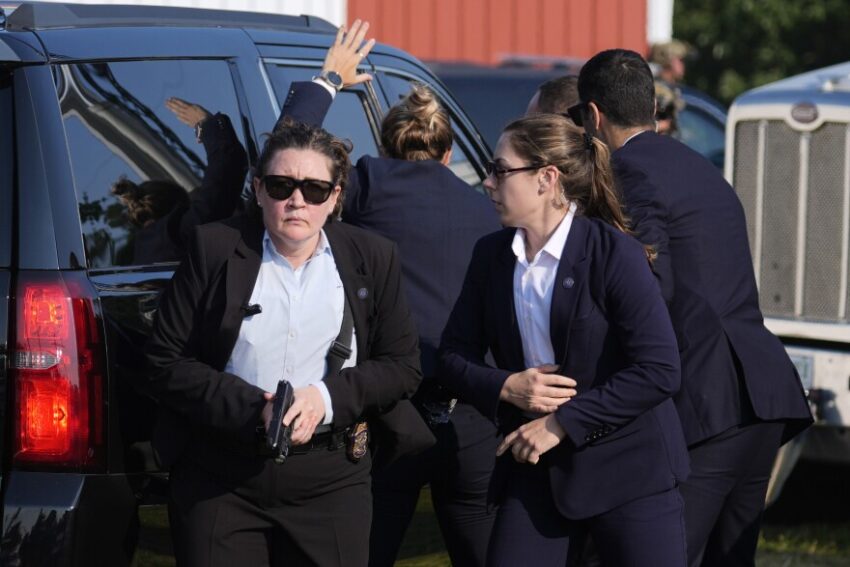
 The image of a Secret Service agent asleep in public while on duty at the U.N. General Assembly, leaving a fully automatic rifle unattended, became a symbol of the agency’s DEI-driven decline under the Biden administration. This agent, overweight and unable to meet fitness standards, had been retained due to politically motivated quotas rather than merit, raising questions about the agency’s ability to protect President Trump.
When Sean Curran took over as director of the Secret Service, he faced an agency undermined by years of cronyism, mismanagement, and DEI priorities that had placed optics over operational readiness.
Curran, a veteran from Trump’s campaign detail, immediately set out to restore the agency’s elite status, focusing on accountability, merit-based promotions, and core mission priorities.
Two assassination attempts on Trump’s life, followed by evasive explanations from the previous leadership, exposed the vulnerabilities created by DEI policies and a lax culture.
Under former director Kimberly Cheatle, initiatives like “30×30” prioritized hiring women to meet quotas, sometimes at the expense of physical fitness and protective experience. Overweight agents who could not pass standard fitness tests were retained, creating obvious security risks.
Curran has shifted the Office of Equity and Employee Support Services back to its original Equal Employment Opportunity mission, eliminating DEI mandates while still addressing legitimate workplace grievances.
Critics, however, continue to scrutinize Curran’s decision to retain DEI advocates like Darnelly De Jesus, who oversee disciplinary actions, citing potential conflicts of interest and lingering influence from prior leadership.
Despite these challenges, the agency has made tangible improvements, creating the Aviation and Airspace Security Division to monitor drones and reallocating resources to ensure threats are prioritized effectively.
Curran has banned uniformed officers from wearing rainbow-colored pride pins or patches and emphasized strict adherence to professional standards, reflecting Trump’s executive order eliminating DEI programs across federal agencies.
Senior agents note that the Secret Service previously accepted underqualified recruits, including those without prior law enforcement experience, leading to weakened operational capability.
Last year, amid fallout from the Butler assassination attempt, the agency attempted to retain agents with bonuses up to 25% of their salaries, but the real problem had been systemic: DEI policies that undermined morale and mission focus.
Veterans like Rashid Ellis publicly blame DEI for the near-assassination of Trump, arguing that gender quotas and diversity initiatives distorted promotions and assignments.
Curran has countered these issues by emphasizing merit-based assignments, ensuring the right person is in the right position, and focusing on protective readiness above all else.
Critics of the prior DEI-focused leadership point to incidents such as the Secret Service sending agents to LGBTQI+ conferences overseas during peak campaign periods, distracting from protective duties.
Curran’s reforms also include reestablishing rigorous fitness standards and restoring the traditional pathway to leadership through presidential protective assignments.
While Curran has kept some former Cheatle deputies in leadership, their roles are being recalibrated to align with operational priorities rather than political quotas.
The agency has successfully thwarted threats against Trump and other officials, including arrests for assassination plots and the discovery of a suspicious hunting stand near Air Force One.
Nevertheless, some embarrassing incidents persist, such as missing firearms during security checks or internal disputes among officers, reflecting the legacy of DEI-driven mismanagement.
Sen. Marsha Blackburn has criticized prior DEI policies for diverting focus from the Secret Service’s essential mission: protecting those under threat.
Under Trump and Curran, the Secret Service is now undergoing a transformation similar to reforms in the U.S. military under Secretary of War Pete Hegseth, who eliminated woke initiatives and restored a warrior ethos.
Hegseth’s reforms, emphasizing physical fitness and meritocracy, have revitalized military recruitment and retention — a model that Curran seeks to replicate within the Secret Service.
Trump’s administration has made clear that identity-based hiring, diversity quotas, and politically correct displays have no place in agencies charged with protecting the president.
Curran’s quiet, disciplined approach has focused on tangible results rather than media appearances, reinforcing operational excellence and morale within the ranks.
Agents on Trump and Vice President JD Vance’s details face some of the longest hours and toughest schedules, but Curran’s reforms aim to ensure they are properly trained, supported, and assigned based on skill rather than DEI metrics.
BREAKING: Anna Paulina Luna Claims The Biden DOJ DESTROYED…
Representative Anna Paulina Luna has leveled explosive information against the Biden Department of Justice, claiming that critical materials related to the Jeffrey Epstein investigation have been deliberately destroyed.
This assertion, if proven true, would represent one of the most damning instances of governmental obstruction and cover-up in recent history.
Luna, who chairs a congressional task force focused on federal transparency, has stated unequivocally that she possesses evidence implicating high-ranking officials in the DOJ.
According to her, these officials not only failed to disclose materials related to Epstein but actively destroyed them to conceal the extent of powerful individuals’ involvement in Epstein’s criminal network.
She introduced legislation titled the SHRED Act, aimed at imposing severe penalties on government agents who destroy or conceal federal records. The proposed bill calls for 20 years to life in prison for anyone caught eliminating evidence in cases of national significance.
“Even if they are conducting a criminal investigation, you should probably pick up the phone and call us,” Luna told Fox News. “We have been more than patient.”
These developments come amid growing conservative suspicion that the Biden administration has no interest in unmasking Epstein’s full network. The notion that key records could be gone forever only intensifies fears that justice is being buried under a bureaucratic rug.
Luna’s office has reportedly sent multiple requests to the Department of Justice demanding clarity on the handling of Epstein-related materials. So far, those inquiries have been met with either vague responses or complete silence.
The congresswoman did not mince words in her public statements, suggesting that the DOJ’s behavior constitutes a deliberate act of obstruction. If true, such actions could violate federal law and trigger an entirely new legal battle.
“The Biden DOJ has obstructed Congress, ignored subpoenas, and now appears to have destroyed critical evidence,” Luna said. “This is corruption at the highest level.”
Critics argue that this is yet another example of double standards in Washington. “Had this been a Republican-led DOJ accused of destroying documents in a child sex trafficking case, the media would be apoplectic,” one conservative commentator noted.
For years, the Epstein case has symbolized the deep rot within America’s elite circles. The financier’s suspicious death in prison and the subsequent lack of high-profile indictments have fueled accusations of a widespread cover-up.
Now, Luna’s allegations breathe new life into those concerns. If records were indeed destroyed, the implications are profound. It would mean that the DOJ, under Biden, actively shielded criminals from justice.
What’s more troubling is that these destroyed materials could have named prominent individuals—politicians, celebrities, and global financiers—who participated in or enabled Epstein’s crimes.
In this context, Luna’s SHRED Act isn’t just legislative symbolism. It is a clarion call for accountability in an era marked by elite impunity. Her bill seeks to ensure that future officials think twice before erasing truth from the historical record.
Despite Luna’s repeated calls for transparency, there has been no formal response from Attorney General Merrick Garland. The silence speaks volumes to many who believe the DOJ is stonewalling on purpose.
Meanwhile, conservative lawmakers have rallied behind Luna. A growing number of Republicans in the House and Senate are voicing support for investigations into the DOJ’s handling of Epstein evidence.
 Sunlight bounced off a sea of windshields at the mall parking lot, casting reflections like tiny stars on the asphalt. It was one of those scorching summer days where the heat seemed to ripple off every surface. In the back seat of a mid-sized sedan, a baby slept in a rear-facing car seat, cheeks flushed a rosy pink, tiny fists opening and closing as if grasping for something in a dream. The car was locked, and the midday sun was relentless.
Minutes ticked by, each one feeling like an eternity to those who had gathered nearby. Concerned shoppers formed a loose circle around the car, whispering among themselves, their eyes darting from the child to the parking lot entrance. It was a scene that could have easily slipped into panic, fueled by the growing anxiety of a crowd unsure of what to do.
Then, the crowd parted slightly as a woman hurried toward the car, waving a key fob in the air with a breathless urgency. “It’s fine—I was gone five minutes,” she called out over the murmur of voices, a strained smile fixed on her face. Her words, intended to reassure, only seemed to heighten the tension.
Standing by the car, a security guard hesitated, a rescue tool clutched in one hand. He weighed the choice, poised between action and inaction. The situation was on the verge of resolution when, from inside the vehicle, a small voice interrupted the scene.
“I don’t know that lady,” the baby said in a drowsy whisper, eyes barely open but clear enough to meet the guard’s.
The crowd fell silent, the chatter swallowed by a wave of surprise. The guard’s eyes met those of a bystander who had been recording the unfolding drama on her phone. For a moment, everyone seemed frozen, caught between disbelief and the unsettling realization of what the child’s words implied.
The woman’s smile faltered, the confidence in her posture ebbing away like a tide. Her gaze flitted nervously across the crowd, seeking an ally, an explanation, anything that might undo the implication of the child’s statement. The air felt thick with unspoken questions, the kind that demanded answers but offered none easily.
“Who are you?” someone from the crowd asked, the voice tinged with suspicion.
“I’m…I’m the mother,” she stammered, but her earlier certainty had evaporated, leaving behind a thin veneer of assurance.
The situation, initially a straightforward case of concern for a child’s safety, had transformed into something far more complex. The guard, now alert to the ambiguity of the situation, stepped back slightly, his hand still grasping the tool but his mind racing through the protocols for such unexpected turns.
Meanwhile, the bystander with the phone had stopped recording, now dialing 911. The crowd, previously passive spectators, began to exchange worried glances, the gravity of the child’s words echoing in their minds.
Within the span of a few seconds, the dynamic had shifted entirely. What had seemed like a simple rescue operation was now shrouded in uncertainty and mistrust. The narrative of the afternoon was rewritten, fueled by a child’s innocent remark and an adult’s faltering response.As the sound of sirens grew in the distance, drawing closer with each passing second, the crowd’s attention remained fixed on the baby and the woman. In that small space of time, under the unrelenting sun, a drama unfolded that revealed the fragility of assumptions and the profound impact of a single, unexpected voice.